✵This article documents the herb Climbing Fern Spore, including its English name, Latin name, Pinyin name, properties and flavor, botanical source—namely one plant species: (1) Lygodium japonicum (Thunb.) Sw.—and provides a detailed description of the botanical features, growth characteristics, and ecological environment of this species, as well as the macroscopic and microscopic characteristics of the herb, its pharmacological actions, medicinal efficacy, and administration guidelines.
Spora Lygodii (Climbing Fern Spore)
Pinyin Name: Hǎi Jīn Shā
English Name: Climbing Fern Spore
Latin Name:Spora Lygodii Properties and Flavor: Cold, sweet, tasteless
Brief Introduction:Spora Lygodii consists of the spores of Lygodium japonicum (Thunb.) Sw. It is used to eliminate damp-heat and act as a lithagogue, primarily for treating bladder damp-heat and urinary calculi. It is commonly known as Spora Lygodii or Hǎi Jīn Shā.
Botanical Source: Classical herbal works define Spora Lygodii (Hǎi Jīn Shā) as the dried, mature spores of (1) Lygodium japonicum (Thunb.) Sw., a perennial climbing fern belonging to the genus Lygodium Sw., family Lygodiaceae, order Polypodiales. The following commonly used species is described:
(1) Lygodium japonicum (Thunb.) Sw.
Botanical Description:Lygodium japonicum (Thunb.) Sw. is also known as Ophioglossum japonicum Thunb. and commonly referred to as Hǎi Jīn Shā. It is a perennial climbing herbaceous vine, 1–5 m long. Roots are fibrous, blackish-brown, and pilose; rhizomes are nearly brown, slender and elongated, decumbent. Leaves are dimorphic, numerous, herbaceous (grass-like), and opposite, grow on short lateral branches of the rachis; the tips of short branches bear dormant buds (resting buds) covered with trichomes. Trophophylls (vegetative leaves) are deltoid-triangular and bipinnate; primary leaflets occur in 2–4 pairs, alternate, ovate, 4–8 cm long and 3–6 cm wide, with short petioles bearing narrow wings; pinnules occur in 2–3 pairs, ovate-triangular, palmately 3-lobed; lobes are short and broad; apical lobes measure 2–3 cm long and 6–8 mm wide, with irregularly shallowly crenate margins.
Fertile fronds are ovate-triangular, length and width nearly equal, 10–20 cm; primary leaflets occur in 4–5 pairs, alternate, oblong-lanceolate, 5–10 cm long and 4–6 cm wide; pinnules occur in 3–4 pairs, ovate-triangular, mostly shriveled and lacerated.
The abaxial margin of pinnae bears penicillate (fringe-like) fertile spikes, blackish-brown, 2–5 mm long; spore surfaces bear small nodules.
Ecological Environment: The plant grows in damp, dense thickets on mountain slopes or along forest edges beside roads. It is distributed in China, tropical Australia, Sri Lanka (formerly Ceylon), and Java.
Growth Characteristics:Lygodium japonicum exhibits strong climbing ability and environmental resilience. It prefers sandy clay or sandy loam soils with good drainage.
Characteristics of the Herb: The spores are powdery, brownish-yellow or tawny (yellowish-brown). The herb is lightweight, smooth, and slippery; when sprinkled onto water, it floats initially, then gradually sinks upon heating; when ignited, it crackles and flashes, leaving no residual ash or dregs. It has a faint odor and a mild taste.
Pharmacological Actions: (1) Diuretic and litholytic (urinary calculus-dissolving) effects; (2) Choleretic effect; (3) Inhibitory activity against Staphylococcus aureus, Pseudomonas aeruginosa, Shigella flexneri, and Salmonella typhi.
Medicinal efficacy: Clears damp-heat, clears heat and detoxifies, treats stranguria and relieves pain, alleviates water retention, and treats stranguria. It is indicated for febrile stranguria, calculous stranguria, urolithiasis, hematuric stranguria, chyluric stranguria (stranguria due to chyluria), gonorrhea (white turbidity), pathological leukorrhea, urethralgia, urinary tract infection, lithangiuria, edema with distension and fullness due to dampness, damp-heat jaundice, hepatitis, nephritis, edema, sore throat, mumps, enteritis, damp-heat dysentery, dysentery, hematemesis (vomiting blood), epistaxis (nosebleed), bleeding from the orifices or subcutaneous tissues, hematuria (blood in urine), traumatic hemorrhage, eczema, and herpes zoster.
Administration of Spora Lygodii (Hǎi Jīn Shā):
Reference:
Administration Guide for Spora Lygodii (Hǎi Jīn Shā)
TCM Books:
(1) Internally: 6–15 grams, preferably wrapped in cloth before decoction; (2) Internally: water decoction, 1.5–8 qian (approximately 4.5–24 grams), or prepared as a finely ground herb powder for oral use; (3) Internally: water decoction, 5–9 grams, wrapped in cloth before decoction; or prepared as a finely ground herb powder, 2–3 grams per dose.
Article Link:
URL QR code:
References:
1.Introduction of Hǎi Jīn Shā: Climbing Fern Spore

 ✵This article documents the herb Climbing Fern Spore, including its English name, Latin name, Pinyin name, properties and flavor, botanical source—namely one plant species: (1) Lygodium japonicum (Thunb.) Sw.—and provides a detailed description of the botanical features, growth characteristics, and ecological environment of this species, as well as the macroscopic and microscopic characteristics of the herb, its pharmacological actions, medicinal efficacy, and administration guidelines.
 Pinyin Name: Hǎi Jīn Shā
 Botanical Description: Lygodium japonicum (Thunb.) Sw. is also known as Ophioglossum japonicum Thunb. and commonly referred to as Hǎi Jīn Shā. It is a perennial climbing herbaceous vine, 1–5 m long. Roots are fibrous, blackish-brown, and pilose; rhizomes are nearly brown, slender and elongated, decumbent. Leaves are dimorphic, numerous, herbaceous (grass-like), and opposite, grow on short lateral branches of the rachis; the tips of short branches bear dormant buds (resting buds) covered with trichomes. Trophophylls (vegetative leaves) are deltoid-triangular and bipinnate; primary leaflets occur in 2–4 pairs, alternate, ovate, 4–8 cm long and 3–6 cm wide, with short petioles bearing narrow wings; pinnules occur in 2–3 pairs, ovate-triangular, palmately 3-lobed; lobes are short and broad; apical lobes measure 2–3 cm long and 6–8 mm wide, with irregularly shallowly crenate margins.
 Fertile fronds are ovate-triangular, length and width nearly equal, 10–20 cm; primary leaflets occur in 4–5 pairs, alternate, oblong-lanceolate, 5–10 cm long and 4–6 cm wide; pinnules occur in 3–4 pairs, ovate-triangular, mostly shriveled and lacerated.
 Ecological Environment: The plant grows in damp, dense thickets on mountain slopes or along forest edges beside roads. It is distributed in China, tropical Australia, Sri Lanka (formerly Ceylon), and Java.
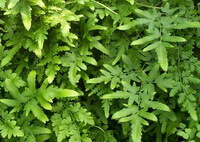 Growth Characteristics: Lygodium japonicum exhibits strong climbing ability and environmental resilience. It prefers sandy clay or sandy loam soils with good drainage.
 URL QR code:

