✵The article records the herb Ricepaper-plant Pith, including its English name, Latin name, Pinyin name, properties and flavor, botanical source—the single plant species Tetrapanax papyriferus (Hook.) K. Koch.—and a detailed introduction to the botanical features, growth characteristics, and ecological environment of this species; the macroscopic and microscopic characteristics of the herb Ricepaper-plant Pith; its pharmacological actions, medicinal efficacy, and administration guidelines.
Medulla Tetrapanacis (Ricepaper-plant Pith)
Pinyin Name: Tōnɡ Cǎo
English Name: Ricepaper-plant Pith
Latin Name:Medulla Tetrapanacis Properties and Flavor: Slightly cold, sweet, bland
Brief Introduction:Medulla Tetrapanacis is the dried stem pith of Tetrapanax papyriferus (Hook.) K. Koch. (family Araliaceae), used (1) to clear heat and drain dampness in cases of stranguria and oliguria, and (2) to promote lactation in cases of insufficient milk secretion. It is commonly known as Rice Paper Plant Pith, Medulla Tetrapanacis, or Tōnɡ Cǎo.
Botanical Source: Classical herbal works define Medulla Tetrapanacis (Rice Paper Plant Pith) as the dried stem pith of Tetrapanax papyriferus (Hook.) K. Koch. This species belongs to the genus Tetrapanax K. Koch, family Araliaceae (the ginseng family), order Apiales. The sole commonly used botanical source is described below:
(1) Tetrapanax papyriferus (Hook.) K.Koch.
Botanical Description:Tetrapanax papyriferus (Hook.) K. Koch., formerly known as Aralia papyrifera Hook. f., is commonly called Tōnɡ Tuō Mù. It is an evergreen shrub or small tree, growing up to 1–3.5 m tall. Stems are stout and unbranched; in the seedling stage, the stem surface is densely covered with yellow stellate hairs or sparsely bears deciduous grayish-yellow (sallow) pubescence. The pith is voluminous, white, and papery (chartaceous); bark is dark brown with shallow, crowfoot-like fissures; new branches are pale brown or fawn (pale yellowish-brown), bearing conspicuous leaf scars and large lenticels. Leaves are large, alternate, and clustered at the stem apex; petioles are stout and terete (cylindrical), 30–50 cm long; stipules are membranous, conical, fused at the base with the petiole, and covered with dense stellate hairs; leaf blades are chartaceous or thinly coriaceous, palmately 5–11-lobed; lobes typically extend 1/3–1/2 the total leaf length (rarely up to 2/3), obovate-oblong or ovate-oblong; each lobe is often further subdivided into 2–3 lobules; margins are entire or coarsely dentate; the upper surface is dark green and glabrous; the lower surface is densely covered with white stellate tomentum.
Umbels are arranged in large, terminal or subterminal compound umbels exceeding 50 cm in diameter; calyx is densely covered with stellate tomentum, entire or nearly so; flowers have four (rarely five) triangular-ovate petals, ~2 mm long, externally covered with dense stellate tomentum; stamens number five—equaling the number of petals; ovary is inferior, bilocular, with two free, retroflexed styles.
The fruit is globose, ~4 mm in diameter, turning atropurpureus (dark purple-black) at maturity. Flowering occurs from October to December; fruiting from January to February of the following year.
Ecological Environment: This species grows in sunny, fertile, deep soils at elevations of 10–2,800 m above sea level. It is also cultivated in gardens or near courtyards.
Growth Characteristics:Tetrapanax papyriferus prefers a warm, moist, and sunny climate; it is not cold-tolerant and requires winter temperatures above 5 °C (41 °F) for survival. Cultivation is best carried out in fertile, well-drained sandy loam.
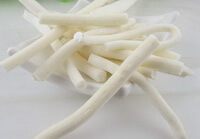
Characteristics of the Herb: The stem pith is cylindrical, 20–40 cm long and 1–2.5 cm in diameter. Surface color is white or primrose yellow (pale yellow), with shallow longitudinal grooves. The herb is lightweight; texture is loose, soft, slightly elastic, and easily fractured; fracture surface is flat, silvery-white, with a central hollow cavity (0.3–1.5 cm in diameter) or a translucent septum. In cross-section, vascular bundles are arranged in a ladder-like (scalariform) pattern. "Farctate" material—referring to solid, non-hollow pith from thin, young stems—is rare. The herb is odorless and tasteless.
Medicinal Efficacy: Clears heat and promotes diuresis, unblocks meridians and promotes lactation, clears lung fire. It is indicated for damp-heat syndrome with red urine; gonorrhea accompanied by pain; dysuria (difficulty in urination); scanty, dark-red urine; oliguria with reddish urine; gonorrhea; edema; edema accompanied by oliguria; jaundice; damp-heat syndrome; postpartum lactation failure; postpartum scanty milk; menorrhagia; pathological leukorrhea; blurred vision (cloudy vision); and nasal obstruction (stuffy nose).
Administration of Medulla Tetrapanacis (Tōnɡ Cǎo):
Reference:
Administration Guide for Medulla Tetrapanacis (Tōnɡ Cǎo)
TCM Books:
(1) Internally: 3–5 grams; (2) Internally:water decoction, 0.5–1.5 qian (approximately 1.5–4.5 grams), or prepared as pills or powder; external use: finely ground herb powder applied with medical cotton to the nasal cavity; (3) Internally:water decoction, 2–5 grams.
Precautions and Adverse Reactions: Medulla Tetrapanacis should be used with caution during pregnancy.

 ✵The article records the herb Ricepaper-plant Pith, including its English name, Latin name, Pinyin name, properties and flavor, botanical source—the single plant species Tetrapanax papyriferus (Hook.) K. Koch.—and a detailed introduction to the botanical features, growth characteristics, and ecological environment of this species; the macroscopic and microscopic characteristics of the herb Ricepaper-plant Pith; its pharmacological actions, medicinal efficacy, and administration guidelines.
 Pinyin Name: Tōnɡ Cǎo
 Botanical Description: Tetrapanax papyriferus (Hook.) K. Koch., formerly known as Aralia papyrifera Hook. f., is commonly called Tōnɡ Tuō Mù. It is an evergreen shrub or small tree, growing up to 1–3.5 m tall. Stems are stout and unbranched; in the seedling stage, the stem surface is densely covered with yellow stellate hairs or sparsely bears deciduous grayish-yellow (sallow) pubescence. The pith is voluminous, white, and papery (chartaceous); bark is dark brown with shallow, crowfoot-like fissures; new branches are pale brown or fawn (pale yellowish-brown), bearing conspicuous leaf scars and large lenticels. Leaves are large, alternate, and clustered at the stem apex; petioles are stout and terete (cylindrical), 30–50 cm long; stipules are membranous, conical, fused at the base with the petiole, and covered with dense stellate hairs; leaf blades are chartaceous or thinly coriaceous, palmately 5–11-lobed; lobes typically extend 1/3–1/2 the total leaf length (rarely up to 2/3), obovate-oblong or ovate-oblong; each lobe is often further subdivided into 2–3 lobules; margins are entire or coarsely dentate; the upper surface is dark green and glabrous; the lower surface is densely covered with white stellate tomentum.
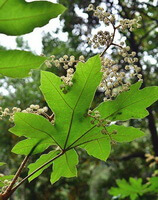 Umbels are arranged in large, terminal or subterminal compound umbels exceeding 50 cm in diameter; calyx is densely covered with stellate tomentum, entire or nearly so; flowers have four (rarely five) triangular-ovate petals, ~2 mm long, externally covered with dense stellate tomentum; stamens number five—equaling the number of petals; ovary is inferior, bilocular, with two free, retroflexed styles.
 Ecological Environment: This species grows in sunny, fertile, deep soils at elevations of 10–2,800 m above sea level. It is also cultivated in gardens or near courtyards.
 Characteristics of the Herb: The stem pith is cylindrical, 20–40 cm long and 1–2.5 cm in diameter. Surface color is white or primrose yellow (pale yellow), with shallow longitudinal grooves. The herb is lightweight; texture is loose, soft, slightly elastic, and easily fractured; fracture surface is flat, silvery-white, with a central hollow cavity (0.3–1.5 cm in diameter) or a translucent septum. In cross-section, vascular bundles are arranged in a ladder-like (scalariform) pattern. "Farctate" material—referring to solid, non-hollow pith from thin, young stems—is rare. The herb is odorless and tasteless.
 URL QR code: