✵The article documents the herb Lilac Pink Herb, including its English name, Latin name, Pinyin name, properties and flavor, botanical sources—two plant species: (1) Dianthus superbus L. and (2) Dianthus chinensis L.—along with a detailed introduction to the botanical features, growth characteristics, and ecological environments of these two species; the morphological characteristics of the herb Lilac Pink Herb; its pharmacological actions, medicinal efficacy, and administration guidelines.
Herba Dianthi (Liliac Pink Herb)
Pinyin Name: Qú Mài
English Name: Liliac Pink Herb
Latin Name:Herba Dianthi Properties and Flavor: Cold, bitter
Brief Introduction:Herba Dianthi is the dried aerial part of Dianthus superbus L. or Dianthus chinensis L., used to (1) promote diuresis and eliminate damp-heat for treating heat stranguria and blood stranguria, and (2) act as an emmenagogue for amenorrhea. It is commonly known as Herba Dianthi, Lilac Pink Herb, or Qú Mài.
Botanical Source: Classical herbal works define Herba Dianthi (Lilac Pink Herb) as the dried aerial part of (1) Dianthus superbus L. or (2) Dianthus chinensis L. These are perennial herbs belonging to the genus Dianthus L., family Caryophyllaceae (the carnation or pink family), order Caryophyllales (formerly in Centrospermae). The two commonly used species are described below:
(1) Dianthus superbus L.
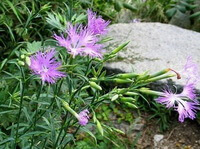
Botanical Description:Dianthus superbus L. is commonly known as Qú Mài. It is a perennial herb growing up to 50–60 cm tall, occasionally reaching 1 m. Stems are fascicled, erect, green, and glabrous; the upper portion is dichotomously branched, with conspicuous nodes. Leaves are opposite; leaf blades are linear or linear-lanceolate, 1.5–9 cm long and 1–4 mm wide; apices are acuminate; bases are short-sheathed and amplexicaul; margins are entire; both surfaces are glabrous.
Flowers are hermaphroditic, solitary or arranged in sparse, bifurcated panicles; pedicels (flower stalks) reach up to 4 cm in length; 4–6 bracteoles are arranged in 2–3 whorls; the calyx is terete (cylindrical), lavender-pink (pale violet-red), up to 4 cm long, apex is 5-lobed with lanceolate lobes; margins are membranaceous and pubescent; petals number five, faintly red (rosy), white, or pale violet-red, deeply cleft at the apex into thin, linear segments, with long claws at the base; stamens number ten; ovary is superior, unilocular, with two slender, elongated styles.
The capsule fruit is oblong-cylindrical, nearly equal in length to the persistent calyx or slightly longer, apically 4-lobed; seeds are oblate-ovoid, ~2 mm long, black, and lustrous. Flowering occurs from August to September; fruiting from September to November.
Ecological Environment: This species grows on hillsides and mountain slopes, meadows, roadsides, forest margins, grasslands, and gully streambanks, at elevations of 400–3,700 meters above sea level. It is distributed across China and also found in Northern and Central Europe, Siberia, Kazakhstan, and Northeast Asia.
Growth Characteristics:Dianthus superbus is cold-tolerant, prefers moist conditions, and is drought-sensitive. Optimal soil for cultivation is sandy loam or clay loam.
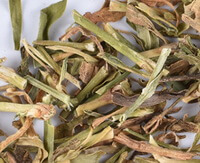
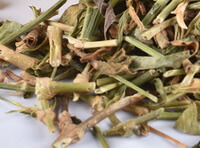
Characteristics of the Herb: Stems are cylindrical, branched in the upper portion, 30–60 cm long, with enlarged nodes; surface is pea-green (pale green) or yellowish-green, slightly glossy, smooth, glabrous, with prominent, slightly swollen nodes; cross-section is hollow. Leaves are mostly wrinkled, opposite, yellowish-green; flattened leaf blades are lanceolate-linear, 2–7 cm long and 1–4 mm wide; leaf tips are slightly reflexed; bases are short-sheathed and amplexicaul. Flowers are brownish-purple or brownish-yellow, 3–4 cm long, solitary or clustered; calyx is persistent, tube is 2.5–3.5 cm long (~3/4 the total flower length); bracteoles beneath the calyx are ~1/4 the length of the calyx tube, acute or acuminate at the apex, with regular longitudinal striations on the outer surface; petals are brownish-purple or brownish-yellow, curled, deeply cleft and fimbriate at the apex. Stem texture is hard and crisp; cross-section is hollow. Capsule fruits are long-cylindrical, equal in length to the persistent calyx. Seeds are small and numerous. The herb is odorless and tastes sweet and mild.
Pharmacological Actions: (1) Diuretic effect; (2) stimulation of intestinal and uterine smooth muscle; (3) hypotensive effect; (4) schistosomicidal activity; (5) inhibitory effects against Staphylococcus aureus, Escherichia coli, Salmonella typhi, Shigella flexneri, and Pseudomonas aeruginosa.
Medicinal efficacy: Promotes diuresis and treats stranguria; clears heat and resolves dampness; promotes blood circulation and regulates menstruation. It is indicated for gonorrhea, pyretic stranguria (heat stranguria), bloody stranguria (stranguria complicated by hematuria), urolithic stranguria, urinary retention, dysuria with dribbling and pain, edema, amenorrhea, carbuncles, red and swollen eyes, nebulae, acute eczema (spreading eczema), chronic eczema with pruritus.
Administration of Herba Dianthi (Qú Mài):
Reference:
Administration Guide for Herba Dianthi (Qú Mài)
TCM Books:
(1) Internally: 9–15 grams; (2) Internally: water decoction, 1.5–3 qián (≈4.5–9 grams), or prepared as pills or powder. External use: apply finely powdered herb topically. (3) Internally: water decoction, 3–10 grams, or prepared as pills or powder. External use: use an appropriate amount—wash affected area with decoction, or sprinkle finely powdered herb.
Precautions and Adverse Reactions: Herba Dianthi should be used with caution during pregnancy and is contraindicated in pregnancy. It should not be combined with Ootheca Mantidis.
(2) Dianthus chinensis L.
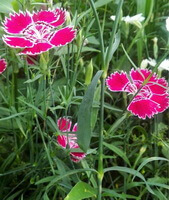
Botanical Description:Dianthus chinensis L. is commonly known as Shí Zhú (literally "stone bamboo", referring to its habit of growing among rocks). It is a perennial herb growing up to 30–50 cm tall; the whole plant is glabrous and bluish-green. Stems arise from a short stem neck, sparsely tufted, erect, and branched in the upper portion. Leaf blades are linear-lanceolate, 3–5 cm long and 2–4 mm wide; apices are acuminate; bases are slightly narrowed; margins are entire or serrulate; midribs are conspicuous.
Flowers are solitary at branch tips or arranged in cymes; pedicels (flower stalks) are 1–3 cm long; four floral bracts are oval (egg-shaped), with long-acuminate apices extending over half the length of the calyx; margins are membranaceous and ciliate; calyx is cylindrical, 15–25 mm long and 4–5 mm in diameter, longitudinally striated; calyx teeth are lanceolate, ~5 mm long, straight, with pointed apices and marginal setae; petals are 16–18 mm long, obovate-triangular, 13–15 mm long, purplish-red, pink, bright red, or white; apical margins are irregularly toothed and lobed; the throat bears markings and sparse beard hairs; stamens extend beyond the corolla throat; anthers are bluish; ovary is oblong; style is linear.
The capsule is terete (cylindrical), enclosed within the persistent calyx, and apically 4-lobed; seeds are black and oblate. Flowering occurs from May to June; fruiting from July to September.
Ecological Environment: This species grows on grasslands and meadows of hillsides and mountain slopes, at elevations below 1,000 meters above sea level. It is native to northern China and is also cultivated in gardens. It is also found in Siberia.
Growth Characteristics: The plant is cold-tolerant, drought-tolerant, and heat-tolerant. It prefers a sunny, well-ventilated, and moderately humid (not waterlogged) climate. Growth is poor or plants may wither in hot summer conditions. For cultivation, fertile, loose, well-drained soils—such as limestone loam or sandy loam—are recommended; waterlogging must be avoided.
Characteristics of the Herb: Stems are erect, cylindrical, and branched, 30–50 cm long; intact leaves are lanceolate-linear, 2–9 cm long and 2–7 mm wide; calyx tube is 1–2 cm long (~½ the flower length); several bracteoles occur beneath the calyx, ~½ the length of the calyx tube, with caudate-acuminate apices and imbricate arrangement. Occasionally, shriveled brownish-purple or brownish-yellow petals are visible, with lobed and serrate apices. Stem texture is hard and crisp; cross-section is hollow. The herb has a faint odor and tastes slightly sweet.

 ✵The article documents the herb Lilac Pink Herb, including its English name, Latin name, Pinyin name, properties and flavor, botanical sources—two plant species: (1) Dianthus superbus L. and (2) Dianthus chinensis L.—along with a detailed introduction to the botanical features, growth characteristics, and ecological environments of these two species; the morphological characteristics of the herb Lilac Pink Herb; its pharmacological actions, medicinal efficacy, and administration guidelines.
 Pinyin Name: Qú Mài
 Botanical Description: Dianthus superbus L. is commonly known as Qú Mài. It is a perennial herb growing up to 50–60 cm tall, occasionally reaching 1 m. Stems are fascicled, erect, green, and glabrous; the upper portion is dichotomously branched, with conspicuous nodes. Leaves are opposite; leaf blades are linear or linear-lanceolate, 1.5–9 cm long and 1–4 mm wide; apices are acuminate; bases are short-sheathed and amplexicaul; margins are entire; both surfaces are glabrous.
 Flowers are hermaphroditic, solitary or arranged in sparse, bifurcated panicles; pedicels (flower stalks) reach up to 4 cm in length; 4–6 bracteoles are arranged in 2–3 whorls; the calyx is terete (cylindrical), lavender-pink (pale violet-red), up to 4 cm long, apex is 5-lobed with lanceolate lobes; margins are membranaceous and pubescent; petals number five, faintly red (rosy), white, or pale violet-red, deeply cleft at the apex into thin, linear segments, with long claws at the base; stamens number ten; ovary is superior, unilocular, with two slender, elongated styles.
 Ecological Environment: This species grows on hillsides and mountain slopes, meadows, roadsides, forest margins, grasslands, and gully streambanks, at elevations of 400–3,700 meters above sea level. It is distributed across China and also found in Northern and Central Europe, Siberia, Kazakhstan, and Northeast Asia.
 Characteristics of the Herb: Stems are cylindrical, branched in the upper portion, 30–60 cm long, with enlarged nodes; surface is pea-green (pale green) or yellowish-green, slightly glossy, smooth, glabrous, with prominent, slightly swollen nodes; cross-section is hollow. Leaves are mostly wrinkled, opposite, yellowish-green; flattened leaf blades are lanceolate-linear, 2–7 cm long and 1–4 mm wide; leaf tips are slightly reflexed; bases are short-sheathed and amplexicaul. Flowers are brownish-purple or brownish-yellow, 3–4 cm long, solitary or clustered; calyx is persistent, tube is 2.5–3.5 cm long (~3/4 the total flower length); bracteoles beneath the calyx are ~1/4 the length of the calyx tube, acute or acuminate at the apex, with regular longitudinal striations on the outer surface; petals are brownish-purple or brownish-yellow, curled, deeply cleft and fimbriate at the apex. Stem texture is hard and crisp; cross-section is hollow. Capsule fruits are long-cylindrical, equal in length to the persistent calyx. Seeds are small and numerous. The herb is odorless and tastes sweet and mild.
 Botanical Description: Dianthus chinensis L. is commonly known as Shí Zhú (literally "stone bamboo", referring to its habit of growing among rocks). It is a perennial herb growing up to 30–50 cm tall; the whole plant is glabrous and bluish-green. Stems arise from a short stem neck, sparsely tufted, erect, and branched in the upper portion. Leaf blades are linear-lanceolate, 3–5 cm long and 2–4 mm wide; apices are acuminate; bases are slightly narrowed; margins are entire or serrulate; midribs are conspicuous.
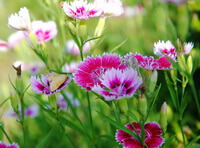 Flowers are solitary at branch tips or arranged in cymes; pedicels (flower stalks) are 1–3 cm long; four floral bracts are oval (egg-shaped), with long-acuminate apices extending over half the length of the calyx; margins are membranaceous and ciliate; calyx is cylindrical, 15–25 mm long and 4–5 mm in diameter, longitudinally striated; calyx teeth are lanceolate, ~5 mm long, straight, with pointed apices and marginal setae; petals are 16–18 mm long, obovate-triangular, 13–15 mm long, purplish-red, pink, bright red, or white; apical margins are irregularly toothed and lobed; the throat bears markings and sparse beard hairs; stamens extend beyond the corolla throat; anthers are bluish; ovary is oblong; style is linear.
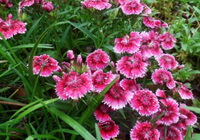 Ecological Environment: This species grows on grasslands and meadows of hillsides and mountain slopes, at elevations below 1,000 meters above sea level. It is native to northern China and is also cultivated in gardens. It is also found in Siberia.
 URL QR code: