✵The article records the herb Common Knotgrass Herb—its English name, Latin name, Pinyin name, properties and flavor, botanical source—a single plant species, Polygonum aviculare L.— and provides a detailed introduction to the botanical features, growth characteristics, and ecological environment of this species; the macroscopic and microscopic characteristics of the herb; its pharmacological actions, medicinal efficacy, and administration guidelines.
Herba Polygoni Avicularis (Common Knotgrass Herb)
Pinyin Name: Biān Xù
English Name: Common Knotgrass Herb
Latin Name:Herba Polygoni Avicularis Properties and Flavor: Cold, bitter
Brief Introduction:Herba Polygoni Avicularis is the dried aerial part of Polygonum aviculare L. It is used (1) to promote diuresis and eliminate damp-heat in cases of stranguria with turbid urine and morbid leukorrhea, and (2) to dispel wind-damp in cases of arthralgia. The herb is commonly known as Herba Polygoni Avicularis, Common Knotgrass Herb, or Biān Xù.
Botanical Source: Classical herbal works define Herba Polygoni Avicularis (Common Knotgrass Herb) as the dried aerial part—or occasionally the whole herb—of Polygonum aviculare L. It is a species of the genus Polygonum L., family Polygonaceae (smartweed family), order Caryophyllales. This commonly used species is described below:
(1) Polygonum aviculare L.
Botanical Description:Polygonum aviculare L. is commonly known as Biān Xù. It is an annual or perennial herb, growing 10–50 cm tall. The plant bears white pruina. Stems are decumbent, ascending, or erect; the base is branched, green, conspicuously grooved, and glabrous; the basal portion is terete (cylindrical), while young branches are angled. Leaves are simple, alternate, and subsessile; ocrea (stipular sheath) is amplexicaul and membranaceous; leaf blades are narrowly oblong-ovate or lanceolate, 1–5 cm long and 0.5–1 cm wide; apex is obtuse or acute; base is cuneate; both surfaces are glabrous; lateral veins are conspicuous.
Flowers are small, solitary or clustered in leaf axils; pedicels are short, articulated at the apex; perianth is green, 5-lobed, lobes are elliptic, margins are white or faintly reddish (rosy), imbricate and enclosing the fruit after fertilization; stamens 8, filaments are short.
Achenes are triangular-ovate, brownish-black to black, 3-ribbed, glabrous, 2.5–3 mm long, subequal to or slightly longer than the persistent perianth, bearing inconspicuous fine lines and spots, and lusterless. Flowering occurs from April to August; fruiting from June to September.
Ecological Environment: The plant grows on hillsides, mountain slopes, fields, roadsides, wastelands, riverbanks, etc. It is widely distributed in the Northern Temperate Zone.
Growth Characteristics:Polygonum aviculare exhibits strong climatic adaptability and thrives in cold mountainous regions as well as warm lowland plains. It grows in wetlands of farmlands and gullies at elevations of 10–4,200 m above sea level. It prefers cool, humid climates but is tolerant of heat and drought. Seeds germinate at temperatures above 10 °C (50 °F); optimal growth occurs at 15–27 °C (59–80.6 °F). Achene cold resistance is extremely high, surviving winter at −40 °C (−40 °F). It adapts well to various soils—including saline sandy wastelands rich in organic matter—and fertile sandy loam. For cultivation, well-drained sandy loam soil is recommended.
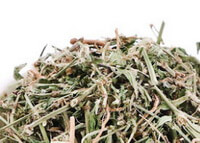
Characteristics of the Herb: The stem is cylindrical and slightly flattened, branched, 10–40 cm long, and 1.0–3 mm in diameter. The surface is grayish-green or reddish-brown and bears fine, dense, slightly raised longitudinal lines. Nodes are slightly enlarged and bear light brown, membranaceous ocreae (stipular sheaths); internode lengths vary. The herb is hard and brittle; the pith at the fracture surface is white. Leaves are alternate but mostly absent or withered and fragmented. When flattened, intact leaves are oblong-ovate or lanceolate, 1–4 cm long and approximately 5 mm wide, with entire margins, and grayish-green or brownish-green in color. Occasionally, small achenes with persistent perianths are visible; these achenes are dark brown to black and ovate-trigonous. The herb has a slight odor and a slightly bitter taste.
Pharmacological Actions: (1) Diuretic effect; (2) Antibacterial effect—inhibitory activity against Shigella flexneri and Sonne bacillus; the decoction inhibits Trichophyton mentagrophytes and Bacillus piliformis, as well as Staphylococcus aureus, Pseudomonas aeruginosa, and dermatophytes; (3) Hypotensive effect; (4) Uterotonically active and hemostatic effects.
Medicinal Efficacy: Promotes diuresis and treats stranguria; clears heat; expels parasites; relieves itching. It is indicated for stranguria, pyretic stranguria of the urinary bladder, oliguria with reddish urine, dysuria (difficulty in urination), dribbling urine with pain, urinary retention, diarrhea and dysentery, eczema, pruritus vulvae, morbid leukorrhea, vulvar erosion, jaundice, ascariasis, enterobiasis, hookworm infection, malnutrition-related accumulation, scabies, hemorrhoids and swelling, etc.
Administration of Herba Polygoni Avicularis (Biān Xù):
Reference:
Administration Guide for Herba Polygoni Avicularis (Biān Xù)
TCM Books:
(1) Internally: 9–15 grams; topical: appropriate amount, applied as a decoction wash. (2) Internally: water decoction, 2–3 qian (≈6–9 grams), or fresh juice; topical: crushed herb applied as a poultice, or decoction wash. (3) Internally: water decoction, 10–15 grams; or prepared as pills or powder. For anthelmintic use (monotherapy), 30–60 grams; fresh juice, 50–100 grams. Topical: appropriate amount, used as a decoction wash, poultice, or juice application.

 ✵The article records the herb Common Knotgrass Herb—its English name, Latin name, Pinyin name, properties and flavor, botanical source—a single plant species, Polygonum aviculare L.— and provides a detailed introduction to the botanical features, growth characteristics, and ecological environment of this species; the macroscopic and microscopic characteristics of the herb; its pharmacological actions, medicinal efficacy, and administration guidelines.
 Pinyin Name: Biān Xù
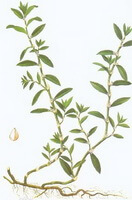 Botanical Description: Polygonum aviculare L. is commonly known as Biān Xù. It is an annual or perennial herb, growing 10–50 cm tall. The plant bears white pruina. Stems are decumbent, ascending, or erect; the base is branched, green, conspicuously grooved, and glabrous; the basal portion is terete (cylindrical), while young branches are angled. Leaves are simple, alternate, and subsessile; ocrea (stipular sheath) is amplexicaul and membranaceous; leaf blades are narrowly oblong-ovate or lanceolate, 1–5 cm long and 0.5–1 cm wide; apex is obtuse or acute; base is cuneate; both surfaces are glabrous; lateral veins are conspicuous.
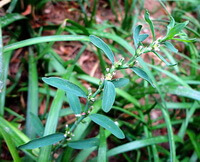 Flowers are small, solitary or clustered in leaf axils; pedicels are short, articulated at the apex; perianth is green, 5-lobed, lobes are elliptic, margins are white or faintly reddish (rosy), imbricate and enclosing the fruit after fertilization; stamens 8, filaments are short.
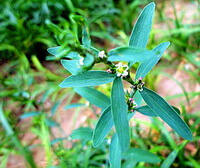 Ecological Environment: The plant grows on hillsides, mountain slopes, fields, roadsides, wastelands, riverbanks, etc. It is widely distributed in the Northern Temperate Zone.
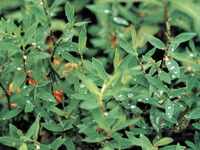 Growth Characteristics: Polygonum aviculare exhibits strong climatic adaptability and thrives in cold mountainous regions as well as warm lowland plains. It grows in wetlands of farmlands and gullies at elevations of 10–4,200 m above sea level. It prefers cool, humid climates but is tolerant of heat and drought. Seeds germinate at temperatures above 10 °C (50 °F); optimal growth occurs at 15–27 °C (59–80.6 °F). Achene cold resistance is extremely high, surviving winter at −40 °C (−40 °F). It adapts well to various soils—including saline sandy wastelands rich in organic matter—and fertile sandy loam. For cultivation, well-drained sandy loam soil is recommended.
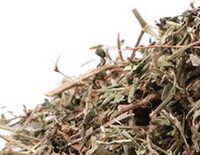 Characteristics of the Herb: The stem is cylindrical and slightly flattened, branched, 10–40 cm long, and 1.0–3 mm in diameter. The surface is grayish-green or reddish-brown and bears fine, dense, slightly raised longitudinal lines. Nodes are slightly enlarged and bear light brown, membranaceous ocreae (stipular sheaths); internode lengths vary. The herb is hard and brittle; the pith at the fracture surface is white. Leaves are alternate but mostly absent or withered and fragmented. When flattened, intact leaves are oblong-ovate or lanceolate, 1–4 cm long and approximately 5 mm wide, with entire margins, and grayish-green or brownish-green in color. Occasionally, small achenes with persistent perianths are visible; these achenes are dark brown to black and ovate-trigonous. The herb has a slight odor and a slightly bitter taste.
 URL QR code: