✵This article documents the herb Shearer’s Pyrrosia Leaf, including its English name, Latin name, Pinyin name, properties and flavor, and botanical sources as defined in classical herbal texts—namely three primary species: (1) Pyrrosia sheareri (Bak.) Ching, (2) Pyrrosia lingua (Thunb.) Farwell, and (3) Pyrrosia petiolosa (Christ) Ching—as well as two additional acceptable species: (4) Pyrrosia gralla (Gies.) Ching and (5) Pyrrosia davidii (Bak.) Ching. It provides a detailed description of the botanical features, growth characteristics, and ecological environments of these five species; the macroscopic and microscopic characteristics of the herb; its pharmacological actions; medicinal efficacy; and administration guidelines.
Folium Pyrrosiae (Shearer's Pyrrosia Leaf)
Pinyin Name: Shí Wéi
English Name: Shearer's Pyrrosia Leaf
Latin Name:Folium Pyrrosiae Properties and Flavor: Cool, bitter, slightly sweet
Brief Introduction:Folium Pyrrosiae consists of the dried leaves of Pyrrosia sheareri (Bak.) Ching, Pyrrosia lingua (Thunb.) Farwell, or Pyrrosia petiolosa (Christ) Ching. It is used (1) to promote diuresis and relieve dysuria in cases of bladder damp-heat, and (2) to clear lung heat and alleviate cough and dyspnea. It is commonly known as Pyrrosia Leaf, Folium Pyrrosiae, Shearer’s Pyrrosia Leaf, or Shí Wéi.
Botanical Source: Classical herbal works define Folium Pyrrosiae (Shearer’s Pyrrosia Leaf) as the dried leaf of (1) Pyrrosia sheareri (Bak.) Ching, (2) Pyrrosia lingua (Thunb.) Farwell, or (3) Pyrrosia petiolosa (Christ) Ching. Other authoritative herbal classics also accept (4) Pyrrosia gralla (Gies.) Ching and (5) Pyrrosia davidii (Bak.) Ching. These are ferns belonging to the genus Pyrrosia Mirbel, family Polypodiaceae (the fern family), order Polypodiales. The three most commonly used species and the two additional acceptable species are described below:
(1) Pyrrosia sheareri (Bak.) Ching.
Botanical Description:Pyrrosia sheareri (Bak.) Ching is also known as Polypodium sheareri Bak. It is commonly referred to as Pyrrosia sheareri, Pyrrosia sheareri (Baker) Ching, Lú Shān Shí Wéi, or Dà Shí Wéi. The plant grows 20–60 cm tall. The rhizome is decumbent and densely covered with lanceolate scales bearing serrated margins.
Leaves are tufted; petioles are stout, 10–30 cm long, arising from nodes on the rhizome; leaf blades are nearly coriaceous, broadly lanceolate, 20–40 cm long and 3–5 cm wide, tapering toward the apex with an acute tip; the base is slightly widened, auriculate or cordate and unequal, not decurrent; lateral veins are slightly concave on both surfaces.
Sori are small and arranged in multiple rows between the lateral veins; no indusium is present.
Ecological Environment:Pyrrosia sheareri grows on tree trunks or rocks within forests at elevations of 500–2,200 meters. It is also found on rocks beneath evergreen broad-leaved forests at 1,100–2,400 meters. Its distribution extends up to 800 meters above sea level.
Growth Characteristics:Pyrrosia sheareri prefers a cool, moderately dry climate and grows on rocks. It tolerates humid environments and low temperatures down to –16 °C (3.2 °F), is frost- and snow-tolerant, and requires air relative humidity above 75%. The plant prefers filtered light and avoids direct sunlight. Although epiphytic, it grows more luxuriantly in fertile, humus-rich soil. Spore production is impaired by fluctuations in humidity, soil acidification, and seasonal drought—resulting in either failure to produce spores or production of immature spores.
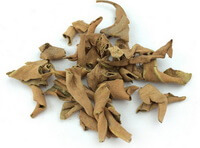
Characteristics of the Herb: Leaves are monomorphic; texture is nearly coriaceous. Leaf blades are broadly lanceolate, 20–40 cm long and 3–5 cm wide; apex is acuminate; base is auriculate and deflexed; margin is entire. The upper surface is chartreuse (yellowish-green) or yellowish-brown, bearing black, sunken pits; the lower surface is densely covered with short, broad, stellate hairs. Sori are stellate in appearance and arranged in rows between lateral veins. Petioles are stout, 10–30 cm long and 3–5 mm in diameter.
Pharmacological Actions: (1) Diuretic effect; (2) Antitussive and expectorant effects; (3) Antibacterial and anti-herpes simplex virus effects; (4) Central nervous system stimulation; (5) Leukogenic effect.
Medicinal efficacy: Promotes diuresis and treats stranguria; clears lung heat; resolves phlegm; cools the blood and stops bleeding. It is indicated for painful stranguria, gonorrhea (white turbidity), hematuria (blood in urine), lithangiuria (urinary calculi), edema, dysuria (difficulty in urination), nephritis, metrorrhagia and metrostaxis, damp-heat dysentery, lung-heat cough, phlegm-heat cough and asthma, chronic tracheitis, hemoptysis, hematemesis, epistaxis (nosebleed), bleeding from the orifices or subcutaneous tissues, traumatic bleeding, incised wounds (e.g., metal-inflicted), and ulcers.
Administration of Folium Pyrrosiae (Shí Wéi):
Reference:
Administration Guide of Folium Pyrrosiae (Shí Wéi)
TCM Books:
(1) Internally: water decoction, 1.5–3 qian (approximately 4.5–9 grams), or prepared as a powder; (2) Internally: water decoction, 9–15 grams, or prepared as a finely ground herb powder. External use: apply the finely ground herb powder directly.
(2) Pyrrosia lingua (Thunb.) Farwell.
Botanical Description:Pyrrosia lingua (Thunb.) Farwell is commonly known as Pyrrosia lingua (Thunb.) Farw., Acrostichum lingua Thunb., Pyrrosia lingua, Shí Wéi, Fēi Dāo Jiàn ("Flying Cutter Sword"), Qī Xīng Jiàn ("Seven-Star Sword"), Wú Gōng Qī ("Centipede Seven"), or Yī Zhī Jiàn ("One-Sword"). The plant grows 10–30 cm tall. The rhizome is slender and elongated, decumbent, and—along with the petiole—is densely covered with brown, lanceolate scales; scale apex is acuminate, peltate (scutiform), and inserted; center is dark brown (puce), margin is pale brown, bearing cilia.
Leaves are spaced apart and dimorphic; petioles are 3–10 cm long, dark brown, shallowly grooved, and covered with stellate hairs when young; they arise from nodes on the rhizome. Leaf blades are coriaceous, lanceolate to oblong-lanceolate, 6–20 cm long and 2–5 cm wide; apex is acuminate; base is attenuated and decurrent onto the petiole; margin is entire. The upper surface is green, occasionally bearing stellate hairs and concave pits; the lower surface is densely covered with taupe-brown (grayish-brown), stellate, aristiform hairs. Sterile and fertile fronds are homophyllous or the fertile fronds are slightly shorter and broader. The midrib is slightly concave on the upper surface and prominently raised on the lower surface; lateral veins are faintly visible; veinlets form a reticulate network.
Sori are scattered across the upper surface of the leaf or its upper portion; they are densely covered with stellate, aristiform hairs when young and become exposed upon maturity; no indusium is present.
Ecological Environment: The plant grows attached to tree trunks in forests or on rocks beside streams, at elevations of 100–1,800 meters above sea level. It prefers a cool, moderately dry climate.
Characteristics of the Herb: Leaves are involute (rolled inward) or explanate, dimorphic, and coriaceous. Leaf blades are lanceolate or rectangular-lanceolate, 6–20 cm long and 2–5 cm wide. The upper surface is yellowish-brown. On the lower surface, the midrib and lateral veins are conspicuous, and dense, pale brown, stellate hairs are visible under magnification. In addition to stellate hairs, sori are present on the lower surface of fertile fronds. Petioles are 3–10 cm long. The herb has a faint odor and a mild taste.
(3) Pyrrosia petiolosa (Christ) Ching.
Botanical Description:Pyrrosia petiolosa (Christ) Ching is also known as Polypodium petiolosum Christ. It is commonly known as Yǒu Bǐng Shí Wéi and Cháng Bǐng Shí Wéi. The plant grows up to 5–20 cm high. The rhizome is long and amphitropous, densely covered with brownish ovate-lanceolate scales with serrate margins.
Leaves are distant and of two types, thickly coriaceous; the upper surface is glabrous and bears small, orderly arranged concave points (pits); the lower surface is densely covered with taupe-brown (grayish-brown) stellate hairs. The petiole of the fertile frond is much longer than the leaf blade—about 3–12 cm long—whereas the petiole of the vegetative (sterile) frond is approximately equal in length to the leaf blade. Leaf blades are oblong or ovate-oblong, with an acute or obtuse apex and a slightly decurrent base; fertile fronds are usually involute (roll inward) when dried, becoming nearly fistuliform (tubulose). The leaf veins are inconspicuous.
The sori are scattered on the lower surface of mature leaves; the sporangia are round dihedra, lacking an indusium and immersed in stellate hairs.
Ecological Environment: The plant grows on dry rocks in mountainous areas at altitudes of 200–2,000 m above sea level. Most individuals grow on dry, exposed rocks at altitudes of 250–2,200 m above sea level.
Characters of herbs: Leaves are involute (roll inward) to nearly fistuliform (tubulose), and are of two types, coriaceous. The leaf blade is rectangular-circular or rectangular-lanceolate, with a decurrent base extending onto the petiole; it is 3–6 cm long and 0.5–2 cm wide. Brown sori are scattered on the lower surface of fertile fronds. The petiole is 3.5–11 cm long—longer than the leaf blade—and 1–2 mm in diameter.
(4) Pyrrosia gralla (Gies.) Ching.
Botanical Description:Pyrrosia gralla (Gies.) Ching is commonly known as Xī Nán Shí Wéi. The plant grows up to 25 cm high. The rhizome is long and amphitropous, densely covered with brown, lanceolate, long-acuminate, entire scales.
Leaves are approximate; petioles are 2–5 cm long and arise from nodes on the rhizome. The leaf blade is soft coriaceous, 3–10 cm long and 6–15 mm wide at the middle, narrowly lanceolate and attenuate toward both ends. Stellate hairs on the lower surface are longer; occasionally, leaf blades are larger, and lateral veins are inconspicuous.
The sori are closely and regularly arranged in lines between the lateral veins; no indusium is present.
Ecological Environment: The plant grows on rocks in forests, attached to tree trunks at altitudes of 1,000–2,900 m above sea level, or on rocks on hillsides.
Characteristics of the Herb: Leaves are of one type and soft coriaceous. Leaf blades are lanceolate, 5–10 cm long. The lower surface is covered with thick, loose stellate hairs whose branches are long, aciform (awl-shaped), puce (dark brown), and slightly lustrous. The sori occur in numerous parallel rows. Petioles are about 5 cm long.
(5) Pyrrosia davidii (Bak.) Ching.
Botanical Description:Pyrrosia davidii (Bak.) Ching is also known as Polypodium davidii Bak. It is commonly known as Huá Běi Shí Wéi, Shí Liǔ Zǐ, and Xiǎo Shí Wéi. The plant grows up to 25 cm high. The rhizome is long and amphitropous, densely covered with lanceolate, long-acuminate, entire scales.
Leaves are distant; petioles are 2–5 cm long and arise from nodes on the rhizome. The leaf blade is soft coriaceous, linear to narrowly lanceolate, 3–8 cm long and 6–15 mm wide at the middle. The upper surface is sparsely covered with stellate hairs when young, but these hairs abscise with age; the surface bears concave points (pits). The lower surface is densely covered with short, thin, orange-tan (tenne) stellate hairs; leaves sometimes involute upward (curl upward and inward) when dried. Lateral veins are inconspicuous.
The sori are regularly arranged in several parallel lines on the lower surface of the leaves; no indusium is present.
Ecological Environment: The plant grows on rocks at altitudes of 300–1,800 m above sea level.
Characteristics of the Herb: Leaves involute (roll inward) into a tube or remain explanate, are of one type, and soft coriaceous. Leaf blades are lanceolate or linear-lanceolate, attenuate toward both ends, 3–8 cm long and 0.6–1.5 cm wide. The lower surface is densely covered with short, thin stellate hairs. The sori occur in numerous parallel rows. Petioles are 2–5 cm long and 1.5–3 mm in diameter.
Article Link:
URL QR code:
References:
1.Introduction of Shí Wéi: Shearer’s Pyrrosia Leaf

 ✵This article documents the herb Shearer’s Pyrrosia Leaf, including its English name, Latin name, Pinyin name, properties and flavor, and botanical sources as defined in classical herbal texts—namely three primary species: (1) Pyrrosia sheareri (Bak.) Ching, (2) Pyrrosia lingua (Thunb.) Farwell, and (3) Pyrrosia petiolosa (Christ) Ching—as well as two additional acceptable species: (4) Pyrrosia gralla (Gies.) Ching and (5) Pyrrosia davidii (Bak.) Ching. It provides a detailed description of the botanical features, growth characteristics, and ecological environments of these five species; the macroscopic and microscopic characteristics of the herb; its pharmacological actions; medicinal efficacy; and administration guidelines.
 Pinyin Name: Shí Wéi
 Botanical Description: Pyrrosia sheareri (Bak.) Ching is also known as Polypodium sheareri Bak. It is commonly referred to as Pyrrosia sheareri, Pyrrosia sheareri (Baker) Ching, Lú Shān Shí Wéi, or Dà Shí Wéi. The plant grows 20–60 cm tall. The rhizome is decumbent and densely covered with lanceolate scales bearing serrated margins.
 Ecological Environment: Pyrrosia sheareri grows on tree trunks or rocks within forests at elevations of 500–2,200 meters. It is also found on rocks beneath evergreen broad-leaved forests at 1,100–2,400 meters. Its distribution extends up to 800 meters above sea level.
 Growth Characteristics: Pyrrosia sheareri prefers a cool, moderately dry climate and grows on rocks. It tolerates humid environments and low temperatures down to –16 °C (3.2 °F), is frost- and snow-tolerant, and requires air relative humidity above 75%. The plant prefers filtered light and avoids direct sunlight. Although epiphytic, it grows more luxuriantly in fertile, humus-rich soil. Spore production is impaired by fluctuations in humidity, soil acidification, and seasonal drought—resulting in either failure to produce spores or production of immature spores.
 Characteristics of the Herb: Leaves are monomorphic; texture is nearly coriaceous. Leaf blades are broadly lanceolate, 20–40 cm long and 3–5 cm wide; apex is acuminate; base is auriculate and deflexed; margin is entire. The upper surface is chartreuse (yellowish-green) or yellowish-brown, bearing black, sunken pits; the lower surface is densely covered with short, broad, stellate hairs. Sori are stellate in appearance and arranged in rows between lateral veins. Petioles are stout, 10–30 cm long and 3–5 mm in diameter.
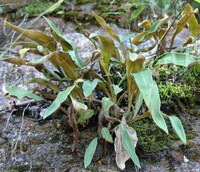 Botanical Description: Pyrrosia lingua (Thunb.) Farwell is commonly known as Pyrrosia lingua (Thunb.) Farw., Acrostichum lingua Thunb., Pyrrosia lingua, Shí Wéi, Fēi Dāo Jiàn ("Flying Cutter Sword"), Qī Xīng Jiàn ("Seven-Star Sword"), Wú Gōng Qī ("Centipede Seven"), or Yī Zhī Jiàn ("One-Sword"). The plant grows 10–30 cm tall. The rhizome is slender and elongated, decumbent, and—along with the petiole—is densely covered with brown, lanceolate scales; scale apex is acuminate, peltate (scutiform), and inserted; center is dark brown (puce), margin is pale brown, bearing cilia.
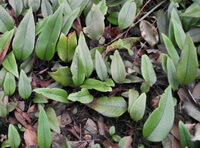 Leaves are spaced apart and dimorphic; petioles are 3–10 cm long, dark brown, shallowly grooved, and covered with stellate hairs when young; they arise from nodes on the rhizome. Leaf blades are coriaceous, lanceolate to oblong-lanceolate, 6–20 cm long and 2–5 cm wide; apex is acuminate; base is attenuated and decurrent onto the petiole; margin is entire. The upper surface is green, occasionally bearing stellate hairs and concave pits; the lower surface is densely covered with taupe-brown (grayish-brown), stellate, aristiform hairs. Sterile and fertile fronds are homophyllous or the fertile fronds are slightly shorter and broader. The midrib is slightly concave on the upper surface and prominently raised on the lower surface; lateral veins are faintly visible; veinlets form a reticulate network.
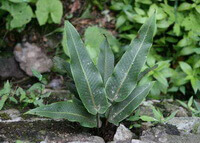 Sori are scattered across the upper surface of the leaf or its upper portion; they are densely covered with stellate, aristiform hairs when young and become exposed upon maturity; no indusium is present.
 Botanical Description: Pyrrosia petiolosa (Christ) Ching is also known as Polypodium petiolosum Christ. It is commonly known as Yǒu Bǐng Shí Wéi and Cháng Bǐng Shí Wéi. The plant grows up to 5–20 cm high. The rhizome is long and amphitropous, densely covered with brownish ovate-lanceolate scales with serrate margins.
 Leaves are distant and of two types, thickly coriaceous; the upper surface is glabrous and bears small, orderly arranged concave points (pits); the lower surface is densely covered with taupe-brown (grayish-brown) stellate hairs. The petiole of the fertile frond is much longer than the leaf blade—about 3–12 cm long—whereas the petiole of the vegetative (sterile) frond is approximately equal in length to the leaf blade. Leaf blades are oblong or ovate-oblong, with an acute or obtuse apex and a slightly decurrent base; fertile fronds are usually involute (roll inward) when dried, becoming nearly fistuliform (tubulose). The leaf veins are inconspicuous.
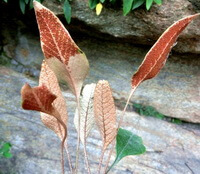 Ecological Environment: The plant grows on dry rocks in mountainous areas at altitudes of 200–2,000 m above sea level. Most individuals grow on dry, exposed rocks at altitudes of 250–2,200 m above sea level.
 Botanical Description: Pyrrosia gralla (Gies.) Ching is commonly known as Xī Nán Shí Wéi. The plant grows up to 25 cm high. The rhizome is long and amphitropous, densely covered with brown, lanceolate, long-acuminate, entire scales.
 Leaves are approximate; petioles are 2–5 cm long and arise from nodes on the rhizome. The leaf blade is soft coriaceous, 3–10 cm long and 6–15 mm wide at the middle, narrowly lanceolate and attenuate toward both ends. Stellate hairs on the lower surface are longer; occasionally, leaf blades are larger, and lateral veins are inconspicuous.
 Ecological Environment: The plant grows on rocks in forests, attached to tree trunks at altitudes of 1,000–2,900 m above sea level, or on rocks on hillsides.
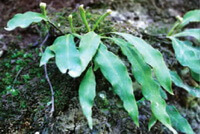 Botanical Description: Pyrrosia davidii (Bak.) Ching is also known as Polypodium davidii Bak. It is commonly known as Huá Běi Shí Wéi, Shí Liǔ Zǐ, and Xiǎo Shí Wéi. The plant grows up to 25 cm high. The rhizome is long and amphitropous, densely covered with lanceolate, long-acuminate, entire scales.
 URL QR code: