✵This article documents Plantain Seed, including its English name, Latin name, Pinyin name, property and flavor, botanical sources as defined in classical herbal texts—namely (1) Plantago asiatica L., (2) Plantago depressa Willd.—and another commonly used species, (3) Plantago major L. It provides a detailed description of the botanical features, growth characteristics, and ecological environments of these three species; the macroscopic and microscopic characteristics of the herb; its pharmacological actions; medicinal efficacy; and administration guidelines.
Semen Plantaginis (Plantain Seed).
Pinyin Name: Chē Qián Zǐ
English Name: Plantain Seed
Latin Name:Semen Plantaginis Property and Flavor: Slightly cold, sweet, and slightly bland (tasteless)
Brief Introduction:Semen Plantaginis is the dried, ripe seed of Plantago asiatica L. or Plantago depressa Willd. It is used (1) to promote diuresis and drain dampness—treating watery diarrhea, edema, and dysuria; (2) to clear liver heat and improve vision in ocular disorders; and (3) to clear lung heat and resolve phlegm in cough with excessive sputum. It is commonly known as Semen Plantaginis, Plantain Seed, or Chē Qián Zǐ.
Botanical Source: Classical herbal works define Semen Plantaginis (Plantain Seed) as the dried, ripe seed of (1) Plantago asiatica L. or (2) Plantago depressa Willd. Other authoritative herbal classics also include (3) Plantago major L. These species belong to the genus Plantago, family Plantaginaceae (plantain family), and order Lamiales. The commonly used species are introduced below:
(1) Plantago asiatica L.
Botanical Description:Plantago asiatica L. is a perennial herbaceous plant of the family Plantaginaceae (plantain or ribwort family) and genus Plantago. It is commonly known as Chē Qián. The plant bears a scape (flower stalk) up to 50 cm tall and has fibrous roots. Basal leaves possess long petioles—equal to or longer than the leaf blade—with an enlarged base. The leaf blade is oval or elliptic, 4–12 cm long and 2–7 cm wide; the apex is acute or obtuse; the base tapers into a long petiole; the margin is entire or bears irregular, shallow, undulating teeth; and the blade typically exhibits 5–7 arcuate veins.
Several scapes (flower stalks), 12–50 cm tall, are angular and sparsely pilose. The inflorescence spikes constitute 2/5 to 1/2 the scape length. Flowers are pale green; each flower bears one persistent, triangular bract. The calyx consists of four sepals, slightly connate at the base, elliptic or oval, and persistent. The corolla is small and membranous: the corolla tube is oval, with a 4-lobed apex; lobes are triangular and revolute. There are four stamens, inserted near the base of the corolla tube and alternating with the corolla lobes; anthers are oblong with triangular apical projections; filaments are linear. There is one pistil: the ovary is superior, ovoid, bilocular (with a false quartilocular appearance), bearing one linear, pilose style.
The capsule fruit is ovate-conical; upon maturity, it dehisces circumscissilely around the lower 2/5 portion, leaving the distal 2/5 persistent. It contains 4–9 seeds, which are nearly elliptic and dark brown. Flowering occurs from June to September; fruiting takes place in October.
Ecological Environment: This species grows in mountains, along roadsides, in grasslands, flowerbeds, vegetable gardens, ditches, riverbanks, wetlands, and around villages—at elevations ranging from 3 to 3,200 meters above sea level. It is widely distributed across China and also occurs in Nepal, Southeast Asia, and eastern Asia.
Growth Characteristics:Plantago asiatica exhibits strong environmental adaptability. It prefers warm, moist climates but tolerates cold and drought. It thrives in mountainous and hilly regions. Soil requirements are not stringent: it grows well in general fields, field margins and corners, and peri-domestic areas. Optimal growth occurs in sunny, fertile, moist sandy loam. Stem and leaf development proceeds normally at temperatures of 20–24 °C (68–75.2 °F); growth slows above 32 °C (89.6 °F), leading to wilting and eventual plant death.
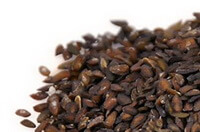
Characteristics of the Herb: Seeds are slightly elliptic or irregularly oblong, slightly flattened, ~2 mm long and ~1 mm wide. The surface is pale brown to brown, slightly rough and uneven. Under magnification, fine longitudinal striations are visible; a faint yellow, punctiform hilum (a concave scar) lies centrally on the flattened side. The seeds are hard in texture; the cross-section appears ash-gray (grayish white). When immersed in water, mucilage exudes from the testa. The herb is nearly odorless and becomes mucilaginous upon chewing.
Pharmacological Actions: (1) Diuretic effect.
Medicinal Efficacy: Clears heat and promotes diuresis; alleviates edema; drains dampness; treats dysuria; drains dampness to relieve diarrhea; improves vision; resolves phlegm. Indications include edema and abdominal distension; urinary obstruction; febrile dysuria; turbid or cloudy urine; pathological leukorrhea; hematuria; diarrhea due to heat-dampness; dysentery; red, swollen, painful eyes; nebulae (corneal opacities); cough due to phlegm-heat; copious sputum; and fixed, painful arthralgia caused by dampness.
Administration of Semen Plantaginis (Chē Qián Zǐ):
Reference:
Administration Guide for Semen Plantaginis (Chē Qián Zǐ)
TCM Books:
(1) Internally: 9–15 grams, wrapped in cloth before decoction; (2) Internally: water decoction, 1.5–3 qián (≈4.5–9 grams); or prepared as pills or powder. Externally: wash affected areas with decoction, or prepare as a fine powder for topical application; (3) Internally: water decoction, 5–15 grams, wrapped in cloth before decoction; or prepared as pills or powder. Externally: use an appropriate amount—wash with decoction, or prepare as a fine powder for topical application.
(2) Plantago depressa Willd.
Botanical Description:Plantago depressa Willd. is an annual or biennial herb of the family Plantaginaceae (plantain family) and genus Plantago. It is commonly known as Píng Chē Qián. Roots are straight and elongated, with numerous lateral roots; they are somewhat succulent. Rhizomes are short. Leaves are basal and arranged in a rosette; they are procumbent, spreading obliquely, or erect. The leaf blade is chartaceous (papery), elliptic, elliptic-lanceolate, or ovate-lanceolate, 3–12 cm long and 1–3.5 cm wide; the apex is acute or slightly obtuse; the margin bears undulating, blunt teeth, irregular serrations, or dentations; the base is broadly to narrowly cuneate and decurrent onto the petiole; there are 5–7 prominent arcuate veins—the upper surface is slightly concave, while the lower surface is conspicuously protuberant; both surfaces are sparsely white-pubescent. Petioles are 2–6 cm long and broaden basally into a sheath.
Inflorescences number 3–10 (occasionally more). Peduncles are 5–18 cm long, longitudinally striped, and sparsely white-pubescent. Spikes are slender and cylindrical—densely flowered in the upper portion and often interrupted at the base—6–12 cm long. Flower bracts are triangular-ovate, 2–3.5 mm long, concave, and glabrous; the keel (midvein of the bract) is broad and thick—wider than the two lateral bracts—and either does not extend beyond the apex or extends just to the tip. The calyx is 2–2.5 mm long and glabrous; its keels are broad and thick and do not extend to the tip. The anterior pair of bracts is narrowly obovate-elliptic to broadly elliptic; the posterior pair is obovate-elliptic to broadly elliptic. The corolla is white and glabrous; the corolla tube is equal to or slightly longer than the calyx lobes; the lobes are minute, elliptic or oval, 0.5–1 mm long, and reflex after flowering. Stamens are inserted near the apex on the inner surface of the corolla tube and are conspicuously exserted beyond the style. Anthers are ovate-elliptic or broadly elliptic, 0.6–1.1 mm long, with broad triangular apical projections; they are white or greenish-white when fresh and turn hazel (pale brown) upon drying. There are five ovules.
The capsule is ovate-elliptic to conical-ovate, 4–5 mm long, and circumscissile above the base. It contains 4–5 seeds, which are elliptic; the ventral surface is flat; seeds measure 1.2–1.8 mm in length and are tawny (yellow-brown) to black; cotyledons are arranged dorsoventrally. Flowering occurs from May to July; fruiting occurs from July to September.
Morphological distinctions of Plantago depressa Willd. from the other two species include: (i) cylindrical, straight primary roots; (ii) leaf blades that are elliptic, elliptic-lanceolate, or ovate-lanceolate with a narrowly cuneate base; (iii) calyx lobes approximately equal in length to the floral bracts; (iv) conical capsules; and (v) oblong, brownish-black seeds.
Ecological Environment: This species grows in grasslands, along riverbanks and ditches, in meadows, fields, and on roadsides—at elevations ranging from 5 to 4,500 meters above sea level. It is distributed across China and also occurs in Siberia, eastern Asia, Kazakhstan, Afghanistan, Pakistan, and Kashmir.
Characteristics of the Herb: Seeds are oblong-oval, slightly flattened, 0.90–1.75 mm long and 0.60–0.98 mm wide. The surface is blackish-brown or brown; the dorsal surface is slightly convex; the ventral surface is relatively flat; and a conspicuous, white, concave hilum lies centrally.
(3) Plantago major L.
Botanical Description:Plantago major L. is commonly known as Dà Chē Qián. It is a biennial or perennial herb with numerous fibrous roots. The rhizome is short and stout. Basal leaves form a rosette and are procumbent, spreading obliquely, or erect. The leaf blade is herbaceous to thin chartaceous or chartaceous, broadly ovate to broadly elliptic, 3–30 cm long and 2–21 cm wide; the apex is obtuse-acuminate or acute; the margin is undulate, with sparse, irregular teeth or nearly entire; both surfaces are sparsely pubescent or subglabrous (a few specimens are densely pubescent); there are 3–7 arcuate veins. Petioles are 1–26 cm long and sheath-forming at the base—often pilose.
Inflorescence is 1 to several; peduncles are erect or arching, 2–5–18 cm long, striate, pubescent or pilose; spikes are slender and terete (cylindrical), 1–3–20 cm long, the base is often discontinuous; bracts are broadly ovate-triangular, 1.2–2 mm long, width equal to or slightly greater than length, glabrous or sparsely pubescent at the apex, keel petals are broad and thick. Flowers are sessile; calyx is 1.5–2.5 mm long, sepal apices are rounded, glabrous or sparsely bearing short marginal setae, margin is membranous, keel petals are not extending to the apex; anterior pair of sepals (calyx lobes) is elliptic to broadly elliptic, posterior pair of bracts is broadly elliptic to orbicular. The corolla is white and glabrous; the corolla tube is equal to or slightly longer than the sepals, and the lobes are lanceolate to narrowly ovate, 1–1.5 mm long, reflexed after flowering. Stamens inserted near the base on the inner surface of the corolla tube, conspicuously exserted beyond the style; anthers are elliptic, 1–1.2 mm long, usually mauve (lilac) at first, rarely white, turning hazel (pale brown) upon drying. Ovules 12 to over 40.
Capsule is subglobular (nearly spherical), ovoid or broadly ellipsoidal, 2–3 mm long, circumscissile at the middle or slightly below the middle. Seeds are 8–34, oval (egg-shaped), elliptic or rhomboid, 0.8–1.2 mm long, angular, ventral surface is raised or nearly flat, tawny (yellow-brown); cotyledons are arranged dorsoventrally. Flowering period: June to August; fruiting period: July to September.
Morphological differences between Plantago major and Plantago asiatica include: leaf blades are oval (egg-shaped) or broadly ovate, 6–10 cm long, 3–6 cm wide, apex is obtuse, base is rounded or broadly cuneate; petiole base is often enlarged or sheathing. Spikes are 3–10 cm long, flowers are densely arranged. Seeds 7–15, black.
Ecological Environment: The plant grows in grasslands, meadows, riverbanks, ditch margins, marshes, hillsides or mountain slopes, roadsides, field margins, or wastelands, at altitudes of 5–2,800 m above sea level. It is distributed in the temperate and cold temperate zones of the Eurasian continent and has been naturalized worldwide.
Characteristics of the Herb: Seeds are nearly triangular or rhombic, small-grained, 0.88–1.60 mm long and 0.55–0.90 mm wide. Surface is blackish-brown or brown; ventral surface is prominently raised; hilum is white, mostly located at the center or one end of the raised ventral surface.

 ✵This article documents Plantain Seed, including its English name, Latin name, Pinyin name, property and flavor, botanical sources as defined in classical herbal texts—namely (1) Plantago asiatica L., (2) Plantago depressa Willd.—and another commonly used species, (3) Plantago major L. It provides a detailed description of the botanical features, growth characteristics, and ecological environments of these three species; the macroscopic and microscopic characteristics of the herb; its pharmacological actions; medicinal efficacy; and administration guidelines.
 Pinyin Name: Chē Qián Zǐ
 Botanical Description: Plantago asiatica L. is a perennial herbaceous plant of the family Plantaginaceae (plantain or ribwort family) and genus Plantago. It is commonly known as Chē Qián. The plant bears a scape (flower stalk) up to 50 cm tall and has fibrous roots. Basal leaves possess long petioles—equal to or longer than the leaf blade—with an enlarged base. The leaf blade is oval or elliptic, 4–12 cm long and 2–7 cm wide; the apex is acute or obtuse; the base tapers into a long petiole; the margin is entire or bears irregular, shallow, undulating teeth; and the blade typically exhibits 5–7 arcuate veins.
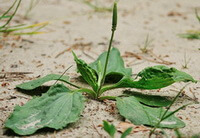 Ecological Environment: This species grows in mountains, along roadsides, in grasslands, flowerbeds, vegetable gardens, ditches, riverbanks, wetlands, and around villages—at elevations ranging from 3 to 3,200 meters above sea level. It is widely distributed across China and also occurs in Nepal, Southeast Asia, and eastern Asia.
 Characteristics of the Herb: Seeds are slightly elliptic or irregularly oblong, slightly flattened, ~2 mm long and ~1 mm wide. The surface is pale brown to brown, slightly rough and uneven. Under magnification, fine longitudinal striations are visible; a faint yellow, punctiform hilum (a concave scar) lies centrally on the flattened side. The seeds are hard in texture; the cross-section appears ash-gray (grayish white). When immersed in water, mucilage exudes from the testa. The herb is nearly odorless and becomes mucilaginous upon chewing.
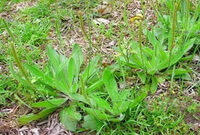 Botanical Description: Plantago depressa Willd. is an annual or biennial herb of the family Plantaginaceae (plantain family) and genus Plantago. It is commonly known as Píng Chē Qián. Roots are straight and elongated, with numerous lateral roots; they are somewhat succulent. Rhizomes are short. Leaves are basal and arranged in a rosette; they are procumbent, spreading obliquely, or erect. The leaf blade is chartaceous (papery), elliptic, elliptic-lanceolate, or ovate-lanceolate, 3–12 cm long and 1–3.5 cm wide; the apex is acute or slightly obtuse; the margin bears undulating, blunt teeth, irregular serrations, or dentations; the base is broadly to narrowly cuneate and decurrent onto the petiole; there are 5–7 prominent arcuate veins—the upper surface is slightly concave, while the lower surface is conspicuously protuberant; both surfaces are sparsely white-pubescent. Petioles are 2–6 cm long and broaden basally into a sheath.
 Inflorescences number 3–10 (occasionally more). Peduncles are 5–18 cm long, longitudinally striped, and sparsely white-pubescent. Spikes are slender and cylindrical—densely flowered in the upper portion and often interrupted at the base—6–12 cm long. Flower bracts are triangular-ovate, 2–3.5 mm long, concave, and glabrous; the keel (midvein of the bract) is broad and thick—wider than the two lateral bracts—and either does not extend beyond the apex or extends just to the tip. The calyx is 2–2.5 mm long and glabrous; its keels are broad and thick and do not extend to the tip. The anterior pair of bracts is narrowly obovate-elliptic to broadly elliptic; the posterior pair is obovate-elliptic to broadly elliptic. The corolla is white and glabrous; the corolla tube is equal to or slightly longer than the calyx lobes; the lobes are minute, elliptic or oval, 0.5–1 mm long, and reflex after flowering. Stamens are inserted near the apex on the inner surface of the corolla tube and are conspicuously exserted beyond the style. Anthers are ovate-elliptic or broadly elliptic, 0.6–1.1 mm long, with broad triangular apical projections; they are white or greenish-white when fresh and turn hazel (pale brown) upon drying. There are five ovules.
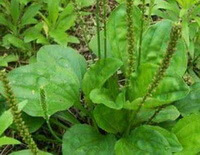 Botanical Description: Plantago major L. is commonly known as Dà Chē Qián. It is a biennial or perennial herb with numerous fibrous roots. The rhizome is short and stout. Basal leaves form a rosette and are procumbent, spreading obliquely, or erect. The leaf blade is herbaceous to thin chartaceous or chartaceous, broadly ovate to broadly elliptic, 3–30 cm long and 2–21 cm wide; the apex is obtuse-acuminate or acute; the margin is undulate, with sparse, irregular teeth or nearly entire; both surfaces are sparsely pubescent or subglabrous (a few specimens are densely pubescent); there are 3–7 arcuate veins. Petioles are 1–26 cm long and sheath-forming at the base—often pilose.
 Inflorescence is 1 to several; peduncles are erect or arching, 2–5–18 cm long, striate, pubescent or pilose; spikes are slender and terete (cylindrical), 1–3–20 cm long, the base is often discontinuous; bracts are broadly ovate-triangular, 1.2–2 mm long, width equal to or slightly greater than length, glabrous or sparsely pubescent at the apex, keel petals are broad and thick. Flowers are sessile; calyx is 1.5–2.5 mm long, sepal apices are rounded, glabrous or sparsely bearing short marginal setae, margin is membranous, keel petals are not extending to the apex; anterior pair of sepals (calyx lobes) is elliptic to broadly elliptic, posterior pair of bracts is broadly elliptic to orbicular. The corolla is white and glabrous; the corolla tube is equal to or slightly longer than the sepals, and the lobes are lanceolate to narrowly ovate, 1–1.5 mm long, reflexed after flowering. Stamens inserted near the base on the inner surface of the corolla tube, conspicuously exserted beyond the style; anthers are elliptic, 1–1.2 mm long, usually mauve (lilac) at first, rarely white, turning hazel (pale brown) upon drying. Ovules 12 to over 40.
 Ecological Environment: The plant grows in grasslands, meadows, riverbanks, ditch margins, marshes, hillsides or mountain slopes, roadsides, field margins, or wastelands, at altitudes of 5–2,800 m above sea level. It is distributed in the temperate and cold temperate zones of the Eurasian continent and has been naturalized worldwide.
 URL QR code:

