✵The article records the herb Plantain Herb, including its English name, Latin name, Pinyin name, properties and flavor, and the botanical sources defined in classical herbal texts: (1) Plantago asiatica L., (2) Plantago depressa Willd., and (3) Plantago major L. It provides a detailed introduction to the botanical features, growth characteristics, and ecological environment of Plantago major L., as well as the characteristics of the herb Plantain Herb, its pharmacological actions, medicinal efficacy, and administration guidelines.
Herba Plantaginis (Plantain Herb)
Pinyin Name: Chē Qián Cǎo
English Name: Plantain Herb
Latin Name: Herba Plantaginis
Properties and Flavor: Cold, sweet
Brief Introduction:Herba Plantaginis is the dried whole plant of Plantago asiatica L. or Plantago depressa Willd. It is used (1) to promote diuresis in cases of edema, oliguria, and stranguria, and (2) to clear heat and detoxify in cases of sores, carbuncles, dysentery, and acute pulmonary or urinary tract infections. The herb is commonly known as Herba Plantaginis, Plantain Herb, or Chē Qián Cǎo.
Botanical Source: Official herbal classics define Herba Plantaginis (Plantain Herb) as the dried whole plant of (1) Plantago asiatica L. or (2) Plantago depressa Willd. Other authoritative herbal classics include (3) Plantago major L. as an additional source. All three species belong to the genus Plantago, family Plantaginaceae (plantain or ribwort family), order Lamiales. Species (3) is described below:
(3) Plantago major L.
Botanical Description: Commonly known as Dà Chē Qián, Plantago major L. is a biennial or perennial herb with numerous fibrous roots. The rhizome is short and stout. Basal leaves form a rosette; they are prostrate, spreading obliquely or erect. Leaf blades are herbaceous to thin chartaceous (papery) or chartaceous, broadly ovate to broadly elliptic, 3–18–30 cm long and 2–11–21 cm wide; apex is obtuse to acute; margin is undulate, with sparse, irregular teeth or nearly entire; both surfaces are sparsely pubescent or subglabrous, occasionally densely pubescent; with 3–5–7 prominent veins. Petioles are 1–3–10–26 cm long; base is sheathing, often pilose.
Inflorescence 1 to several; peduncles are erect or arching, 2–5–18 cm long, striate, pubescent or pilose; spikes are slender and terete (cylindrical), 1–3–20 cm long, base is often discontinuous; bracts are broadly ovate-triangular, 1.2–2 mm long, width is equal to or slightly greater than length, glabrous or sparsely pubescent at the apex, keel petals are broad and thick. Flowers are sessile; calyx is 1.5–2.5 mm long, sepal apices are rounded, glabrous or sparsely bearing short marginal setae, margin is membranous, keel petals are not extending to the apex; anterior pair of sepals (calyx lobes) is elliptic to broadly elliptic, posterior pair of sepals is broadly elliptic to orbicular. Corolla is white and glabrous; corolla tube is equal to or slightly longer than the sepals; lobes are lanceolate to narrowly ovate, 1–1.5 mm long, reflexed after flowering. Stamens are inserted near the base on the inner surface of the corolla tube, conspicuously exserted beyond the style; anthers are elliptic, 1–1.2 mm long, usually mauve (lilac) when fresh, rarely white, turning hazel (pale brown) upon drying. Ovules are 12 to over 40.
Capsule is subglobular (nearly spherical), ovoid or broadly ellipsoidal, 2–3 mm long, circumscissile at the middle or slightly below the middle. Seeds are 8–34, oval (egg-shaped), elliptic or rhomboid, 0.8–1.2 mm long, angular; ventral surface is raised or nearly flat, tawny (yellow-brown); cotyledons are arranged dorsoventrally. Flowering period: June to August; fruiting period: July to September.
Morphological differences between Plantago major and Plantago asiatica include: leaf blades are oval (egg-shaped) or broadly ovate, 6–10 cm long and 3–6 cm wide, apex is blunt, base is rounded or broadly cuneate; petiole base is often enlarged or sheathing. Spikes are 3–10 cm long, flowers are densely arranged; seeds are 7–15, black.
Ecological Environment: The plant grows in grassland, meadows, river beach, ditch sides, marshland, hillsides or mountain slopes, roadsides, field edges, or wasteland, in areas at altitudes of 5~2,800 meters above sea level. The plant is distributed in the temperate zone and cold temperate zone of the Asia-Europe continent, naturalization around the world.
Growth Characteristics:Plantago major prefers a warm, humid climate and exhibits cold tolerance. It grows on mountains, hills, and plains. Soil requirements are not strict; it can be cultivated in ordinary fields, field margins, corners, or around dwellings, but fertile, moist, well-drained sandy loam is optimal.
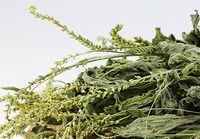
Characteristics of the Herb: The herb prepared from Plantago asiatica has tufted fibrous roots. Leaves arise densely from the base and have long petioles; leaf blades are wrinkled—when flattened, they are oval (egg-shaped) or broadly ovate, 4–12 cm long and 2–5 cm wide; apex is obtuse or mucronate; base is broadly cuneate; margin is nearly entire, undulate, or sparsely crenate; with 7 conspicuous basal veins; surface is celadon (sage green) or dull green. Several spikes arise on scapes 5–15 cm long, bearing flowers sparsely arranged. Capsule is elliptic and circumscissile; calyx is persistent. The herb has a slight fragrance and a slightly bitter taste.
The herb prepared from Plantago major has a short, succulent rhizome with fibrous roots. Leaf blades are oval (egg-shaped) or broadly ovate, 6–10 cm long and 3–6 cm wide; apex is obtuse; base is rounded or broadly cuneate; with 5–7 basal veins. Spikes bear densely arranged flowers. Other characteristics are identical to those of Plantago asiatica.
The herb prepared from Plantago depressa Willd. has a conical taproot, straight and elongated. Leaf blades are oblong-oval or elliptic-lanceolate, 5–10 cm long and 1–3 cm wide; margin is serrulate or irregularly serrate; base is attenuate; with 5–7 basal veins. Flowers are densely arranged at the spike apex and sparsely arranged toward the base. Other characteristics are identical to those of Plantago major.
Pharmacological Actions: (1) Effects on the urinary system; (2) Antitussive, antiasthmatic, and expectorant effects.
Medicinal efficacy: Clears heat and promotes diuresis; resolves phlegm; cools the blood; detoxifies. Indicated for edema and oliguria; dysuria; pyretic stranguria (heat-induced painful urination); turbid stranguria; morbid leukorrhea; bladder heat accumulation; summer-dampness diarrhea; phlegm-heat cough; hematemesis (hemorrhage from the stomach); epistaxis (nasal bleeding); hematuria (blood in urine); liver-fire manifesting as red, painful eyes; sore throat; and carbuncles or toxic swellings.
Administration of Herba Plantaginis (Chē Qián Cǎo):
Reference:
Administration Guide of Herba Plantaginis (Chē Qián Cǎo)
TCM Books:
(1) Internally: 9–30 grams dried herb; fresh herb 30–60 grams—administered as decoction or freshly extracted juice. External use: appropriate amount of fresh herb, mashed and applied topically. (2) Internally: water decoction, 15–30 grams dried herb; fresh herb 30–60 grams—or freshly extracted juice. External use: appropriate amount—used as wash (decoction), topical poultice (mashed herb), or topical application of juice.
Precautions and Adverse Reactions: Contraindicated in spermatorrhea and in conditions involving instability of jīng (essence) and qì.

 ✵The article records the herb Plantain Herb, including its English name, Latin name, Pinyin name, properties and flavor, and the botanical sources defined in classical herbal texts: (1) Plantago asiatica L., (2) Plantago depressa Willd., and (3) Plantago major L. It provides a detailed introduction to the botanical features, growth characteristics, and ecological environment of Plantago major L., as well as the characteristics of the herb Plantain Herb, its pharmacological actions, medicinal efficacy, and administration guidelines.
 Pinyin Name: Chē Qián Cǎo
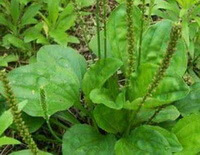 Botanical Description: Commonly known as Dà Chē Qián, Plantago major L. is a biennial or perennial herb with numerous fibrous roots. The rhizome is short and stout. Basal leaves form a rosette; they are prostrate, spreading obliquely or erect. Leaf blades are herbaceous to thin chartaceous (papery) or chartaceous, broadly ovate to broadly elliptic, 3–18–30 cm long and 2–11–21 cm wide; apex is obtuse to acute; margin is undulate, with sparse, irregular teeth or nearly entire; both surfaces are sparsely pubescent or subglabrous, occasionally densely pubescent; with 3–5–7 prominent veins. Petioles are 1–3–10–26 cm long; base is sheathing, often pilose.
 Capsule is subglobular (nearly spherical), ovoid or broadly ellipsoidal, 2–3 mm long, circumscissile at the middle or slightly below the middle. Seeds are 8–34, oval (egg-shaped), elliptic or rhomboid, 0.8–1.2 mm long, angular; ventral surface is raised or nearly flat, tawny (yellow-brown); cotyledons are arranged dorsoventrally. Flowering period: June to August; fruiting period: July to September.
 Ecological Environment: The plant grows in grassland, meadows, river beach, ditch sides, marshland, hillsides or mountain slopes, roadsides, field edges, or wasteland, in areas at altitudes of 5~2,800 meters above sea level. The plant is distributed in the temperate zone and cold temperate zone of the Asia-Europe continent, naturalization around the world.
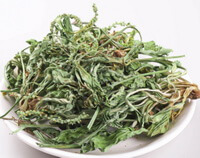 Characteristics of the Herb: The herb prepared from Plantago asiatica has tufted fibrous roots. Leaves arise densely from the base and have long petioles; leaf blades are wrinkled—when flattened, they are oval (egg-shaped) or broadly ovate, 4–12 cm long and 2–5 cm wide; apex is obtuse or mucronate; base is broadly cuneate; margin is nearly entire, undulate, or sparsely crenate; with 7 conspicuous basal veins; surface is celadon (sage green) or dull green. Several spikes arise on scapes 5–15 cm long, bearing flowers sparsely arranged. Capsule is elliptic and circumscissile; calyx is persistent. The herb has a slight fragrance and a slightly bitter taste.
 URL QR code: