✵The article records the herb Rice Bean, including its English name, Latin name, Pinyin name, properties and flavors, botanical sources—two plant species: (1) Phaseolus calcaratus Roxb. and (2) Phaseolus angularis Wight.—as well as detailed descriptions of the botanical features, growth characteristics, and ecological environments of these two species; the macroscopic and microscopic characteristics of the herb Rice Bean; its pharmacological actions; medicinal efficacy; and administration guidelines.
Semen Phaseoli (Rice Bean)
Pinyin Name: Chì Xiǎo Dòu
English Name: Rice Bean
Latin Name:Semen Phaseoli Properties and Flavors: Slightly cool; sour and sweet
Brief Introduction:Semen Phaseoli is the dried, ripe seed of Phaseolus calcaratus Roxb. or Phaseolus angularis Wight. It promotes diuresis, detoxifies, and facilitates pus drainage in cases of boils, sores, and abscesses. It is commonly known as Semen Phaseoli, Rice Bean, or Chì Xiǎo Dòu.
Botanical source: Classical herbal works define Semen Phaseoli (Rice Bean) as the dried, ripe seed of (1) Phaseolus calcaratus Roxb. or (2) Phaseolus angularis Wight. These are plants of the genus Vigna, family Fabaceae (Leguminosae, the legume or pea family), order Fabales. The two commonly used species are described below:
(1) Phaseolus calcaratus Roxb.
Botanical Description:Phaseolus calcaratus Roxb. is a plant of the Fabaceae family and genus Vigna. It is also known as Vigna umbellata (Thunb.) Ohwi et Ohashi or Dolichos umbellatus Thunb. Common names include Phaseolus calcaratus Roxb., Rice Bean, Small Red Bean, and Chì Xiǎo Dòu. It is an annual, semi-climbing herb. Stems are slender, up to 1.8 m long, and densely covered with appressed hairs. Leaves are trifoliolate; petioles are 8–16 cm long; stipules (peraphylla) are lanceolate or ovate-lanceolate; leaflets (foliolules) are 3 in number, lanceolate to oblong-lanceolate, 6–10 cm long and 2–6 cm wide, with acuminate apices and broadly triangular, cuneate, or orbicular bases; margins are entire or slightly 3-lobed; both surfaces are glabrous or sparsely pilose; texture is chartaceous (papery); leaflets are stipitate and trinervious.
Racemes are axillary, bearing numerous flowers; pedicels are very short; two bracteoles are lanceolate-linear, ~5 mm long, and pilose; calyx is short-campanulate with five teeth; corolla is papilionaceous and yellow; vexillum is reniform and emarginate, with a cordate base; alae are obliquely ovate with narrowed claw-like bases; keel (carina) is long and narrow, bearing angular protrusions; stamens are 10, diadelphous; anthers are small; ovary is superior and densely covered with short hirsute hairs; style is linear.
Legumes (pods) are linear-flat cylindrical, pendulous, 6–10 cm long and 5 mm wide, and glabrous. Each pod contains 6–10 seeds, oblong in shape, usually dark purple or dark red, occasionally brown, black, or yellow; seeds are 3–3.5 mm in diameter, with blunt ends and a straight, sunken hilum. Flowering occurs from May to August; fruiting from August to September.
Ecological Environment: The plant is cultivated or grows wild. Native to tropical Asia, it is widely grown in Southeast Asian countries and also cultivated in other parts of East Asia.
Growth Characteristics:Phaseolus calcaratus exhibits strong adaptability and can be grown in general farmland. Sunny fields with loose, moderately fertile soil are optimal; excessive fertilizer may cause spindly growth and reduced pod yield. Continuous cropping should be avoided. Soil requirements are not strict: it tolerates sandy, loamy, and even clayey soils, and can be cultivated on valley or basin roadsides and mountain slopes. It is tolerant of both waterlogging and drought, has a short growth cycle, and requires simple cultivation techniques—making it suitable as a relay crop.
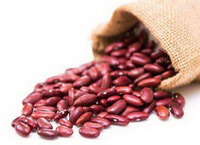
Characteristics of the Herb: Seeds are cylindrical and slightly flattened or oblong and slightly flattened, with both ends truncate or blunt; length: 5–7 mm or 5–8 mm; diameter: 3–5 mm. Surface color is purplish-red or dark reddish-brown, smooth, slightly glossy or dull. A linear, whitish hilum extends along one side, inclined toward one end, measuring approximately two-thirds the seed length; its center is sunken into a longitudinal groove. The opposite side bears an inconspicuous ridge. Seed texture is hard and not easily fractured. Upon sectioning, the seed coat is thin and crisp; two cotyledons are cream-white (milky white), fleshy and hypertrophic; the radicle is thin, elongated, and curved toward one end. The herb has a slight odor and a mildly sweet taste, with a faint beany (leguminous) odor when chewed.
Pharmacological Actions: (1) Inhibitory effects against Staphylococcus aureus, Shigella flexneri, and Salmonella typhi; (2) inhibition of trypsin and human sperm acrosomal enzyme activity.
Medicinal efficacy: Alleviates water retention and edema (reduce swelling), resolves dampness, clears jaundice, detoxifies and promotes diuresis, harmonizes the blood and promotes diuresis, reduces swelling and detoxifies, clears heat and detoxifies, and resolves carbuncles. It is indicated for edematous swelling, beriberi and limb edema, jaundice, jaundice with red urine, diarrhea and dysentery, hematochezia (bloody stool), gonorrhea, wind-damp-heat arthralgia, carbuncles and toxic sores, acute appendicitis with abdominal pain, scabies, and tinea.
Administration of Semen Phaseoli (Chì Xiǎo Dòu):
Reference:
Administration Guide of Semen Phaseoli (Chì Xiǎo Dòu)
TCM Books:
(1) Internally: 9–30 grams; topical use: appropriate amount—prepare as a finely ground herb powder and apply as a paste. (2) Internally: water decoction, 0.3–1 liang (approximately 9–30 grams), or administered as a powder; topical use: prepare as a finely ground herb powder and apply as a paste. (3) Internally: water decoction, 10–30 grams, , or prepared as a powder; topical use: appropriate amount—prepare as a finely ground herb powder and apply as a paste, or wash with a water decoction.
Precautions and Adverse Reactions: Contraindicated within 100 days after a snake bite (should not use the herb Semen Phaseoli).
(2) Phaseolus angularis Wight
Botanical Description:Phaseolus angularis Wight is a plant of the Fabaceae family (Leguminosae, the legume or pea family) and the genus Vigna. It is also known as Phaseolus angularis (Willd.) W.F. Wight, Dolichos angularis Willd., or Vigna angularis (Willd.) Ohwi et Ohashi. Common names include Phaseolus angularis, rice bean, red bean, Chi Dou, etc. An annual erect or twining herb, growing upright or climbing, reaching 30–90 cm in height; stems are covered with white, long, hirsute hairs. Trifoliolate leaves; stipules (leaf-like appendages at the base of the petiole) are lanceolate and covered with white, long, pilose hairs; stipels (small stipule-like structures at the base of leaflets) are linear; petioles reach up to 20 cm in length and are sparsely covered with long, pilose hairs; terminal leaflets (foliolules) are oval (egg-shaped), lateral leaflets are rhombic-ovate, 5–10 cm long and 3.5–7 cm wide; apex is mucronate or acuminate; base is triangular or orbicular; margin is entire or slightly 3-lobed; both surfaces are sparsely covered with long, pilose hairs; petiolules are very short; three basal veins present.
Inflorescence: 2–6 flowers grow on the apex of axillary peduncles; corolla is yellow; bracteoles are linear and longer than the calyx; calyx is campanulate (bell-shaped), 5-toothed, teeth triangular; vexillum (standard petal) is disc-shaped (oblate) or sub-reniform, often slightly oblique, apex is concave; alae (wing petals) are broader than keel petals (carina), each with a short claw and auricle; keel apex bent and nearly half-rolled; one keel petal bears corniform (horn-like) protrusions in its middle to lower portion; base of keel with a claw; 10 stamens, diadelphous (9+1); ovary linear; style is curved, pilose is near the apex.
Fruit: Legumes (pods) are cylindrical and slightly flattened; seeds are contract at maturity; each pod contains 6–10 seeds. Seeds are elliptic, both ends are truncate or rounded, dirty red (dark red); hilum is white and non-concave. Flowering period: July–August; fruiting period: August–September.
Ecological Environment: Widely cultivated or occurring wild.
Characteristics of the Herb: Seeds are short-cylindrical or nearly rectangular-circular and slightly flattened, with truncate or blunt ends, 4–6 mm in diameter; surface is dark brown-red and lustrous; hilum is not prominent. The main distinction from common red bean (Phaseolus vulgaris) seeds is that the hilum is flat—not protruding—and the center is not sunken.

 ✵The article records the herb Rice Bean, including its English name, Latin name, Pinyin name, properties and flavors, botanical sources—two plant species: (1) Phaseolus calcaratus Roxb. and (2) Phaseolus angularis Wight.—as well as detailed descriptions of the botanical features, growth characteristics, and ecological environments of these two species; the macroscopic and microscopic characteristics of the herb Rice Bean; its pharmacological actions; medicinal efficacy; and administration guidelines.
 Pinyin Name: Chì Xiǎo Dòu
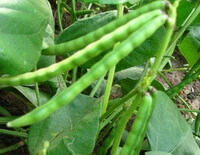 Botanical Description: Phaseolus calcaratus Roxb. is a plant of the Fabaceae family and genus Vigna. It is also known as Vigna umbellata (Thunb.) Ohwi et Ohashi or Dolichos umbellatus Thunb. Common names include Phaseolus calcaratus Roxb., Rice Bean, Small Red Bean, and Chì Xiǎo Dòu. It is an annual, semi-climbing herb. Stems are slender, up to 1.8 m long, and densely covered with appressed hairs. Leaves are trifoliolate; petioles are 8–16 cm long; stipules (peraphylla) are lanceolate or ovate-lanceolate; leaflets (foliolules) are 3 in number, lanceolate to oblong-lanceolate, 6–10 cm long and 2–6 cm wide, with acuminate apices and broadly triangular, cuneate, or orbicular bases; margins are entire or slightly 3-lobed; both surfaces are glabrous or sparsely pilose; texture is chartaceous (papery); leaflets are stipitate and trinervious.
 Legumes (pods) are linear-flat cylindrical, pendulous, 6–10 cm long and 5 mm wide, and glabrous. Each pod contains 6–10 seeds, oblong in shape, usually dark purple or dark red, occasionally brown, black, or yellow; seeds are 3–3.5 mm in diameter, with blunt ends and a straight, sunken hilum. Flowering occurs from May to August; fruiting from August to September.
 Characteristics of the Herb: Seeds are cylindrical and slightly flattened or oblong and slightly flattened, with both ends truncate or blunt; length: 5–7 mm or 5–8 mm; diameter: 3–5 mm. Surface color is purplish-red or dark reddish-brown, smooth, slightly glossy or dull. A linear, whitish hilum extends along one side, inclined toward one end, measuring approximately two-thirds the seed length; its center is sunken into a longitudinal groove. The opposite side bears an inconspicuous ridge. Seed texture is hard and not easily fractured. Upon sectioning, the seed coat is thin and crisp; two cotyledons are cream-white (milky white), fleshy and hypertrophic; the radicle is thin, elongated, and curved toward one end. The herb has a slight odor and a mildly sweet taste, with a faint beany (leguminous) odor when chewed.
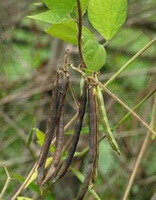 Botanical Description: Phaseolus angularis Wight is a plant of the Fabaceae family (Leguminosae, the legume or pea family) and the genus Vigna. It is also known as Phaseolus angularis (Willd.) W.F. Wight, Dolichos angularis Willd., or Vigna angularis (Willd.) Ohwi et Ohashi. Common names include Phaseolus angularis, rice bean, red bean, Chi Dou, etc. An annual erect or twining herb, growing upright or climbing, reaching 30–90 cm in height; stems are covered with white, long, hirsute hairs. Trifoliolate leaves; stipules (leaf-like appendages at the base of the petiole) are lanceolate and covered with white, long, pilose hairs; stipels (small stipule-like structures at the base of leaflets) are linear; petioles reach up to 20 cm in length and are sparsely covered with long, pilose hairs; terminal leaflets (foliolules) are oval (egg-shaped), lateral leaflets are rhombic-ovate, 5–10 cm long and 3.5–7 cm wide; apex is mucronate or acuminate; base is triangular or orbicular; margin is entire or slightly 3-lobed; both surfaces are sparsely covered with long, pilose hairs; petiolules are very short; three basal veins present.
 URL QR code: