✵The article documents the herb Coix Seed, including its English name, Latin name, Pinyin name, properties and flavor, botanical source—specifically one plant species: (1) Coix lacryma-jobi L. var. ma-yuen (Romanet) Stapf.—and provides a detailed introduction to the botanical features, growth characteristics, and ecological environment of this species; the macroscopic and microscopic characteristics of the herb Coix Seed; its pharmacological actions; medicinal efficacy; and administration guidelines.
Semen Coicis (Coix Seed, Job’s-tear Seed)
Pinyin Name: Yì Yǐ Rén
English Name: Coix Seed, Job’s-tear Seed
Latin Name:Semen Coicis Properties and Flavor: Slightly cold; bland (tasteless), sweet
Brief Introduction:Semen Coicis is the dried, ripe kernel obtained by removing the hard husk and seed coat of Coix lacryma-jobi L. var. ma-yuen (Romanet) Stapf. It is used: (1) to strengthen the spleen and resolve dampness for diarrhea and edema; (2) to clear heat and discharge pus in lung abscess and acute appendicitis; and (3) to treat verruca plana. Common names include Semen Coicis, Coix Seed, Job’s-tear Seed, and Yì Yǐ Rén.
Botanical Source: Classical herbal works define Semen Coicis (Coix Seed, Job’s-tear Seed) as the dried, ripe kernel derived from Coix lacryma-jobi L. var. ma-yuen (Romanet) Stapf., a plant of the genus Coix, family Poaceae (Gramineae, grass family), order Poales. This widely used species is described below:
(1) Coix lacryma-jobi L. var. ma-yuen (Romanet) Stapf.
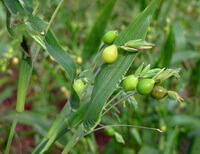
Botanical Description:Coix lacryma-jobi L. var. ma-yuen (Romanet) Stapf.—also known as C. ma-yuen Romanet or C. lacryma-jobi L. var. frumentacea Makino—is a member of the Poaceae family (Gramineae, grass family) and genus Coix. Common names include tear grass and Yì Yǐ. It is an annual or perennial herb, 1–1.5 meters tall. Fibrous roots are relatively thick, up to 3 mm in diameter. The culm is erect, with approximately 10 nodes. Leaf blades are linear-lanceolate, up to 30 cm long and 1.5–3 cm wide; margins are scabrous (rough), and the midrib is thick and prominently raised on the abaxial surface. Leaf sheaths are smooth; upper sheaths are shorter than the internodes. The ligule is rigid, ~1 mm long.
Inflorescences are axillary racemes, grow in clusters. Female spikelets occupy the lower portion of the inflorescence and are enclosed by a hardened, bead-like general involucre approximately equal in length to the spikelet. In fertile spikelets, the first glume is membranous at the base and thickened, chartaceous (papery) above, with an obtuse apex; the second glume is scaphiform (boat-shaped). The second inferior palea is shorter than the first inferior palea; the palea resembles the inferior palea but is smaller. There are three stamens, a staminode, and a pistil with a long style. Infertile spikelets are reduced to tubular glumes; two or three male spikelets typically arise at the first node. In sessile spikelets, the first glume is flattened, with both sides folded toward the midrib and bearing unequal wings; the second glume is scaphiform; both the inferior palea and palea are membranous. There are three stamens. Sessile spikelets resemble subsessile ones but are smaller or degenerate.
The caryopsis is enclosed by a hard general involucre and is oval (egg-shaped) or ovoid. Flowering occurs from July to September; fruiting from September to October.
Ecological Environment:Coix lacryma-jobi grows near dwellings, in wilderness areas, along rivers and streams, and in moist valleys. It is distributed and cultivated throughout China. Native to Southeast Asia, it is grown as an annual in gardens elsewhere and has become naturalized in the southern United States and tropical regions.
Growth Characteristics:Coix lacryma-jobi prefers warm, humid climates and is drought-sensitive but fertilizer-tolerant. It thrives in various soil types, exhibiting strong tolerance to salinity and waterlogging in saline-alkali soils and marshlands. Optimal cultivation occurs in sunny, fertile fields—particularly loamy or clay soils. Continuous cropping should be avoided, and rotation with other Gramineae (grass-family) crops is not recommended.
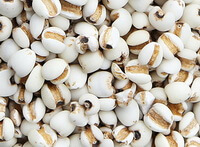
Characteristics of the Herb: The kernel is broadly ovate or oblong-ovoid, 4–8 mm long and 3–6 mm wide. The surface is creamy white (milky white), smooth, and occasionally retains patches of tawny (yellowish-brown) seed coat. One end is blunt and rounded; the other is broader and emarginate (slightly notched), bearing a pale brown, punctate hilum. The dorsal surface is convex and rounded; a broad, deep longitudinal groove runs along the ventral surface. The texture is solid and firm; the fracture surface is white and mealy. It has a faint odor and a slightly sweet taste.
Pharmacological Actions: (1) Anticancer and antimicrobial effects; (2) Analgesic effect; (3) Hypoglycemic and antipyretic effects.
Medicinal efficacy: Strengthens the spleen and resolves dampness; alleviates arthralgia and diarrhea; relaxes tendons and dispels numbness; clears heat and discharges pus; moistens the lungs; clears heat and resolves dampness via diuresis. It is indicated for dysuria (difficulty in urination), dribbling urine, fixed-damp arthralgia, rheumatic arthralgia, damp-heat syndrome, diarrhea, leukorrhea, spleen-deficiency diarrhea, turbid strangury, leukorrhea, muscular spasm, impaired flexion and extension, periappendiceal abscess (acute appendicitis), atrophic lung disease, pulmonary abscess, edema, beriberi, and verruca plana.
Administration of Semen Coicis (Yì Yǐ Rén):
Reference:
Administration Guide of Semen Coicis (Yì Yǐ Rén)
TCM Books:
(1) Internally: 9–30 grams; (2) Internally: water decoction, 0.3–1 liang (≈9–30 grams), or prepare to powder; (3) Internally: water decoction, 10–30 grams, or prepared as pills, powder, wine infusions, congee (rice porridge), or thick decoctions.
Precautions and Adverse Reactions: Semen Coicis should be used with caution in cases of spleen-deficiency constipation and during pregnancy.

 ✵The article documents the herb Coix Seed, including its English name, Latin name, Pinyin name, properties and flavor, botanical source—specifically one plant species: (1) Coix lacryma-jobi L. var. ma-yuen (Romanet) Stapf.—and provides a detailed introduction to the botanical features, growth characteristics, and ecological environment of this species; the macroscopic and microscopic characteristics of the herb Coix Seed; its pharmacological actions; medicinal efficacy; and administration guidelines.
 Pinyin Name: Yì Yǐ Rén
 Botanical Description: Coix lacryma-jobi L. var. ma-yuen (Romanet) Stapf.—also known as C. ma-yuen Romanet or C. lacryma-jobi L. var. frumentacea Makino—is a member of the Poaceae family (Gramineae, grass family) and genus Coix. Common names include tear grass and Yì Yǐ. It is an annual or perennial herb, 1–1.5 meters tall. Fibrous roots are relatively thick, up to 3 mm in diameter. The culm is erect, with approximately 10 nodes. Leaf blades are linear-lanceolate, up to 30 cm long and 1.5–3 cm wide; margins are scabrous (rough), and the midrib is thick and prominently raised on the abaxial surface. Leaf sheaths are smooth; upper sheaths are shorter than the internodes. The ligule is rigid, ~1 mm long.
 Ecological Environment: Coix lacryma-jobi grows near dwellings, in wilderness areas, along rivers and streams, and in moist valleys. It is distributed and cultivated throughout China. Native to Southeast Asia, it is grown as an annual in gardens elsewhere and has become naturalized in the southern United States and tropical regions.
 Growth Characteristics: Coix lacryma-jobi prefers warm, humid climates and is drought-sensitive but fertilizer-tolerant. It thrives in various soil types, exhibiting strong tolerance to salinity and waterlogging in saline-alkali soils and marshlands. Optimal cultivation occurs in sunny, fertile fields—particularly loamy or clay soils. Continuous cropping should be avoided, and rotation with other Gramineae (grass-family) crops is not recommended.
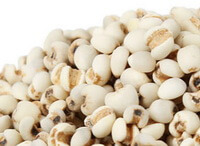 Characteristics of the Herb: The kernel is broadly ovate or oblong-ovoid, 4–8 mm long and 3–6 mm wide. The surface is creamy white (milky white), smooth, and occasionally retains patches of tawny (yellowish-brown) seed coat. One end is blunt and rounded; the other is broader and emarginate (slightly notched), bearing a pale brown, punctate hilum. The dorsal surface is convex and rounded; a broad, deep longitudinal groove runs along the ventral surface. The texture is solid and firm; the fracture surface is white and mealy. It has a faint odor and a slightly sweet taste.
 URL QR code: