Introduction of Fén Bì Xiè: Hypoglaucous Yam Rhizome
✵This article documents the herb Hypoglaucous Yam Rhizome, including its English name, Latin name, Pinyin name, properties and flavor, botanical source—the single plant species (1) Dioscorea hypoglauca Palib.—and provides a detailed description of its botanical features, growth characteristics, ecological environment, macroscopic characteristics of the dried rhizome, pharmacological actions, medicinal efficacy, and administration guidelines.
Pinyin Name: Fěn Bì Xiè
English Name: Hypoglaucous Yam Rhizome
Latin Name:Rhizoma Dioscoreae Hypoglaucae Properties and Flavor: Neutral; bitter.
Brief Introduction:Rhizoma Dioscoreae Hypoglaucae is the dried rhizome of Dioscorea hypoglauca Palib. Its clinical applications are similar to those of Rhizoma Dioscoreae Septemlobae. Common names include Rhizoma Dioscoreae Hypoglaucae, Hypoglaucous Yam Rhizome, and Fěn Bì Xiè.
Botanical Source: Classical herbal works define Rhizoma Dioscoreae Hypoglaucae (Hypoglaucous Yam Rhizome) as the dried rhizome of (1) Dioscorea hypoglauca Palib. It belongs to the genus Dioscorea L., family Dioscoreaceae (yam family), order Liliales. This commonly used species is described below:
(1) Dioscorea hypoglauca Palib.
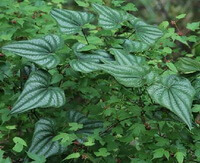
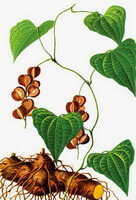
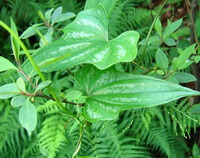
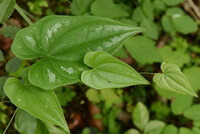
Botanical Description:Dioscorea hypoglauca Palib. is also known as Dioscorea collettii Hook. f. var. hypoglauca (Palibin) Péi et Ting, and is commonly known as Fěn Bēi Shǔ Yù (meaning “pink-backed Dioscorea rhizome”). It is a perennial twining herbaceous vine. Rhizomes are amphitropous, ginger-root–shaped, with a ginger-colored fracture surface; numerous fibrous roots grow on the surface. The stem is sinistrorse, glabrous, and sometimes densely covered with yellow pubescence. Leaves are simple and alternate; leaf blades are triangular-cordate or ovate-lanceolate, with an acuminate apex and undulate or subentire margins; the abaxial surface is ash gray (grayish-white), covered with yellowish-white hirsuteness along the veins and margins; in some plants, the margin is translucent and scarious, turning black upon drying.
The plant is dioecious. Male inflorescences are solitary or occur in clusters of 2–3 in leaf axils; male flowers are sessile, with 2–3 flowers tufted at the base of the inflorescence and often solitary at the apex. Floral bracts are ovate-lanceolate; bracteoles are ovoid (egg-shaped), with an acuminate apex, sometimes 2-lobed; the perianth is phialiform (disc-shaped), with a 6-lobed tip; lobes are yellow when fresh but turn black upon drying—though occasionally a few remain unchanged. There are 3 stamens inserted on the perianth tube; filaments are short; anthers are ovoid, with the septum widening after flowering to about half the length of the anthers, forming a short, fork-shaped structure; staminodes—when present—are filamentous and alternate with the 3 fertile stamens. Female inflorescences are spicate; staminodes in female flowers are filamentous; the ovary is long-cylindrical, with a 3-lobed stigma. Flowers are solitary; the ovary is inferior; the stigma is 3-lobed; and staminodes are filamentous.
The capsule fruit has 3 wings, is truncate at both ends, and typically exhibits equal width at the apex and base; the surface is chestnut-brown and glossy, retroflexed and pendulous at maturity; it contains 2 seeds inserted midway along the fruit axis, each surrounded by a membranous wing at maturity. Flowering occurs from May to August; fruiting occurs from June to October.
Ecological Environment: The plant grows at forest edges—particularly in mixed or sparse forests—on steep mountain slopes, gentle valley slopes, or shaded gullies, at elevations of 200–1,300 meters above sea level.
Growth Characteristics: Cultivation requires deep, sandy loam soil that is loose, fertile, well-drained, moisture-retentive, and rich in organic matter and nutrients. Soil pH should be neutral to slightly acidic.
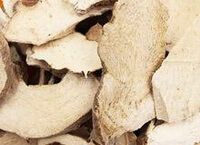
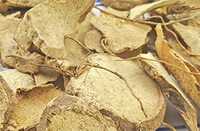
Characteristics of the Herb: Rhizomes are bamboo-like, cylindrical, and branched, with a wrinkled surface bearing residual withered scars and attached tender fibrous roots. Slices are irregular in shape and size, approximately 0.5 mm thick, with uneven edges; some exhibit brownish-black or taupe-brown bark. The fracture surface is yellowish-white or pale grayish-brown, flat, fine-textured, and powdery, with scattered vascular bundles appearing as small dots—highly conspicuous under light. The herb is loosely textured, slightly elastic, and easily broken. It has a faint odor and a bitter, slightly pungent taste.
Medicinal Efficacy: Promotes diuresis to remove dampness, clears turbidity, dispels wind, and alleviates arthralgia. Indicated for stranguria due to chyluria, gonorrhea or white turbidity, profuse leukorrhea, rheumatic arthralgia and pain, joint stiffness, and lumbocrural pain (pain in the lumbar and knee regions).
Administration of Rhizoma Dioscoreae Hypoglaucae (Fěn Bì Xiè):
Reference:
Administration Guide of Rhizoma Dioscoreae Hypoglaucae (Fěn Bì Xiè)
TCM Books:
(1) Internally: 9–15 grams.
Article Link:
URL QR code:
References:
1.Introduction of Fén Bì Xiè: Hypoglaucous Yam Rhizome.

 ✵This article documents the herb Hypoglaucous Yam Rhizome, including its English name, Latin name, Pinyin name, properties and flavor, botanical source—the single plant species (1) Dioscorea hypoglauca Palib.—and provides a detailed description of its botanical features, growth characteristics, ecological environment, macroscopic characteristics of the dried rhizome, pharmacological actions, medicinal efficacy, and administration guidelines.
 Pinyin Name: Fěn Bì Xiè
 Botanical Description: Dioscorea hypoglauca Palib. is also known as Dioscorea collettii Hook. f. var. hypoglauca (Palibin) Péi et Ting, and is commonly known as Fěn Bēi Shǔ Yù (meaning “pink-backed Dioscorea rhizome”). It is a perennial twining herbaceous vine. Rhizomes are amphitropous, ginger-root–shaped, with a ginger-colored fracture surface; numerous fibrous roots grow on the surface. The stem is sinistrorse, glabrous, and sometimes densely covered with yellow pubescence. Leaves are simple and alternate; leaf blades are triangular-cordate or ovate-lanceolate, with an acuminate apex and undulate or subentire margins; the abaxial surface is ash gray (grayish-white), covered with yellowish-white hirsuteness along the veins and margins; in some plants, the margin is translucent and scarious, turning black upon drying.
 The plant is dioecious. Male inflorescences are solitary or occur in clusters of 2–3 in leaf axils; male flowers are sessile, with 2–3 flowers tufted at the base of the inflorescence and often solitary at the apex. Floral bracts are ovate-lanceolate; bracteoles are ovoid (egg-shaped), with an acuminate apex, sometimes 2-lobed; the perianth is phialiform (disc-shaped), with a 6-lobed tip; lobes are yellow when fresh but turn black upon drying—though occasionally a few remain unchanged. There are 3 stamens inserted on the perianth tube; filaments are short; anthers are ovoid, with the septum widening after flowering to about half the length of the anthers, forming a short, fork-shaped structure; staminodes—when present—are filamentous and alternate with the 3 fertile stamens. Female inflorescences are spicate; staminodes in female flowers are filamentous; the ovary is long-cylindrical, with a 3-lobed stigma. Flowers are solitary; the ovary is inferior; the stigma is 3-lobed; and staminodes are filamentous.
 Ecological Environment: The plant grows at forest edges—particularly in mixed or sparse forests—on steep mountain slopes, gentle valley slopes, or shaded gullies, at elevations of 200–1,300 meters above sea level.
 Characteristics of the Herb: Rhizomes are bamboo-like, cylindrical, and branched, with a wrinkled surface bearing residual withered scars and attached tender fibrous roots. Slices are irregular in shape and size, approximately 0.5 mm thick, with uneven edges; some exhibit brownish-black or taupe-brown bark. The fracture surface is yellowish-white or pale grayish-brown, flat, fine-textured, and powdery, with scattered vascular bundles appearing as small dots—highly conspicuous under light. The herb is loosely textured, slightly elastic, and easily broken. It has a faint odor and a bitter, slightly pungent taste.
 Medicinal Efficacy: Promotes diuresis to remove dampness, clears turbidity, dispels wind, and alleviates arthralgia. Indicated for stranguria due to chyluria, gonorrhea or white turbidity, profuse leukorrhea, rheumatic arthralgia and pain, joint stiffness, and lumbocrural pain (pain in the lumbar and knee regions).
 URL QR code: