✵The article records the herb Virgate Wormwood Herb—including its English name, Latin name, Pinyin name, property and flavor—as well as its botanical sources: two plant species, (1) Artemisia capillaris Thunb. and (2) Artemisia scoparia Waldst. et Kit. It provides a detailed introduction to the botanical features, growth characteristics, and ecological environments of these two species; the morphological and medicinal features of Virgate Wormwood Herb; its pharmacological actions, medicinal efficacy, and administration guide.
Pinyin Name: Yīn Chén
English Name: Virgate Wormwood Herb, Capillary Wormwood Herb
Latin Name:Herba Artemisiae Scophariae Property and Flavor: cold, bitter
Brief Introduction:Herba Artemisiae Scopariae is the dried young shoot or flowering top of Artemisia scoparia Waldst. et Kit. or Artemisia capillaris Thunb., used to eliminate damp-heat in the liver and gallbladder for the treatment of jaundice and eczema. The herb is commonly known as Herba Artemisiae Scopariae, Virgate Wormwood Herb, or Yīn Chén.
Botanical Source:Herba Artemisiae Scopariae (Virgate Wormwood Herb) is the dried young shoot or flowering top of Artemisia scoparia Waldst. et Kit. or Artemisia capillaris Thunb.—plants of the genus Artemisia, family Asteraceae (Compositae, daisy family), order Asterales. These two commonly used species are introduced below:
(1) Artemisia capillaris Thunb.
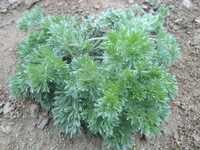
Botanical Description:Artemisia capillaris Thunb. is a plant of the Asteraceae family (Compositae, daisy family) and the genus Artemisia; it is commonly known as Artemisia capillaris or Yin Chen Hao. It is a suffrutescent perennial herb with a strong aroma. The main root is ligneous (woody), elongated vertically or obliquely pendulous; the rhizome is 5–8 mm in diameter, upright, sparsely slanted upward or prostrate, and often bears fine vegetative shoots. A few stems grow in clusters and slant upward; the first-year stem is usually solitary, with a stout base and a higher degree of lignification than Artemisia scoparia Waldst. et Kit. Occasionally, the middle trichiform lobules are slender, straight, and longer—reaching up to 2.5 cm.
Stems and branches at the early growth stage are densely covered with hoary (ash-gray) or grayish-yellow sericeous fluff (silky soft hairs); the pubescence becomes sparse later.
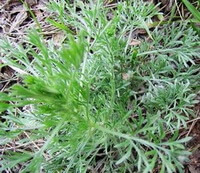
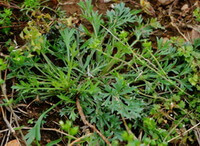
Dense leaf clusters occur at the branch tips, and basal leaves often form rosettes. Basal leaves, lower-stem leaves, and the surfaces of foliage-branch (vegetative shoot) leaves are covered with brownish-yellow or grayish-yellow sericeous fluff (silky pubescence); lower-stem leaves tend to abscise. Leaves are ovoid or ovate-elliptic, 2–5 cm long and 1.5–3.5 cm wide, bipinnatisect, with 2–3 (sometimes 4) lobes on each side; each lobe is 3–5-parted; lobelets (lobules) are linear or linear-lanceolate—usually straight and not curved—5–10 mm long and 0.5–2 mm wide; petioles are 3–7 mm long and axillary. Middle-stem leaves are broad-ovate, orbicular, or ovoid, 2–3 cm long and 1.5–2.5 cm wide, pinnatisect to bipinnatisect; lobelets are linear or thread-like—typically thin, straight, and not curved—8–12 mm long and 0.3–1 mm wide; the surface is glabrate; basal lobes are usually half-amplexicaul (stem-clasping). Upper leaves and bract leaves are 5-pinnatisect or tripinnatisect.
Capitula (flower heads) are ovoid, rarely subsphaeroidal, numerous, 1.5–2 mm in diameter, grow on short pedicels with linear bracteoles; they grow outward at the upper ends of branches or twig tips, arranged in compound racemes that collectively form large, expansive panicles at the stem apices. The phyllaries (general involucre) are primrose yellow (pale yellow) and glabrous; each capitulum contains 6–10 male flowers and 3–7 hermaphroditic flowers. Achenes are oblong or long-ovate, up to 1 mm long. The flowering period extends from July to October.
Ecological Environment:Artemisia capillaris Thunb. grows on riverbanks at low altitudes, humid sandy soils near beaches, roadsides, and low hillsides or gentle mountain slopes. It is predominantly distributed in China and also occurs widely worldwide.
Growth Characteristics: The plant prefers a warm, humid climate and exhibits strong environmental adaptability. For cultivation, it is advisable to select sunny fields with deep, loose, fertile, well-drained sandy loam soil.
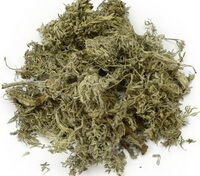
Characteristics of the Herb: Most specimens are curled into balls, ash-gray (grayish-white) or celadon (sage-green) in color, densely covered with white tomentum and velvety to touch. The stem is slender and cylindrical, highly branched, 30–100 cm long and 2–8 mm in diameter; its surface is mauve (lilac) or purple, pubescent, with an off-white fracture surface. Leaves are mostly abscised; lower leaves are 2–3-pinnately parted, with strap-shaped lobes; both surfaces bear white pubescence. Cauline leaves are pinnatisect to bipinnatisect, with amplexicaul (stem-clasping) bases and filamentous lobes. Capitula (flower heads) are ovoid (egg-shaped), 1.2–1.5 cm long and 1–1.2 mm in diameter, grow on short pedicels; phyllaries are arranged in 3–4 series—the outer series typically bears 6–10 female flowers, while the inner series bears 2–9 hermaphroditic flowers. Achenes are oblong and yellowish-brown. The herb possesses a fragrant aroma and a slightly bitter taste. High-grade herb material is fresh, soft, ash-gray (hoary), and strongly aromatic.
Pharmacological Actions: (1) Choleretic and hepatoprotective effects; (2) Hypolipidemic and antihypertensive effects; (3) Anti-atherosclerotic effect; (4) Analgesic and anti-inflammatory effects; (5) Antimicrobial activity—with inhibitory effects against most bacilli and certain dermatophytes, ECHO virus, and influenza virus; it completely (100%) inhibits Aspergillus flavus mycelial growth and suppresses sterigmatocystin production.
Medicinal efficacy: Clears heat and dampness, promotes diuresis to resolve damp-heat, and resolves jaundice. It is indicated for jaundice, oliguria, damp sores, pruritus, and infectious icteric hepatitis.
Administration of Herba Artemisiae Scophariae (Yīn Chén):
Reference:
Administration Guide for Herba Artemisiae Scophariae (Yīn Chén)
TCM Books:
(1) Internally: 6–15 grams; externally: appropriate amount, used as fumigation or wash with water decoction. (2) Internally: water decoction, 3–5 qian (≈9–15 grams); externally: wash with water decoction. (3) Internally: water decoction, 10–15 grams, or prepared as pills or powder; externally: appropriate amount, used as wash with water decoction.
(2) Artemisia scoparia Waldst. et Kit.
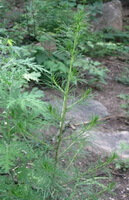
Botanical Description:Artemisia scoparia Waldst. et Kit. is also known as Artemisia capillaris Thunb. var. scoparia Pamp. (A. capillaris Thunb. var. scoparia Pamp.), a plant of the Asteraceae family (Compositae, daisy family) and genus Artemisia. It is commonly known as virgate wormwood or Zhū Máo Hāo (“Pig Hair Wormwood”). An annual to biennial or perennial herb, it has a strong aromatic odor. The main root is fusiform (spindle-shaped) or conical and mostly erect. The whole plant is covered with ash-gray silky pubescence; mature plants reach 45–100 cm in height. The stem is usually solitary, occasionally 2–4 in number, with a frequently lignified base. The surface is purple or yellowish-green, bearing longitudinal stripes; the stem is much branched. Older branches are glabrate; younger branches and fresh twigs are densely covered with grayish-white silky pubescence. Sterile shoots sometimes bear large, dense leaves. Leaves are densely arranged: basal leaves resemble those on sterile shoots, with long petioles; they are oblong, 1.5–5 cm long, bipinnatisect to tripinnatisect, with lanceolate or linear terminal lobes, acute apices, and often silky pubescent—or sparsely so—on the upper surface. Middle stem leaves are 1–2 cm long, bipinnatisect, with amplexicaul (stem-clasping) bases; lobes are linear or capillary, pilose or glabrous. Upper stem leaves are sessile, 3-lobed or entire, with short, capillary lobes.
Capitula (flower heads) are abundant, pedunculate, and arranged in compound racemes on lateral branches of the stem. Phyllaries are ovoid or subglobose, 1–2 mm in diameter; involucral bracts are arranged in 3–5 series, with 3 bracts per series, imbricate, ovoid, elliptic, oblong, or broadly ovate, with obtuse apices. Outer bracts are short and small; inner bracts are larger, with membranous margins and green, glabrate abaxial surfaces. Flowers are hermaphroditic; all are tubular florets. Outer florets number 5–15 (usually 10–12) pistillate, fertile, with bifurcated, ramose styles that exsert beyond the corolla. Inner florets number 3–9, hermaphroditic, with slightly enlarged, 5-lobed apices; lobes are triangular—sometimes purplish—and the lower portion is constricted, obovate; ovaries are degenerate and sterile.
Achenes are small, oblong or obovate, ~0.7 mm long, longitudinally striate, and glabrous. Flowering occurs from August to September; fruiting from September to October.
Growth Characteristics:Artemisia scoparia grows on hillsides and mountain slopes, in wilderness, along roadsides, at forest edges, in grasslands of semi-arid or semi-humid regions, on the Loess Plateau, and at desert margins. It is widely distributed across rural China.
Characteristics of the Herb: Crude material is curled into balls or compact masses, ash-gray (grayish-white) or celadon (grayish-green) in color; the whole herb is densely covered with white pubescence and feels velvety soft. Stems are slender, 1.5–2.5 cm long and 0.1–0.2 cm in diameter; conspicuous longitudinal stripes become visible upon removal of the white pubescence. The herb is brittle and easily broken. Leaves are petiolate; flattened leaves measure 1–3 cm in length; lobelets are ovoid or slightly oblanceolate and strap-shaped, with acute apices. The herb possesses a fragrant odor and tastes slightly bitter.

 ✵The article records the herb Virgate Wormwood Herb—including its English name, Latin name, Pinyin name, property and flavor—as well as its botanical sources: two plant species, (1) Artemisia capillaris Thunb. and (2) Artemisia scoparia Waldst. et Kit. It provides a detailed introduction to the botanical features, growth characteristics, and ecological environments of these two species; the morphological and medicinal features of Virgate Wormwood Herb; its pharmacological actions, medicinal efficacy, and administration guide.
 Pinyin Name: Yīn Chén
 Botanical Description: Artemisia capillaris Thunb. is a plant of the Asteraceae family (Compositae, daisy family) and the genus Artemisia; it is commonly known as Artemisia capillaris or Yin Chen Hao. It is a suffrutescent perennial herb with a strong aroma. The main root is ligneous (woody), elongated vertically or obliquely pendulous; the rhizome is 5–8 mm in diameter, upright, sparsely slanted upward or prostrate, and often bears fine vegetative shoots. A few stems grow in clusters and slant upward; the first-year stem is usually solitary, with a stout base and a higher degree of lignification than Artemisia scoparia Waldst. et Kit. Occasionally, the middle trichiform lobules are slender, straight, and longer—reaching up to 2.5 cm.
 Dense leaf clusters occur at the branch tips, and basal leaves often form rosettes. Basal leaves, lower-stem leaves, and the surfaces of foliage-branch (vegetative shoot) leaves are covered with brownish-yellow or grayish-yellow sericeous fluff (silky pubescence); lower-stem leaves tend to abscise. Leaves are ovoid or ovate-elliptic, 2–5 cm long and 1.5–3.5 cm wide, bipinnatisect, with 2–3 (sometimes 4) lobes on each side; each lobe is 3–5-parted; lobelets (lobules) are linear or linear-lanceolate—usually straight and not curved—5–10 mm long and 0.5–2 mm wide; petioles are 3–7 mm long and axillary. Middle-stem leaves are broad-ovate, orbicular, or ovoid, 2–3 cm long and 1.5–2.5 cm wide, pinnatisect to bipinnatisect; lobelets are linear or thread-like—typically thin, straight, and not curved—8–12 mm long and 0.3–1 mm wide; the surface is glabrate; basal lobes are usually half-amplexicaul (stem-clasping). Upper leaves and bract leaves are 5-pinnatisect or tripinnatisect.
 Capitula (flower heads) are ovoid, rarely subsphaeroidal, numerous, 1.5–2 mm in diameter, grow on short pedicels with linear bracteoles; they grow outward at the upper ends of branches or twig tips, arranged in compound racemes that collectively form large, expansive panicles at the stem apices. The phyllaries (general involucre) are primrose yellow (pale yellow) and glabrous; each capitulum contains 6–10 male flowers and 3–7 hermaphroditic flowers. Achenes are oblong or long-ovate, up to 1 mm long. The flowering period extends from July to October.
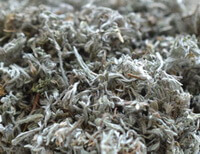 Characteristics of the Herb: Most specimens are curled into balls, ash-gray (grayish-white) or celadon (sage-green) in color, densely covered with white tomentum and velvety to touch. The stem is slender and cylindrical, highly branched, 30–100 cm long and 2–8 mm in diameter; its surface is mauve (lilac) or purple, pubescent, with an off-white fracture surface. Leaves are mostly abscised; lower leaves are 2–3-pinnately parted, with strap-shaped lobes; both surfaces bear white pubescence. Cauline leaves are pinnatisect to bipinnatisect, with amplexicaul (stem-clasping) bases and filamentous lobes. Capitula (flower heads) are ovoid (egg-shaped), 1.2–1.5 cm long and 1–1.2 mm in diameter, grow on short pedicels; phyllaries are arranged in 3–4 series—the outer series typically bears 6–10 female flowers, while the inner series bears 2–9 hermaphroditic flowers. Achenes are oblong and yellowish-brown. The herb possesses a fragrant aroma and a slightly bitter taste. High-grade herb material is fresh, soft, ash-gray (hoary), and strongly aromatic.
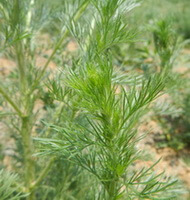 Botanical Description: Artemisia scoparia Waldst. et Kit. is also known as Artemisia capillaris Thunb. var. scoparia Pamp. (A. capillaris Thunb. var. scoparia Pamp.), a plant of the Asteraceae family (Compositae, daisy family) and genus Artemisia. It is commonly known as virgate wormwood or Zhū Máo Hāo (“Pig Hair Wormwood”). An annual to biennial or perennial herb, it has a strong aromatic odor. The main root is fusiform (spindle-shaped) or conical and mostly erect. The whole plant is covered with ash-gray silky pubescence; mature plants reach 45–100 cm in height. The stem is usually solitary, occasionally 2–4 in number, with a frequently lignified base. The surface is purple or yellowish-green, bearing longitudinal stripes; the stem is much branched. Older branches are glabrate; younger branches and fresh twigs are densely covered with grayish-white silky pubescence. Sterile shoots sometimes bear large, dense leaves. Leaves are densely arranged: basal leaves resemble those on sterile shoots, with long petioles; they are oblong, 1.5–5 cm long, bipinnatisect to tripinnatisect, with lanceolate or linear terminal lobes, acute apices, and often silky pubescent—or sparsely so—on the upper surface. Middle stem leaves are 1–2 cm long, bipinnatisect, with amplexicaul (stem-clasping) bases; lobes are linear or capillary, pilose or glabrous. Upper stem leaves are sessile, 3-lobed or entire, with short, capillary lobes.
 Capitula (flower heads) are abundant, pedunculate, and arranged in compound racemes on lateral branches of the stem. Phyllaries are ovoid or subglobose, 1–2 mm in diameter; involucral bracts are arranged in 3–5 series, with 3 bracts per series, imbricate, ovoid, elliptic, oblong, or broadly ovate, with obtuse apices. Outer bracts are short and small; inner bracts are larger, with membranous margins and green, glabrate abaxial surfaces. Flowers are hermaphroditic; all are tubular florets. Outer florets number 5–15 (usually 10–12) pistillate, fertile, with bifurcated, ramose styles that exsert beyond the corolla. Inner florets number 3–9, hermaphroditic, with slightly enlarged, 5-lobed apices; lobes are triangular—sometimes purplish—and the lower portion is constricted, obovate; ovaries are degenerate and sterile.
 URL QR code:

