Introduction of Chui Pen Cao: Stringy Stonecrop Herb
✵This article documents the herb Stringy Stonecrop Herb, including its English name, Latin name, Pinyin name, properties and flavors, botanical source—namely, a single plant species: (1) Sedum sarmentosum Bunge—and provides a detailed description of the plant’s botanical features, growth characteristics, ecological environment, as well as the macroscopic characteristics of the herb, its pharmacological actions, medicinal efficacy, and administration guidelines.
Herba Sedi (Stringy Stonecrop Herb)
Pinyin Name: Chuí Pén Cǎo
English Name: Stringy Stonecrop Herb
Latin Name:Herba Sedi, or Herba Sedi Sarmentosi Properties and Flavors: Cool, sweet, bland, slightly sour
Brief Introduction:Herba Sedi is the fresh or dried whole plant of Sedum sarmentosum Bunge, used to clear damp-heat and detoxify. It is indicated for acute and chronic hepatitis, jaundice, boils, and sores. Commonly known as Stringy Stonecrop Herb, Chuí Pén Cǎo, or Herba Sedi.
Botanical Source: Classical herbal works define Herba Sedi (Stringy Stonecrop Herb) as the fresh or dried whole plant of (1) Sedum sarmentosum Bunge, a species of the genus Sedum L., family Crassulaceae (orpine or stonecrop family), order Rosales. This widely used species is described below:
(1) Sedum sarmentosum Bunge.
Botanical Description:Sedum sarmentosum Bunge is also known as Sedum sheareri S. Moore. It is commonly called Stringy Stonecrop, Chuí Pén Cǎo, Pú Xíng Jǐng Tiān (also known as Wò Jǐng Jǐng Tiān or Pá Jǐng Tiān, meaning “creeping stonecrop”), and Yě Mǎ Chǐ Xiān (meaning “wild purslane”). A perennial succulent herb; the whole plant is glabrous. Roots are fibrous. Sterile stems are procumbent, 10–25 cm long; nodes near the ground readily decay. Leaves are usually arranged in whorls of three; leaf blades are oblanceolate to oblong, 1.5–2.5 cm long and 3–7 mm wide; apices are acute; bases are decurrent, narrow, and calcarate; margins are entire.
Cymes are terminal, with 3–5 branches; flowers are small and sessile. Sepals are 5-lobed, broadly lanceolate, unequal in length, 3.5–5 mm long. Petals number five, yellow, lanceolate to oblong, 5–8 mm long. Stamens number ten, arranged in two whorls, shorter than the petals. Five nectary scales are cuneate (wedge-shaped) and square, with slightly emarginate apices. Carpels number five, oblong, slightly bifurcated, 5–6 mm long.
Follicles contain numerous minute seeds. Seeds are ovoid; their surfaces bear small papillae. Flowering occurs from May to July; fruiting from July to August.
Ecological Environment: The plant grows on sunny hillsides and mountain slopes, in rock crevices, gullies, and along moist roadsides, at elevations below 1,600 m above sea level.
Growth Characteristics:Sedum sarmentosum prefers shady, humid or damp environments and is cold-tolerant. It thrives best in fertile, sandy loam soils.
Characteristics of the Herb: The dried herb is slightly curled and shriveled. Roots are thin and short. Stems are slender, brownish-green, 4–8 cm long (occasionally exceeding 20 cm), and 1–2 mm in diameter. More than ten slightly raised, brown, annular nodes are present on the stems; some nodes bear adventitious roots, and inflorescences may appear at the apex. The herb is tough or brittle; the fracture surface shows a primrose-yellow (pale yellow) center. Leaves are shriveled, fragile, and easily detached; intact leaves are oblanceolate to oblong, brownish-green, 1.5–2.8 cm long and 0.3–0.7 cm wide. The inflorescence is cymose; small flowers are yellowish-white. The herb has a faint odor and tastes slightly bitter.
Pharmacological Actions: (1) Antibacterial activity: strong inhibition of Staphylococcus albus, moderate inhibition of Staphylococcus aureus, and mild inhibitory effects on Escherichia coli, Salmonella typhi, Pseudomonas aeruginosa, Streptococcus spp., Candida albicans, and Shigella flexneri; (2) hepatoprotective effect and reduction of serum alanine aminotransferase (ALT).
Medicinal Efficacy: The herb clears heat and dampness, detoxifies, reduces swelling, and lowers serum alanine aminotransferase (ALT). It is indicated for damp-heat jaundice, dysuria, gonorrhea, carbuncles, furuncles, ulcerated sores, acute and chronic hepatitis, persistent hepatitis, diarrhea and dysentery, pulmonary abscess, acute appendicitis, sore throat, furuncular swelling and toxicity, snake or insect bites, burns (thermal or scald), pharyngeal swelling and pain, dental ulcers, eczema, and herpes zoster.
Administration of Herba Sedi (Chuí Pén Cǎo):
Reference:
Administration Guide of Herba Sedi (Chuí Pén Cǎo)
TCM Books:
(1) Internally: dried herb, 15–30 grams; fresh herb, 250 grams; (2) Internally: water decoction, 15–30 grams; fresh herb, 50–100 g; or juice extracted and taken orally. Externally: appropriate amount—mashed fresh herb applied topically; or ground herb powder sprinkled or smeared; or juice applied topically; or water decoction used for external wash or compress.
Article Link:
URL QR code:
References:
1.Introduction of Chui Pen Cao: Stringy Stonecrop Herb

 ✵This article documents the herb Stringy Stonecrop Herb, including its English name, Latin name, Pinyin name, properties and flavors, botanical source—namely, a single plant species: (1) Sedum sarmentosum Bunge—and provides a detailed description of the plant’s botanical features, growth characteristics, ecological environment, as well as the macroscopic characteristics of the herb, its pharmacological actions, medicinal efficacy, and administration guidelines.
 Pinyin Name: Chuí Pén Cǎo
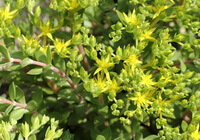 Botanical Description: Sedum sarmentosum Bunge is also known as Sedum sheareri S. Moore. It is commonly called Stringy Stonecrop, Chuí Pén Cǎo, Pú Xíng Jǐng Tiān (also known as Wò Jǐng Jǐng Tiān or Pá Jǐng Tiān, meaning “creeping stonecrop”), and Yě Mǎ Chǐ Xiān (meaning “wild purslane”). A perennial succulent herb; the whole plant is glabrous. Roots are fibrous. Sterile stems are procumbent, 10–25 cm long; nodes near the ground readily decay. Leaves are usually arranged in whorls of three; leaf blades are oblanceolate to oblong, 1.5–2.5 cm long and 3–7 mm wide; apices are acute; bases are decurrent, narrow, and calcarate; margins are entire.
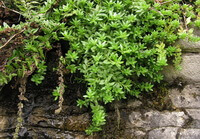 Ecological Environment: The plant grows on sunny hillsides and mountain slopes, in rock crevices, gullies, and along moist roadsides, at elevations below 1,600 m above sea level.
 Characteristics of the Herb: The dried herb is slightly curled and shriveled. Roots are thin and short. Stems are slender, brownish-green, 4–8 cm long (occasionally exceeding 20 cm), and 1–2 mm in diameter. More than ten slightly raised, brown, annular nodes are present on the stems; some nodes bear adventitious roots, and inflorescences may appear at the apex. The herb is tough or brittle; the fracture surface shows a primrose-yellow (pale yellow) center. Leaves are shriveled, fragile, and easily detached; intact leaves are oblanceolate to oblong, brownish-green, 1.5–2.8 cm long and 0.3–0.7 cm wide. The inflorescence is cymose; small flowers are yellowish-white. The herb has a faint odor and tastes slightly bitter.
 URL QR code:

