✵The article records information on the herb Dried Ginger, including its English name, Latin name, Pinyin name, properties and flavor, and botanical source—namely, Zingiber officinale (Willd.) Rosc. It provides a detailed introduction to the botanical features of this plant species, its growth characteristics and ecological environment, the characteristics of the herb Dried Ginger, its pharmacological actions, medicinal efficacy, and administration guidelines.
Rhizoma Zingiberis (Dried Ginger)
Pinyin Name: Gàn Jiānɡ
English Name: Dried Ginger
Latin Name:Rhizoma Zingiberis Properties and Flavor: Hot, pungent
Brief Introduction:Rhizoma Zingiberis is the dried rhizome of Zingiber officinale (Willd.) Rosc. It is used (1) to warm the spleen and stomach for relieving nausea, vomiting, abdominal pain, and diarrhea due to spleen- and stomach-deficiency-cold, and (2) to warm the lung for treating chronic cough with thin, white, foamy sputum. The herb is commonly known as Rhizoma Zingiberis, Dried Ginger, or Gàn Jiānɡ.
Botanical source: Classical herbal works define Rhizoma Zingiberis (Dried Ginger) as the dried rhizome of Zingiber officinale (Willd.) Rosc., a plant of the genus Zingiber, family Zingiberaceae (the ginger family), order Zingiberales. This widely used species is described below:
(1) Zingiber officinale (Willd.) Rosc.
Botanical Description:Zingiber officinale Rosc. is a perennial herb growing up to 50–80 cm tall. Its rhizomes are thick and fleshy, with a yellowish-white fracture surface and a strong spicy aroma. Leaves are alternate, arranged in two rows, sessile and amplexicaul (stem-clasping); the paraphyll is 2–4 mm long; leaf blades are lanceolate to linear-lanceolate, 15–30 cm long and 1.5–2.2 cm wide, with an acuminate apex and a narrow, sheath-like, amplexicaul base; both surfaces are glabrous.
Scapes arise from the rhizome, measuring 15–25 cm in length; inflorescences are elliptic spikes, 4–5 cm long. Bracts are ovate or ovoid, ~2.5 cm long, pale green with pale yellow margins and a mucronate apex. The hypanthium (calyx tube) is ~1 cm long and bears three mucronate teeth. The corolla is yellow-green; its tube is 2–2.5 cm long and divided into three lanceolate lobes, each less than 2 cm long. The central labellum is oblong-ovate and shorter than the corolla lobes, marked with purple stripes and pale yellow spots; the two lateral lobes are oval, yellow-green, and edged with purple. There is one stamen, dark purple in color; the anthers are ~9 mm long, and the connective appendages envelop the style. The ovary is trilocular and glabrous; there is one style, and the stigma is subglobose.
The fruit is a capsule containing numerous black seeds. Flowering occurs in August.
Ecological Environment: Zingiber is a creeping perennial native to tropical Southeast Asia and widely cultivated in China.
Growth Characteristics:Zingiber officinale Rosc. prefers a warm, humid climate; it is intolerant of low temperatures and frost, sensitive to excessive moisture, and susceptible to strong direct sunlight. It thrives best on gently sloping, slightly shaded land. Ideal cultivation sites have deep, loose, fertile, well-drained soils—ranging from sandy loam to heavy loam.
Fresh ginger rhizomes are a versatile ingredient in Eastern Asian cuisine and are now commonly used worldwide. Their flavor is lemony-balsamic, and their taste is moderately pungent.
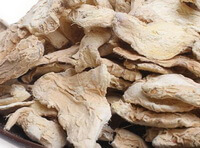
Characteristics of the Herb: Dried Ginger: The rhizome is an irregular, slightly flattened mass with finger-like branches, 3–7 cm long and 1–2 cm thick. The surface is taupe brown (grayish brown) or light yellowish brown, coarse and rough, bearing longitudinal wrinkles and prominent annular nodes. Remnants of scale leaves often persist on the branches, and stem scars or buds may be observed at the branch apices. The texture is firm and solid. The fracture surface is yellowish white or ash gray (grayish white), mealy (powdery) and granular, with a distinct endodermal ring, scattered vascular bundles, and yellow oil spots. The herb has a fragrant, characteristic odor and a spicy, pungent taste.
Dried Ginger Slices: These are irregular vertical or oblique slices of the rhizome, bearing finger-like branches, 1–6 cm long, 1–2 cm wide, and 0.2–0.4 cm thick. The outer skin is sallow (grayish yellow) or light yellowish brown, coarse and rough, with longitudinal wrinkles and conspicuous nodes. The cross-sectional surface is sallow (grayish yellow) or ash gray (grayish white), slightly mealy (powdery), and traversed by numerous longitudinal fibers—some bearing fine hairs. The texture is solid and firm; the fracture surface is fibrous. The herb possesses an aromatic, characteristic odor and a spicy, pungent taste.
Pharmacological Actions: (1) protective effect on gastric mucosal cells in rats; (2) hepatoprotective effect against liver damage; (3) transient blood pressure–elevating effect; (4) inhibition of spontaneous locomotor activity in rats; (5) cholagogue, analgesic, antiplatelet aggregation, anti-inflammatory, antibacterial, and antiprotozoal effects.
Medicinal Efficacy: Dried Ginger warms the spleen and stomach to dispel cold, restores yang and unblocks meridians, transforms dampness and resolves phlegm, and warms the lung to transform thin, watery phlegm. It is indicated for epigastric cold pain, cold pain in the chest and abdomen, vomiting and diarrhea, cold limbs with a weak pulse, yang collapse with cold extremities, phlegm-damp retention and wheezing-cough, wind-cold-damp bi syndrome, numbness and pain due to cold-damp obstruction, as well as vomiting, epistaxis, or other bleeding disorders arising from yang deficiency.
Administration of Rhizoma Zingiberis (Gàn Jiānɡ):
Reference:
Administration Guide for Rhizoma Zingiberis (Gàn Jiānɡ)
TCM Books:
(1) Internally: 3–9 grams; (2) Internally: water decoction, 0.5–1.5 qián (≈1.5–4.5 grams); (3) Internally: water decoction, 3–10 grams; or prepared as pills or powder. External use: Apply an appropriate amount—either as a wash with water decoction or as a topical paste made from powdered herb.
Contraindications, Precautions, and Adverse Reactions: Contraindicated in cases of heat-induced bleeding (hemopyretic bleeding). Use with caution during pregnancy. Should not be combined with Rhizoma Coptidis, Radix Scutellariae, or Faeces Trogopteri.

 ✵The article records information on the herb Dried Ginger, including its English name, Latin name, Pinyin name, properties and flavor, and botanical source—namely, Zingiber officinale (Willd.) Rosc. It provides a detailed introduction to the botanical features of this plant species, its growth characteristics and ecological environment, the characteristics of the herb Dried Ginger, its pharmacological actions, medicinal efficacy, and administration guidelines.
 Pinyin Name: Gàn Jiānɡ
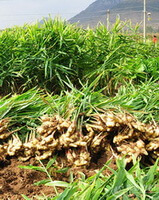 Botanical Description: Zingiber officinale Rosc. is a perennial herb growing up to 50–80 cm tall. Its rhizomes are thick and fleshy, with a yellowish-white fracture surface and a strong spicy aroma. Leaves are alternate, arranged in two rows, sessile and amplexicaul (stem-clasping); the paraphyll is 2–4 mm long; leaf blades are lanceolate to linear-lanceolate, 15–30 cm long and 1.5–2.2 cm wide, with an acuminate apex and a narrow, sheath-like, amplexicaul base; both surfaces are glabrous.
 The fruit is a capsule containing numerous black seeds. Flowering occurs in August.
 Characteristics of the Herb: Dried Ginger: The rhizome is an irregular, slightly flattened mass with finger-like branches, 3–7 cm long and 1–2 cm thick. The surface is taupe brown (grayish brown) or light yellowish brown, coarse and rough, bearing longitudinal wrinkles and prominent annular nodes. Remnants of scale leaves often persist on the branches, and stem scars or buds may be observed at the branch apices. The texture is firm and solid. The fracture surface is yellowish white or ash gray (grayish white), mealy (powdery) and granular, with a distinct endodermal ring, scattered vascular bundles, and yellow oil spots. The herb has a fragrant, characteristic odor and a spicy, pungent taste.
 URL QR code: