✵The article provides records of the herb Cassia Bark, including its English name, Latin name, Pinyin name, properties and flavor, and its botanical sources as defined in classical herbal works: (1) Cinnamomum cassia Presl., and another usable plant species, (2) Cinnamomum cassia Presl. var. macrophyllum Chu. It offers a detailed introduction to the botanical features, growth characteristics, and ecological environments of these two plant species; the characteristics of the herb Cassia Bark; its pharmacological actions, medicinal efficacy, and administration guidelines.
Cortex Cinnamoni (Cassia Bark)
Pinyin Name: Ròu Guì
English Name: Cassia Bark
Latin Name:Cortex Cinnamoni Properties and Flavor: Hot, pungent, sweet
Brief Introduction:Cortex Cinnamomi is the dried stem bark of Cinnamomum cassia Presl. It is used (1) to warm the kidneys in the treatment of impotence and chronic diarrhea with cold limbs; (2) to alleviate pain by dispelling cold in cases of epigastric and abdominal pain due to cold invasion or deficiency-cold; and (3) to promote menstruation in amenorrhea and dysmenorrhea. The herb is commonly known as Cortex Cinnamomi, Cassia Bark, or Ròu Guì.
Botanical Source: Classical herbal works define Cortex Cinnamomi (Cassia Bark) as the dried stem bark of (1) Cinnamomum cassia Presl. Other authoritative herbal classics identify it as the dried stem bark of (2) Cinnamomum cassia Presl. var. macrophyllum Chu. Both belong to the genus Cinnamomum, family Lauraceae (laurel family), order Laurales. These two commonly used species are described below:
(1) Cinnamomum cassia Presl.
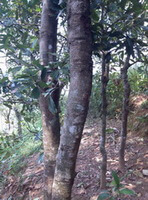
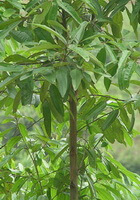
Botanical Description:Cinnamomum cassia is an evergreen tree reaching 12–17 m in height. Its bark is tan-brown (grayish-brown) and fragrant; young branches are slightly quadrangular and covered with yellowish-gray pubescence. Leaves are alternate or nearly opposite and coriaceous; petioles are stout, 1.2–2 cm long, and covered with yellow pubescence; leaf blades are long-elliptic to nearly lanceolate, 8–34 cm long and 4–9.5 cm wide; the apex is acute or acuminate, the base is cuneate, the margin is recurved (inwardly curled), the upper surface is green, glossy, and glabrous, and the lower surface is light green and sparsely covered with yellow pubescence; three primary veins arise from the base (basinerved ternate venation), with fine, nearly parallel cross-veins; the texture is coriaceous.
Panicles are axillary or subapical, 8–16 cm long, and covered with yellow pubescence; three flowers are arranged in a cymose pattern at the branching ends of the inflorescence. Flowers are hermaphroditic, ~4.5 mm long (not cm), white; pedicels are 3–6 mm long and covered with yellow-brown pubescence; the perianth tube is obconical, ~2 mm long; tepals (perianth lobes) are ovate or oval, ~2.5 mm long and 1.5 mm wide, with blunt or acute apices; 9 stamens; filaments are pubescent; stamens in the first and second whorls are ~2.5 mm long; anthers are ovate, tetralocular, with the two upper locules smaller and dehiscing inward toward the lobes, while the two lower locules dehisce outward; three staminodes are arrow-shaped, ~2 mm long including the stalk, which is pubescent; the ovary is ovoid, ~1.7 mm long and glabrous; the style is approximately equal in length to the ovary; the stigma is small and inconspicuous.
Fruits are elliptical, ~1 cm long and 8 mm wide, purple and glabrous; the fruit receptacle is shallow cyathiform (cotyloid), ~4 mm long, with a diameter of ~7 mm at the apex, sometimes slightly rictal. Flowering occurs from June to August; fruiting occurs from October to December or from February to March of the following year.
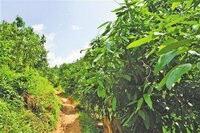
Ecological Environment:Cinnamomum cassia Presl. grows naturally in evergreen broad-leaved forests but is now predominantly cultivated. It is cultivated in tropical and subtropical regions of China.
The twigs of Cinnamomum cassia Presl. serve as the botanical source of the herb Cassia Twig (Guī Zhī). The bark serves as the botanical source of the herb Cinnamon Bark (Cortex Cinnamomi or Ròu Guì).
The aromatic bark of Cinnamomum cassia Presl., a member of the Lauraceae family (laurel family), is similar to true cinnamon (Cinnamomum verum); however, cassia bark has a more pungent, less delicate flavor and is thicker than true cinnamon bark. It contains ~2% cassia oil—a volatile oil whose principal component is cinnamaldehyde. Cassia bark is used as a flavoring agent in cooking, especially in liqueurs and chocolate. Southern Europeans prefer it to true cinnamon, whereas in North America, ground cinnamon is often sold without distinction among species.
Growth Characteristics: The tree grows in evergreen broad-leaved forests but is now predominantly cultivated. It thrives in tropical and subtropical regions of South Asia characterized by high temperatures and high humidity; it is cold-intolerant and susceptible to freeze damage when winter temperatures fall below 0 °C (32 °F). It is a semi-shade species: young trees prefer shade, while mature trees require ample sunlight. It does not tolerate waterlogging; therefore, cultivation is best carried out in fields with deep, loose, acidic, well-drained soils. Stony, gravelly, or alkaline soils are unsuitable for cultivation. It is distributed in the southern coastal areas of China.
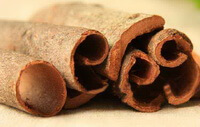
Characteristics of the Herb: The herb occurs in shallow groove-shaped pieces with slightly inwardly curled margins and tapered ends. The oil-rolled Cassia Bark is typically reel-shaped, 30–50 cm long, 3–10 cm wide (or with a diameter of 3–10 cm), and 2–8 mm thick. The outer surface is tan-brown (grayish-brown), slightly coarse and rough, bearing numerous slightly raised lenticels and a few transverse cracks, and often covered with grayish lichen-like patches. The inner surface is reddish-brown, smooth, marked with fine longitudinal striations, and exhibits oily exudate when scratched with a fingernail. The herb is solid, firm, and crisp in texture; its fracture surface is granular — the outer layer brown, the inner layer reddish-brown and oily (oleose); a pale yellow tangential band (cycloband of stone cells) is visible near the outer layer. It possesses a strong, distinctive aroma and tastes sweet and pungent.
Pharmacological Actions: (1) Dilation of peripheral blood vessels, promotion of blood circulation, and resistance to myocardial ischemia; (2) Inhibition of platelet aggregation; (3) Antithrombin activity; (4) Protection of adrenal cortical function; (5) Cinnamon oil exhibits potent bactericidal activity, with greater efficacy against Gram-positive bacteria than Gram-negative bacteria.
Medicinal Efficacy: Tonifies fire and augments Yang; restores the ministerial fire (Mingmen fire) to its origin; invigorates the primordial Yang; warms the Spleen and Stomach; dispels Cold and alleviates pain; activates blood circulation and unblocks meridians; eliminates interior Cold; promotes blood circulation. It is indicated for impotence; coldness of the uterus; decline of Mingmen fire; cold limbs and thready-weak pulse; Yang collapse due to severe deficiency; cold pain in the lumbar region and knees; asthma from Kidney-Yang deficiency; dizziness due to Yang deficiency; floating of deficient Yang; “heat above/cold below” syndrome; red eyes and sore throat; cold pain in the chest and abdomen; diarrhea with abdominal pain; vomiting and diarrhea due to deficiency-Cold; cold hernia; renal mass; menorrhagia; abdominal mass; dysmenorrhea; dorsal furuncles; deep-seated or multiple abscesses.
Administration of Cortex Cinnamoni (Ròu Guì):
Reference:
Administration Guide for Cortex Cinnamoni (Ròu Guì)
TCM Books:
(1) Internally: 1–4.5 grams; (2) Internally: water decoction, 0.5–1.5 qian (≈1.5–4.5 grams); or prepared as pills or powder. External use: apply finely ground herb powder as a paste, or soak in wine and apply topically. (3) Internally: water decoction, 2–5 grams (avoid prolonged boiling); or as finely ground powder, 0.5–1.5 g per dose, or prepared as pills or powder. External use: apply an appropriate amount of finely ground herb powder as a paste, soak in wine and apply topically.
Precautions and Adverse Reactions: Cortex Cinnamomi should be used with caution in individuals with hemorrhagic tendencies or during pregnancy; contraindicated in cases of excess Heat or Yin deficiency with Yang hyperactivity. It should not be combined with red halloysite (Chi Yu).
(2) Cinnamomum cassia Presl var.macrophyllum Chu.
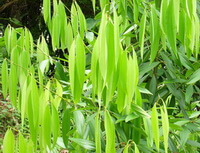
Botanical Description:Cinnamomum cassia Presl. var. macrophyllum Chu. — also known as Large-leaf Cassia or Qinghua Large-leaf Cassia — is a variety of Cinnamomum cassia Presl. in the Lauraceae family (laurel family). It is an evergreen tree reaching 12–17 m in height; the entire plant is aromatic. The bark is tan-brown (grayish-brown); young branches are slightly quadrangular. Leaves are alternate, glossy; young leaves are purplish, and the abaxial surface of mature leaves is dark green. Panicles are axillary or terminal; flowers are small and yellowish-green; berries are ovoid (egg-shaped), green when immature and turning black-purple at maturity. Flowering occurs from June to July; fruiting occurs from February to March of the following year.
Key distinguishing features from Cinnamomum cassia Presl. include: leaf blades are markedly larger — 25–48 cm long and 8–13 cm wide — and filaments are nearly glabrous.
Ecological Environment: The plant grows in tropical and subtropical regions of China and is also widely distributed across Southeast Asia, where it has grown naturally since ancient times or has been cultivated for centuries.
Growth Characteristics: The tree is cultivated on hilly or sloping terrain and is extensively grown in the Zhujiang River Basin and other regions of China. It prefers a warm, humid climate and exhibits good tolerance to temperature fluctuations; brief exposure to low temperatures of –1 °C to –3 °C (30.2 °F to 26.6 °F) does not typically cause cold injury. Young trees prefer partial shade, whereas mature trees require full sunlight. Optimal cultivation conditions include deep, loose, well-drained, acidic soils — particularly red or yellow soils, with yellow soil being especially suitable. Barren land with shallow soil, year-round drought, or poorly drained clay soils should be avoided for cultivation.
Characteristics of the Herb: The herb closely resembles the bark of Cinnamomum cassia Presl. in macroscopic and organoleptic properties. It is highly aromatic when chewed and yields minimal residue upon mastication. Quality is generally considered good.
The fresh twigs of Cinnamomum cassia Presl. var. macrophyllum Chu. serve as an additional botanical source of the herb Cassia Twig (Guī Zhī). The bark of this variety is known as Cortex Cinnamomi Macrophylli or Qinghua Ròu Guì and constitutes another accepted botanical source of Cinnamon Bark (Cortex Cinnamomi).

 ✵The article provides records of the herb Cassia Bark, including its English name, Latin name, Pinyin name, properties and flavor, and its botanical sources as defined in classical herbal works: (1) Cinnamomum cassia Presl., and another usable plant species, (2) Cinnamomum cassia Presl. var. macrophyllum Chu. It offers a detailed introduction to the botanical features, growth characteristics, and ecological environments of these two plant species; the characteristics of the herb Cassia Bark; its pharmacological actions, medicinal efficacy, and administration guidelines.
 Pinyin Name: Ròu Guì
 Botanical Description: Cinnamomum cassia is an evergreen tree reaching 12–17 m in height. Its bark is tan-brown (grayish-brown) and fragrant; young branches are slightly quadrangular and covered with yellowish-gray pubescence. Leaves are alternate or nearly opposite and coriaceous; petioles are stout, 1.2–2 cm long, and covered with yellow pubescence; leaf blades are long-elliptic to nearly lanceolate, 8–34 cm long and 4–9.5 cm wide; the apex is acute or acuminate, the base is cuneate, the margin is recurved (inwardly curled), the upper surface is green, glossy, and glabrous, and the lower surface is light green and sparsely covered with yellow pubescence; three primary veins arise from the base (basinerved ternate venation), with fine, nearly parallel cross-veins; the texture is coriaceous.
 Ecological Environment: Cinnamomum cassia Presl. grows naturally in evergreen broad-leaved forests but is now predominantly cultivated. It is cultivated in tropical and subtropical regions of China.
 The aromatic bark of Cinnamomum cassia Presl., a member of the Lauraceae family (laurel family), is similar to true cinnamon (Cinnamomum verum); however, cassia bark has a more pungent, less delicate flavor and is thicker than true cinnamon bark. It contains ~2% cassia oil—a volatile oil whose principal component is cinnamaldehyde. Cassia bark is used as a flavoring agent in cooking, especially in liqueurs and chocolate. Southern Europeans prefer it to true cinnamon, whereas in North America, ground cinnamon is often sold without distinction among species.
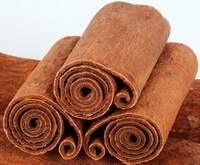 Characteristics of the Herb: The herb occurs in shallow groove-shaped pieces with slightly inwardly curled margins and tapered ends. The oil-rolled Cassia Bark is typically reel-shaped, 30–50 cm long, 3–10 cm wide (or with a diameter of 3–10 cm), and 2–8 mm thick. The outer surface is tan-brown (grayish-brown), slightly coarse and rough, bearing numerous slightly raised lenticels and a few transverse cracks, and often covered with grayish lichen-like patches. The inner surface is reddish-brown, smooth, marked with fine longitudinal striations, and exhibits oily exudate when scratched with a fingernail. The herb is solid, firm, and crisp in texture; its fracture surface is granular — the outer layer brown, the inner layer reddish-brown and oily (oleose); a pale yellow tangential band (cycloband of stone cells) is visible near the outer layer. It possesses a strong, distinctive aroma and tastes sweet and pungent.
 Botanical Description: Cinnamomum cassia Presl. var. macrophyllum Chu. — also known as Large-leaf Cassia or Qinghua Large-leaf Cassia — is a variety of Cinnamomum cassia Presl. in the Lauraceae family (laurel family). It is an evergreen tree reaching 12–17 m in height; the entire plant is aromatic. The bark is tan-brown (grayish-brown); young branches are slightly quadrangular. Leaves are alternate, glossy; young leaves are purplish, and the abaxial surface of mature leaves is dark green. Panicles are axillary or terminal; flowers are small and yellowish-green; berries are ovoid (egg-shaped), green when immature and turning black-purple at maturity. Flowering occurs from June to July; fruiting occurs from February to March of the following year.
 Growth Characteristics: The tree is cultivated on hilly or sloping terrain and is extensively grown in the Zhujiang River Basin and other regions of China. It prefers a warm, humid climate and exhibits good tolerance to temperature fluctuations; brief exposure to low temperatures of –1 °C to –3 °C (30.2 °F to 26.6 °F) does not typically cause cold injury. Young trees prefer partial shade, whereas mature trees require full sunlight. Optimal cultivation conditions include deep, loose, well-drained, acidic soils — particularly red or yellow soils, with yellow soil being especially suitable. Barren land with shallow soil, year-round drought, or poorly drained clay soils should be avoided for cultivation.
 URL QR code: