✵The article records the herb Prickly Ash Peel, including its English name, Latin name, Pinyin name, properties and flavor, and botanical sources—namely, (1) Zanthoxylum bungeanum Maxim. and (2) Zanthoxylum schinifolium Sieb. et Zucc. It provides a detailed introduction to the botanical features of these two species, their growth characteristics and ecological environments, the characteristics of the herb Prickly Ash Peel, its pharmacological actions, medicinal efficacy, and administration guidelines.
Pericarpium Zanthoxyli (Prickly-ash Peel)
Pinyin Name: Huā Jiāo
English Name: Prickly Ash Peel; Bunge Prickly Ash Peel
Latin Name:Pericarpium Zanthoxyli Properties and Flavor: Warm, pungent, slightly toxic
Brief Introduction:Pericarpium Zanthoxyli is the dried ripe pericarp of Zanthoxylum schinifolium Sieb. et Zucc. or Zanthoxylum bungeanum Maxim. It is used (1) to warm the stomach for treating gastralgia and dyspepsia due to cold; (2) as an anthelmintic (specifically, an ascaricide); and (3) externally for eczema and pruritus. The herb is commonly known as Pericarpium Zanthoxyli, Prickly Ash Peel, or Huā Jiāo.
Botanical Source:Pericarpium Zanthoxyli is the dried ripe pericarp of Zanthoxylum schinifolium Sieb. et Zucc. or Zanthoxylum bungeanum Maxim., both belonging to the genus Zanthoxylum L., family Rutaceae (the rue family), order Sapindales. These two widely used species are described below:
(1) Zanthoxylum bungeanum Maxim.
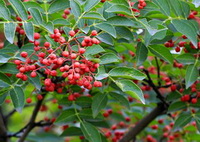
Botanical Description:Zanthoxylum bungeanum Maxim. is a deciduous shrub or small tree of the Rutaceae family and genus Zanthoxylum L. It is commonly known as Huā Jiāo, Hóng Jiāo, or Dà Hóng Páo. It grows up to 3–7 m tall and is aromatic. Stems typically bear enlarged, corky thorns on the cortex; current-year branches are pubescent. Leaves are alternate, imparipinnate compound; the rachis ventrally bears narrow, wing-like extensions on both sides, and scattered, upward-curving small thorns occur on the dorsal surface; petioles often bear a pair of flattened, broadly based thorns on either side; leaflets are sessile; there are 5–11 leaf blades, which are oval (ovate) or ovate-oblong, 1.5–7 cm long and 1–3 cm wide; the apex is acute or shortly acuminate, often emarginate; the base is cuneate; the margin is crenate or undulate-crenate; large, translucent glandular dots are present between the teeth. The upper surface is glabrous; the midrib on the lower surface often bears small, slanting upward thorns. Clusters of rusty-brown, pilose hairs cover the bases of the leaflets; the leaflets are chartaceous (papery).
Inflorescences are terminal, definite racemes (racemose cymes), 2–6 cm long; the rachis is densely pubescent; flowering branches are spreading. Floral bracts are thin and minute, caducous. Flowers are unisexual. The perianth consists of 4–8 narrowly triangular or lanceolate lobes (tepals), arranged in a single whorl, 1–2 mm long. Male flowers possess 4–8 stamens (typically 5–7); female flowers have 4–6 carpels (usually 3–4), lacking a gynophore; the style is excurved (curved outward), and the stigma is capitate. Mature fruits usually consist of 2–3 follicles. Follicles are globose, red or purplish-red, and densely covered with large, prominent, glandular tubercles. Seeds are ovoid, ~3.5 mm in diameter, and glossy. Flowering occurs from April to June; fruiting occurs from September to October.
Ecological Environment: This species grows in sunny, warm, and fertile habitats and is widely cultivated.
Growth Characteristics: Zanthoxylum bungeanum prefers a warm, humid climate and full sunlight. It is intolerant of cold: seedlings suffer damage at −18 °C (−0.4 °F), and mature trees may die at −25 °C (−13 °F). It is drought-tolerant and moderately shade-tolerant but intolerant of waterlogging and strong winds. It exhibits strong soil adaptability and thrives in deep, loose, fertile sandy loam or loam; however, it grows best in alkaline soils derived from limestone—hence its frequent use in afforestation on calcareous mountains.
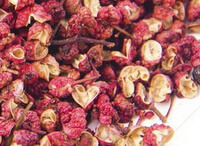
Characteristics of the Herb: It consists of 1–2, occasionally 3–4, spherical mericarps (follicles). The follicles are mostly solitary; each mericarp is 4.5–5 mm in diameter and dehisces along the ventral suture—or sometimes the ventral-dorsal suture—from the apex, typically forming two valves connected at the base. The mericarps bear tiny rostrums (beaks) at the apex and 1–2 granular, undeveloped free carpels at the base, 1–2 mm in diameter. The outer surface is crimson (deep red), purplish-red, or brownish-red; it is shriveled and bears numerous punctate, raised oil spots, 0.5–1 mm in diameter. The endocarp is smooth, primrose yellow (pale yellow), thinly coriaceous, separated from the mesocarp, and slightly curled. The stalk is about 0.8 mm in diameter and covered with sparse, short hairs. The pericarp is coriaceous, slightly tough, possesses a distinctive aroma, tastes pungent and hot, and has a persistent aftertaste.
Pharmacological Actions: (1) antidiarrheal; (2) hepatoprotective; (3) anti-inflammatory; (4) antibacterial; (5) acaricidal (kills scabies mites and other ectoparasites), etc.
Medicinal Efficacy: Warms the middle energizer and alleviates pain; warms the middle energizer and dispels cold; resolves dampness; alleviates pain; relieves diarrhea; expels intestinal worms and relieves pruritus; neutralizes fishy odor and counteracts fish poison. It is indicated for epigastric cold pain due to spleen- and stomach-cold deficiency; cold-type abdominal and stomach pain; vomiting and diarrhea; abdominal pain caused by parasitic infestation (e.g., ascariasis, enterobiasis); colic; toothache (including carious toothache); food retention and prolonged elema (a TCM term referring to stagnant damp-turbidity); vomiting; cough and reversed flow of Qi; cold-type cough and wheezing; wind-cold-damp bi syndrome (numbness and impediment); dysentery; and externally, for eczematous pruritus, pruritus vulvae, morbid leukorrhea (pathological leukorrhea), scabies, etc.
Administration of Pericarpium Zanthoxyli (Huā Jiāo):
Reference:
Administration Guide for Pericarpium Zanthoxyli (Huā Jiāo)
TCM Books:
(1) Internally: 3–6 grams. topical: appropriate amount, used as a fumigation wash prepared from a water decoction. (2) Internally: water decoction, 0.5–1.5 qian (≈1.5–4.5 grams), or formulated into pills or powders; topical: finely ground herb powder applied directly, or used as a fumigation wash prepared from a water decoction. (3) Internally: water decoction, 3–6 grams, or formulated into pills or powders; topical: appropriate amount, used as a wash, mouth rinse, or direct application of finely ground herb powder.
Contraindications, Precautions, and Adverse Reactions: Pericarpium Zanthoxyli should be used with caution during pregnancy. It should not be combined with Radix Aconiti Carmichaeli or Radix Saposhnikoviae.
(2) Zanthoxylum schinifolium Sieb. et Zucc.
Botanical Description:Zanthoxylum schinifolium Sieb. et Zucc. is a shrub of the Rutaceae family (rue or citrus family) and the genus Zanthoxylum L. It is commonly known as Qīng Jiāo, Xiāng Huā Jiāo, or Qīng Huā Jiāo. Plants grow up to 1–2 m tall. Stem branches bear short thorns; the base of the thorns is flattened on both sides, and young branches are dark purple-red. The bark is dark gray, spiny, and glabrous. Leaves are pinnately compound with 7–19 leaflets; leaflets are chartaceous (papery), opposite or subopposite, subsessile, and often alternate near the base of the rachis; petiolules are 1–3 mm long; leaflets are broadly ovate to lanceolate—or broadly ovate-rhombic—5–10 mm long and 4–6 mm wide, rarely up to 70 mm long and 25 mm wide; the apex is short-acuminate; the base is rounded or broadly cuneate, symmetrical or sometimes slightly oblique; oil spots are numerous or inconspicuous; the leaf surface is covered with fine, short hairs or piliferous convex bodies, visible under a magnifying glass; leaf margins are finely serrulate or nearly entire; the midvein is slightly concave below the middle portion.
Corymbose panicles are terminal; flowers are numerous or few. Sepals (calyx lobes) and petals number five each; petals are pale yellowish-white and about 2 mm long. The pistillode in male inflorescences is very short and 2–3-lobed; female inflorescences bear 3 carpels, rarely 4 or 5.
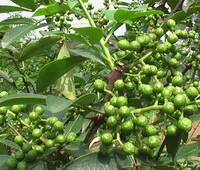
The mericarps are brunneous (reddish-brown); upon drying, the surface turns dark bluish-green or brownish-black. Each mericarp is 4–5 mm in diameter; the apex bears no awns or only vestigial ones; oil spots are small. Seeds are 3–4 mm in diameter. Flowering occurs from July to September; fruiting from September to December.
Ecological Environment: The plant grows at forest edges, in thickets, or on rocky slopes.
Characteristics of the Herb: The fruit consists of 1–3 spherical mericarps aggregated on a short common stalk; follicles are spherical and dehisce along the ventral suture. Each mericarp measures 3–4 mm in diameter and bears a short rostrum (beak) at the apex. The outer surface is prasinous (grass-green), yellowish-green, or brownish-green, with reticulate venation and numerous sunken oil glands. The endocarp is ash-gray (grayish-white) and smooth; it is often detached from the exocarp at the base. The stalk is glabrous. The pericarp is thin and brittle. The residual seeds are ovoid, 3–4 mm long and 2–3 mm in diameter, with a black, glossy surface. The herb has a fragrant aroma and tastes slightly sweet and pungent.

 ✵The article records the herb Prickly Ash Peel, including its English name, Latin name, Pinyin name, properties and flavor, and botanical sources—namely, (1) Zanthoxylum bungeanum Maxim. and (2) Zanthoxylum schinifolium Sieb. et Zucc. It provides a detailed introduction to the botanical features of these two species, their growth characteristics and ecological environments, the characteristics of the herb Prickly Ash Peel, its pharmacological actions, medicinal efficacy, and administration guidelines.
 Pinyin Name: Huā Jiāo
 Botanical Description: Zanthoxylum bungeanum Maxim. is a deciduous shrub or small tree of the Rutaceae family and genus Zanthoxylum L. It is commonly known as Huā Jiāo, Hóng Jiāo, or Dà Hóng Páo. It grows up to 3–7 m tall and is aromatic. Stems typically bear enlarged, corky thorns on the cortex; current-year branches are pubescent. Leaves are alternate, imparipinnate compound; the rachis ventrally bears narrow, wing-like extensions on both sides, and scattered, upward-curving small thorns occur on the dorsal surface; petioles often bear a pair of flattened, broadly based thorns on either side; leaflets are sessile; there are 5–11 leaf blades, which are oval (ovate) or ovate-oblong, 1.5–7 cm long and 1–3 cm wide; the apex is acute or shortly acuminate, often emarginate; the base is cuneate; the margin is crenate or undulate-crenate; large, translucent glandular dots are present between the teeth. The upper surface is glabrous; the midrib on the lower surface often bears small, slanting upward thorns. Clusters of rusty-brown, pilose hairs cover the bases of the leaflets; the leaflets are chartaceous (papery).
 Inflorescences are terminal, definite racemes (racemose cymes), 2–6 cm long; the rachis is densely pubescent; flowering branches are spreading. Floral bracts are thin and minute, caducous. Flowers are unisexual. The perianth consists of 4–8 narrowly triangular or lanceolate lobes (tepals), arranged in a single whorl, 1–2 mm long. Male flowers possess 4–8 stamens (typically 5–7); female flowers have 4–6 carpels (usually 3–4), lacking a gynophore; the style is excurved (curved outward), and the stigma is capitate. Mature fruits usually consist of 2–3 follicles. Follicles are globose, red or purplish-red, and densely covered with large, prominent, glandular tubercles. Seeds are ovoid, ~3.5 mm in diameter, and glossy. Flowering occurs from April to June; fruiting occurs from September to October.
 Characteristics of the Herb: It consists of 1–2, occasionally 3–4, spherical mericarps (follicles). The follicles are mostly solitary; each mericarp is 4.5–5 mm in diameter and dehisces along the ventral suture—or sometimes the ventral-dorsal suture—from the apex, typically forming two valves connected at the base. The mericarps bear tiny rostrums (beaks) at the apex and 1–2 granular, undeveloped free carpels at the base, 1–2 mm in diameter. The outer surface is crimson (deep red), purplish-red, or brownish-red; it is shriveled and bears numerous punctate, raised oil spots, 0.5–1 mm in diameter. The endocarp is smooth, primrose yellow (pale yellow), thinly coriaceous, separated from the mesocarp, and slightly curled. The stalk is about 0.8 mm in diameter and covered with sparse, short hairs. The pericarp is coriaceous, slightly tough, possesses a distinctive aroma, tastes pungent and hot, and has a persistent aftertaste.
 Botanical Description: Zanthoxylum schinifolium Sieb. et Zucc. is a shrub of the Rutaceae family (rue or citrus family) and the genus Zanthoxylum L. It is commonly known as Qīng Jiāo, Xiāng Huā Jiāo, or Qīng Huā Jiāo. Plants grow up to 1–2 m tall. Stem branches bear short thorns; the base of the thorns is flattened on both sides, and young branches are dark purple-red. The bark is dark gray, spiny, and glabrous. Leaves are pinnately compound with 7–19 leaflets; leaflets are chartaceous (papery), opposite or subopposite, subsessile, and often alternate near the base of the rachis; petiolules are 1–3 mm long; leaflets are broadly ovate to lanceolate—or broadly ovate-rhombic—5–10 mm long and 4–6 mm wide, rarely up to 70 mm long and 25 mm wide; the apex is short-acuminate; the base is rounded or broadly cuneate, symmetrical or sometimes slightly oblique; oil spots are numerous or inconspicuous; the leaf surface is covered with fine, short hairs or piliferous convex bodies, visible under a magnifying glass; leaf margins are finely serrulate or nearly entire; the midvein is slightly concave below the middle portion.
 Corymbose panicles are terminal; flowers are numerous or few. Sepals (calyx lobes) and petals number five each; petals are pale yellowish-white and about 2 mm long. The pistillode in male inflorescences is very short and 2–3-lobed; female inflorescences bear 3 carpels, rarely 4 or 5.
 URL QR code: