✵The article records the herbs Lotus Seed and Lotus Stamen, including their English names, Latin names, Pinyin names, properties and flavors, botanical source—namely the single plant species (1) Nelumbo nucifera Gaertn.—and provides a detailed introduction to the botanical features, growth characteristics, and ecological environment of this species, as well as the morphological features of the herbs Lotus Seed and Lotus Stamen, their pharmacological actions, medicinal efficacy, and administration guidelines.
Semen Nelumbinis (Lotus Seed)
Pinyin Name: Lián Zǐ
English Name: Lotus Seed
Latin Name:Semen Nelumbinis Property and Flavor: Neutral in nature; sweet and slightly astringent in taste
Brief Introduction:Semen Nelumbinis is the dried, ripe seed of Nelumbo nucifera Gaertn., used as an astringent to treat chronic diarrhea, spontaneous emission, and leukorrhea. It is commonly known as Semen Nelumbinis, Lotus Seed, or Lián Zǐ.
Botanical Source: Classical herbal works define Semen Nelumbinis (Lián Zǐ) as the seed of the plant species Nelumbo nucifera Gaertn. from the family Nelumbonaceae (formerly classified under Nymphaeaceae). It belongs to the genus Nelumbo, family Nelumbonaceae (lotus-lily family), order Proteales. This widely used species is described below:
(1) Nelumbo nucifera Gaertn.
Botanical Description:Nelumbo nucifera Gaertn. is a perennial aquatic herb of the family Nelumbonaceae and genus Nelumbo. It is commonly known as sacred lotus or Lián. The rhizomes are horizontal, hypertrophied, with enlarged internodes containing numerous vertical aerenchyma cavities; fibrous adventitious roots arise externally. Leaves arise from nodes and emerge above the water surface; the petiole inserts centrally on the abaxial surface of the leaf blade, is thick and cylindrical, and bears scattered prickles; the leaf blade is circular, 25–90 cm in diameter, entire or slightly undulate; the adaxial surface is pinkish-green, while the veins radiate from the center on the abaxial surface, each with one or two secondary forked branches. Solitary flowers arise at the apex of the peduncle; the peduncle and petiole are equal in length or the peduncle is slightly longer, bearing scattered small prickles; flower diameter is 10–20 cm, fragrant, red, pink, or white; petals are elliptic or obovate, 5–10 cm long and 3–5 cm wide; numerous stamens are present, with linear anthers and slender filaments inserted below the receptacle; numerous carpels are embedded within the enlarged receptacle; the ovary is elliptic, and the style is very short. After flowering, the receptacle develops into a conical or obconical seedpod, 5–10 cm in diameter, bearing 20–30 apertures, each containing one fruit; the nut is elliptic or oval, 1.5–2.5 cm long, with a coriaceous, firm, hard pericarp that turns blackish-brown upon maturity. Seeds are oval or elliptic, 1.2–1.7 cm long, with a testa (seed coat) that is reddish or white. Flowering occurs from June to August; fruiting occurs from August to October.
Ecological Environment: The plant grows in marshes, ponds, lake margins, or paddy fields—either wild or cultivated. It is widely distributed across China’s water-rich regions from south to north and is commonly cultivated in water gardens. It is also native to Southeast Asia.
Growth Characteristics: The plant prefers warm, humid climates. Germination begins when soil temperature exceeds 10 °C (50 °F); stem and leaf growth initiates above 15 °C (59 °F); optimal growth, flowering, and fruiting occur at 20–30 °C (68–86 °F); 25–35 °C (77–95 °F) is most favorable for rhizome (lotus root) development; growth ceases below 15 °C (59 °F). Optimal water depth is 5–10 cm during early growth, 20–30 cm during peak vegetative growth, and must not submerge the leaves.
The rhizomes are planted in the mud at the bottom of ponds or rivers, while leaves and flower stalks emerge above the water surface. A few centimeters of the flower stalk extend above water to bear flowers. The plant typically reaches a height of up to 150 cm and spreads horizontally up to 3 meters. Leaf diameter may reach 60 cm; the showy flower may attain 20 cm in diameter. Numerous cultivars exist, ranging in flower color from snow-white to yellow or pink.
Lotus can be propagated by seeds or rhizomes. Notably, lotus seeds possess extraordinary longevity and can remain viable for thousands of years. Scientists have successfully germinated thousand-year-old lotus seeds, yielding healthy, living plants. Two ancient lotus seeds excavated from the Yangshao cultural site are over 3,000 years old but are considered too precious for cultivation.
Building a pond with lotus plants and constructing bridges along the water creates a classic lotus-themed scenic view—a traditional feature of Chinese gardens. Such landscapes are widely employed across the country and are also suitable for garden ponds, purified water systems, or container cultivation. Lotus rhizomes and seeds are rich in nutrients and are edible both raw and cooked. Lotus rhizomes can be processed into products such as lotus root powder, candied lotus root, and more. Lotus seeds have a calming effect and are commonly used in soups or as candied snacks to nourish the body. Lotus petals and young leaves are also edible. All parts of the lotus plant have medicinal applications.
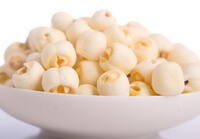
Characteristics of the Herb: The seeds are slightly elliptic or subsphaeroidal (nearly spherical), 1.2–1.7 cm long and 0.8–1.5 cm in diameter—or up to 1.8 cm in diameter. The surface is light yellowish-brown to reddish-brown, marked with fine longitudinal lines and prominent veins; the apex bears a papillary, dark brown hilum, often fissured, while the periphery and basal region are slightly depressed. The testa (seed coat) is thin and tightly adherent to the cotyledons, making it difficult to remove. The herb is hard in texture; when broken, two yellowish-white, hypertrophied cotyledons are exposed, with a groove-shaped depression at their center containing a green lotus plumule—or, in some cases, a small apical cavity without a plumule. The herb has a faint odor, tastes sweet and slightly astringent, and the lotus plumule is intensely bitter.
Medicinal Efficacy: Tonifies the Spleen and arrests diarrhea; consolidates the Kidney to arrest leukorrhea; nourishes the Heart; tonifies the Kidney and restrains seminal emission; calms the Spirit by nourishing the Heart. Indications include nocturnal dreaming, restlessness, palpitations with anxiety, insomnia, Spleen-deficiency diarrhea, chronic Spleen-deficiency diarrhea, slippery diarrhea, deficiency-type diarrhea, protracted dysentery, metrorrhagia and metrostaxis, pathological leukorrhea, spermatorrhea (seminal emission), Kidney-deficiency–related emission, enuresis (involuntary urination), and turbid stranguria.
Administration of Semen Nelumbinis (Lián Zǐ):
Reference:
Administration Guide for Semen Nelumbinis (Lián Zǐ)
TCM Books:
(1) Internally: 6–15 grams; (2) Internally: water decoction, 2–4 qián (≈6–12 grams); or prepared as pills or powder; (3) Internally: water decoction, 6–15 grams; or prepared as pills or powder.
Contraindications, Precautions, and Adverse Reactions: Semen Nelumbinis is contraindicated in cases of abdominal distension, epigastric fullness, or constipation.
Stamen Nelumbinis (Lotus Stamen)
Pinyin Name: Lián Xū
English Name: Lotus Stamen
Latin Name: Stamen Nelumbinis
Property and Flavor: Neutral; sweet and slightly astringent
Brief Introduction:Stamen Nelumbinis is the dried stamen of Nelumbo nucifera Gaertn., used as an astringent to consolidate Kidney Qi for treating seminal emission and pathological leukorrhea. It is commonly known as Lián Xū.
Botanical Source: Authoritative classical herbal texts—including major official pharmacopoeias—define Stamen Nelumbinis (Lotus Stamen) as the dried stamen of Nelumbo nucifera Gaertn. This species belongs to the genus Nelumbo, family Nelumbonaceae (lotus-lily family), order Proteales. It was previously described under "Semen Nelumbinis (Lotus Seed)".
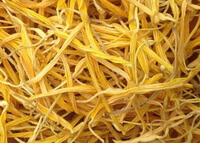
Characteristics of the Herb: The herb consists of dried stamens, linear and often spirally twisted. Anthers measure 1.2–1.5 cm in length and approximately 2 mm in diameter; they are pale yellow, bilocular, longitudinally dehiscent, and contain abundant yellow pollen. Filaments are filiform (threadlike), slightly flattened and gently curved, 1–1.5 cm long, and brown to tan (light chocolate brown). The herb has a faint odor and tastes slightly astringent.
Medicinal Efficacy: Clears Heart Fire; tonifies the Kidney; restrains seminal emission; stops bleeding. Indications include spermatorrhea (seminal emission), frequent urination, enuresis (bed-wetting), pathological leukorrhea, hematemesis (vomiting blood), epistaxis (nosebleed), metrorrhagia and metrostaxis, diarrhea, and dysentery.
Administration of Stamen Nelumbinis (Lián Xū):
Reference:
Administration Guide for Stamen Nelumbinis (Lián Xū)
TCM Books:
(1) Internally: 3–5 grams; (2) Internally: water decoction, 0.8–1.5 qián (≈2.4–4.5 grams); or prepared as pills or powder; (3) Internally:water decoction, 3–9 grams; or prepared as pills or powder.
Contraindications, Precautions, and Adverse Reactions: Stamen Nelumbinis should not be used concurrently with Rehmannia root (Shu Dì Huáng), scallion (Cōng Bái), or garlic (Dà Suàn). It is contraindicated in cases of urinary inhibition (oliguria or anuria).

 ✵The article records the herbs Lotus Seed and Lotus Stamen, including their English names, Latin names, Pinyin names, properties and flavors, botanical source—namely the single plant species (1) Nelumbo nucifera Gaertn.—and provides a detailed introduction to the botanical features, growth characteristics, and ecological environment of this species, as well as the morphological features of the herbs Lotus Seed and Lotus Stamen, their pharmacological actions, medicinal efficacy, and administration guidelines.
 Pinyin Name: Lián Zǐ
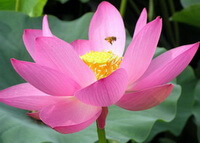 Botanical Description: Nelumbo nucifera Gaertn. is a perennial aquatic herb of the family Nelumbonaceae and genus Nelumbo. It is commonly known as sacred lotus or Lián. The rhizomes are horizontal, hypertrophied, with enlarged internodes containing numerous vertical aerenchyma cavities; fibrous adventitious roots arise externally. Leaves arise from nodes and emerge above the water surface; the petiole inserts centrally on the abaxial surface of the leaf blade, is thick and cylindrical, and bears scattered prickles; the leaf blade is circular, 25–90 cm in diameter, entire or slightly undulate; the adaxial surface is pinkish-green, while the veins radiate from the center on the abaxial surface, each with one or two secondary forked branches. Solitary flowers arise at the apex of the peduncle; the peduncle and petiole are equal in length or the peduncle is slightly longer, bearing scattered small prickles; flower diameter is 10–20 cm, fragrant, red, pink, or white; petals are elliptic or obovate, 5–10 cm long and 3–5 cm wide; numerous stamens are present, with linear anthers and slender filaments inserted below the receptacle; numerous carpels are embedded within the enlarged receptacle; the ovary is elliptic, and the style is very short. After flowering, the receptacle develops into a conical or obconical seedpod, 5–10 cm in diameter, bearing 20–30 apertures, each containing one fruit; the nut is elliptic or oval, 1.5–2.5 cm long, with a coriaceous, firm, hard pericarp that turns blackish-brown upon maturity. Seeds are oval or elliptic, 1.2–1.7 cm long, with a testa (seed coat) that is reddish or white. Flowering occurs from June to August; fruiting occurs from August to October.
 Growth Characteristics: The plant prefers warm, humid climates. Germination begins when soil temperature exceeds 10 °C (50 °F); stem and leaf growth initiates above 15 °C (59 °F); optimal growth, flowering, and fruiting occur at 20–30 °C (68–86 °F); 25–35 °C (77–95 °F) is most favorable for rhizome (lotus root) development; growth ceases below 15 °C (59 °F). Optimal water depth is 5–10 cm during early growth, 20–30 cm during peak vegetative growth, and must not submerge the leaves.
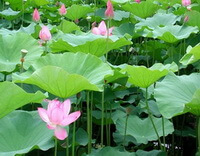 The rhizomes are planted in the mud at the bottom of ponds or rivers, while leaves and flower stalks emerge above the water surface. A few centimeters of the flower stalk extend above water to bear flowers. The plant typically reaches a height of up to 150 cm and spreads horizontally up to 3 meters. Leaf diameter may reach 60 cm; the showy flower may attain 20 cm in diameter. Numerous cultivars exist, ranging in flower color from snow-white to yellow or pink.
 Lotus can be propagated by seeds or rhizomes. Notably, lotus seeds possess extraordinary longevity and can remain viable for thousands of years. Scientists have successfully germinated thousand-year-old lotus seeds, yielding healthy, living plants. Two ancient lotus seeds excavated from the Yangshao cultural site are over 3,000 years old but are considered too precious for cultivation.
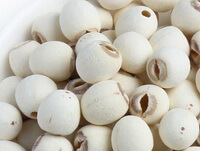 Characteristics of the Herb: The seeds are slightly elliptic or subsphaeroidal (nearly spherical), 1.2–1.7 cm long and 0.8–1.5 cm in diameter—or up to 1.8 cm in diameter. The surface is light yellowish-brown to reddish-brown, marked with fine longitudinal lines and prominent veins; the apex bears a papillary, dark brown hilum, often fissured, while the periphery and basal region are slightly depressed. The testa (seed coat) is thin and tightly adherent to the cotyledons, making it difficult to remove. The herb is hard in texture; when broken, two yellowish-white, hypertrophied cotyledons are exposed, with a groove-shaped depression at their center containing a green lotus plumule—or, in some cases, a small apical cavity without a plumule. The herb has a faint odor, tastes sweet and slightly astringent, and the lotus plumule is intensely bitter.
 Pinyin Name: Lián Xū
 URL QR code: