✵The article records the herb Gordon Euryale Seed, including its English name, Latin name, Pinyin name, property and flavor, botanical source—the single plant species (1) Euryale ferox Salisb.—and provides a detailed introduction to the botanical features, growth characteristics, and ecological environment of this species, as well as the morphological characteristics of the herb Gordon Euryale Seed, its pharmacological actions, medicinal efficacy, and administration guidelines.
Semen Euryales (Gordon Euryale Seed)
Pinyin Name: Qiàn Shí
English Name: Gordon Euryale Seed
Latin Name:Semen Euryales Property and Flavor: Neutral in nature; sweet and slightly astringent
Brief Introduction:Semen Euryales is the dried kernel of the ripe seed of Euryale ferox Salisb., used as an astringent to treat chronic diarrhea, spontaneous emission, enuresis, and pathological leukorrhea. It is commonly known as Semen Euryales, Gordon Euryale Seed, Seed of Gordon Euryale, or Qiàn Shí.
Botanical Source: Classical herbal works define Semen Euryales (Qiàn Shí) as the dried kernel of the ripe seed of Euryale ferox Salisb. This species belongs to the genus Euryale Salisb. ex DC., family Nymphaeaceae (water lily family), order Proteales. The species is described below:
(1) Euryale ferox Salisb.
Botanical Description:Euryale ferox Salisb. is a large annual aquatic herb, commonly known as Qiàn. The entire plant bears sharp, pointed spines. Rhizomes are stout and short, bearing white fibrous roots and inconspicuous stems. Primary (submerged) leaves are arrow-shaped or elliptic-reniform, 4–10 cm long; both surfaces and petioles are unarmed (spineless). Floating metaphylls are coriaceous, elliptic-reniform to circular, 10–130 cm in diameter; the adaxial surface is dark green, deeply wrinkled; the abaxial surface is purplish-red, pubescent, with prominently convex veins and upturned margins. Petioles and pedicels (flower stalks) are stout and may reach 25 cm in length.
Flowers are solitary and diurnal (opening by day, closing at night), approximately 5 cm in diameter. There are 4 sepals, lanceolate, 1–1.5 cm long, with a purple inner surface; numerous petals, oblong-lanceolate, 1.5–2 cm long, violet-red, arranged in several whorls; numerous stamens; the ovary is inferior, with 8 carpels; the stigma is red, discoid and concave (plate-like and flat).
Fruits are globose (spherical), 3–5 cm in diameter, spongy in texture, and dark violet-red. Seeds are globose, ~10 mm in diameter, and black. Flowering occurs from July to August; fruiting occurs from August to September.
Ecological Environment: The plant grows in ponds, lacustrine marshes, and irrigated fields (marshy agricultural land). It is primarily cultivated and harvested in China.
Growth Characteristics: The plant prefers warm, moist climates with abundant sunshine but is neither cold-tolerant nor drought-resistant. Optimal growth temperature is 20–30 °C (68–86 °F); optimal water depth is 30–90 cm (some sources cite 60–120 cm). It is suitable for cultivation in ponds, reservoirs, ditches, and canals with loose, nutrient-rich, organic-matter–abundant mud and a stable water level. Soil pH should not be excessively acidic, and cold regions are unsuitable for cultivation.
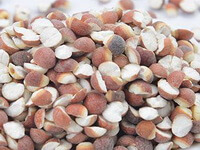
Characteristics of the Herb: Kernels are subsphaeroidal (nearly spherical), 5–8 mm in diameter; some are fragmented. Intact kernels exhibit a reddish-brown to dark purple testa (inner seed coat) marked with irregular, reticulate venation; approximately one-third of one pole is yellowish-white. The embryo is small and situated within a shallow, rounded, concave depression at the pale yellow pole. The herb is hard in texture; the fracture surface is white and mealy (starchy, powdery). It has a faint odor and a mild taste.
Pharmacological Actions: (1) Semen Euryales is rich in protein, calcium, phosphorus, iron, fat, starch, vitamin B₁, vitamin B₂, vitamin C, crude fiber, carotene, and other nutrients. Among these, B-complex vitamins support lipid metabolism; crude fiber promotes intestinal motility and aids in lipid elimination and defecation; (2) supports restoration of Spleen function and digestive health; (3) alleviates diarrhea; (4) indirectly reduces phlegm accumulation; (5) exhibits sedative and astringent effects.
Medicinal Efficacy: Tonifies the kidney, relieves seminal emission, replenishes the spleen, and alleviates diarrhea; eliminates dampness and leukorrhea. It is indicated for spermatorrhea and nocturnal emission (seminal emission), frequent urination, enuresis (bed-wetting), urinary incontinence, chronic diarrhea due to splenic deficiency, stranguria with turbid urine, white turbid discharge, pathological leukorrhea, etc.
Administration of Semen Euryales (Qiàn Shí):
Reference:
Administration Guide for Semen Euryales (Qiàn Shí)
TCM Books:
(1) Internally: 9–15 grams; (2) Internally:water decoction, 3–5 qián (approximately 9–15 grams); or prepared as pills or powders; (3) Internally: water decoction, 15–30 grams; or prepared as pills, powders, or congee.
Contraindications, Precautions, and Adverse Reactions: Semen Euryales is contraindicated in cases of urinary retention and constipation, as well as in indigestion and food stagnation.

 ✵The article records the herb Gordon Euryale Seed, including its English name, Latin name, Pinyin name, property and flavor, botanical source—the single plant species (1) Euryale ferox Salisb.—and provides a detailed introduction to the botanical features, growth characteristics, and ecological environment of this species, as well as the morphological characteristics of the herb Gordon Euryale Seed, its pharmacological actions, medicinal efficacy, and administration guidelines.
 Pinyin Name: Qiàn Shí
 Botanical Description: Euryale ferox Salisb. is a large annual aquatic herb, commonly known as Qiàn. The entire plant bears sharp, pointed spines. Rhizomes are stout and short, bearing white fibrous roots and inconspicuous stems. Primary (submerged) leaves are arrow-shaped or elliptic-reniform, 4–10 cm long; both surfaces and petioles are unarmed (spineless). Floating metaphylls are coriaceous, elliptic-reniform to circular, 10–130 cm in diameter; the adaxial surface is dark green, deeply wrinkled; the abaxial surface is purplish-red, pubescent, with prominently convex veins and upturned margins. Petioles and pedicels (flower stalks) are stout and may reach 25 cm in length.
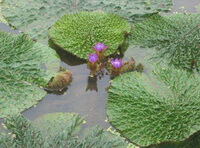 Flowers are solitary and diurnal (opening by day, closing at night), approximately 5 cm in diameter. There are 4 sepals, lanceolate, 1–1.5 cm long, with a purple inner surface; numerous petals, oblong-lanceolate, 1.5–2 cm long, violet-red, arranged in several whorls; numerous stamens; the ovary is inferior, with 8 carpels; the stigma is red, discoid and concave (plate-like and flat).
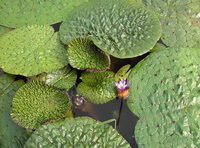 Ecological Environment: The plant grows in ponds, lacustrine marshes, and irrigated fields (marshy agricultural land). It is primarily cultivated and harvested in China.
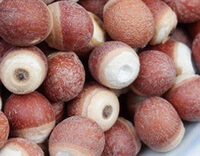 Characteristics of the Herb: Kernels are subsphaeroidal (nearly spherical), 5–8 mm in diameter; some are fragmented. Intact kernels exhibit a reddish-brown to dark purple testa (inner seed coat) marked with irregular, reticulate venation; approximately one-third of one pole is yellowish-white. The embryo is small and situated within a shallow, rounded, concave depression at the pale yellow pole. The herb is hard in texture; the fracture surface is white and mealy (starchy, powdery). It has a faint odor and a mild taste.
 Pharmacological Actions: (1) Semen Euryales is rich in protein, calcium, phosphorus, iron, fat, starch, vitamin B₁, vitamin B₂, vitamin C, crude fiber, carotene, and other nutrients. Among these, B-complex vitamins support lipid metabolism; crude fiber promotes intestinal motility and aids in lipid elimination and defecation; (2) supports restoration of Spleen function and digestive health; (3) alleviates diarrhea; (4) indirectly reduces phlegm accumulation; (5) exhibits sedative and astringent effects.
 URL QR code: