Introduction of Fu Pen Zi: Palmleaf Raspberry Fruit
✵The article records the herb Palmleaf Raspberry Fruit, including its English name, Latin name, Pinyin name, property and flavor; its botanical sources as defined in classical herbal texts—namely, (1) Rubus chingii Hu. and (2) Rubus coreanus Miq.; and provides a detailed introduction to the botanical features, growth characteristics, and ecological environments of these two plant species; as well as the characteristics, pharmacological actions, medicinal efficacy, and administration guidelines of the herb Palmleaf Raspberry Fruit.
Fructus Rubi (Palmleaf Raspberry Fruit)
Pinyin Name: Fù Pén Zi
English Name: Palmleaf Raspberry Fruit
Latin Name:Fructus Rubi Property and Flavor: Warm; sweet and sour.
Brief Introduction:Fructus Rubi is the steamed and dried fruit of Rubus chingii Hu., used as an astringent to treat frequent urination, enuresis, and seminal emission. It is commonly known as Fructus Rubi, Palmleaf Raspberry Fruit, or Fù Pén Zi.
Botanical source: Classical herbal works define Fructus Rubi (Fù Pén Zi) or Palmleaf Raspberry Fruit (Fù Pén Zi) as the dried fruit of Rubus chingii Hu. (Rosaceae family, genus Rubus L.). Other authoritative works also accept the unripe fruit of Rubus chingii Hu. or Rubus coreanus Miq. (Rosaceae family) as valid sources. These two commonly used species are described below:
(1) Rubus chingii Hu.
Botanical Description:Rubus chingii Hu. is a deciduous shrub of the Rosaceae family (rose family), genus Rubus L. It is commonly known as Dōng Huá Fù Pén Zi (East China Raspberry) or Zhǎng Yè Fù Pén Zi (Palmleaf Raspberry). Plants grow up to 2–3 meters tall. Young shoots (twigs) are green, glaucous (covered with a whitish bloom), and bear few antrorse (forward-pointing) thorns.
Simple leaves are alternate; petioles measure 3–4.5 cm in length; stipules (perphylls) are linear-lanceolate; leaf blades are orbicular (nearly round), 5–9 cm in diameter, palmately 5-lobed; the central lobe is rhomboid-ovate; the base is subcordate (nearly cordate); margins are biserrate; leaf veins on both surfaces bear white pubescence; basal pentacostal veins are prominent.
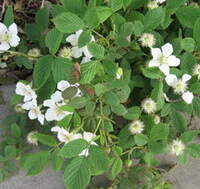
Flowers are hermaphroditic, solitary, and grow at the tips of short branches. The calyx consists of 5 persistent, ovate-oblong sepals, pubescent on both surfaces. There are 5 white petals, elliptic or ovate-oblong, with obtuse apices. The flower measures 2.5–3.5 cm in diameter. Pedicels are 2–3.5 cm long. Stamens are numerous; filaments are broad and flattened; anthers are T-shaped, bilocular, and dorsifixed. Pistils are numerous, pubescent, and inserted on a raised receptacle.
Aggregate fruits (composite fruits) are globular (spherical), 1.5–2 cm in diameter, red, and pendulous; small drupes (drupe fruits) are densely covered with ash-gray pilose. Its flowering period is from March to April, and the fruiting period is from May to August.
Ecological Environment: The roots of Rubus chingii Hu are shallowly distributed and grow in moist, well-drained soil. In the wild, it is mostly found at forest edges or in sparse forests, as well as in ditches, canals, along roadsides, on hillsides or mountain slopes, and in shaded bushy areas—especially where soils remain moist. It grows at low to mid-elevations.
Growth Characteristics: The plant prefers cool climates, avoids heat, and requires light but should be protected from intense insolation. It can be cultivated in ordinary soils; however, optimal cultivation occurs in loose, humus-rich, acidic yellow loam with good drainage.
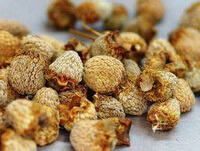
Characteristics of the Herb: The herb is an aggregate fruit composed of numerous small drupes, slightly conical or nearly spherical, with a blunt apex and flat base, 0.6–1.3 cm in height and 0.5–1.2 cm in diameter. The surface is celadon (sage green) or hazel (pale brown), densely covered with ash-gray (grayish-white) or celadon short pubescence. The persistent calyx is brown and 5-lobed; its apex is often broken. Numerous residual filaments remain on the top, and carpopodium scars (fruit-stalk marks) are present—or fine carpopodia remain attached—at the base. The small drupes are semilunar (half-moon-shaped), with a convex dorsal surface and a ventral surface bearing prominent ridge lines. The surface is brown, with grayish-white hairs on the dorsal surface and apical region, and reticulated concave lines on both sides of the ventral surface. The herb is lightweight and hard in texture, containing a single brown seed. It has a delicate fragrance and tastes slightly sour and astringent.
Main value: The Rubus genus is rich in resources. The bark contains tannins and fibers; leaves are used for tea, sweeteners, and medicinal purposes; flowers serve as an important nectar source for honeybees; fruits are edible and medicinal, and are processed into beverages, jams, fermented products, sugar, vinegar, juice, etc.; seeds are used medicinally and for oil extraction; roots and root bark (rich in tannins) are employed as herbal medicines; the whole plant is used medicinally, and some species serve as ornamental shrubs. Locally, fruits are used to brew wine, make jams, and prepare juices and drinks.
Medicinal Value: Rubus chingii Hu., commonly known as Palmleaf Raspberry, is the sole species among the 194 raspberry species selected and officially designated as the botanical source of Fructus Rubi in authoritative Chinese herbal pharmacopoeias.
Pharmacological Actions: (1) Antioxidant activity; (2) Antibacterial activity—inhibitory effects against Staphylococcus aureus and Vibrio cholerae; (3) Estrogen-like effects.
Medicinal Efficacy: Tonifies the kidney and supports Yang; astringes and controls nocturnal emission; nourishes the liver and improves vision (visual acuity). Indicated for spermatorrhea (nocturnal emission), impotence (sexual dysfunction), premature ejaculation, enuresis (bedwetting), frequent urination, uterine coldness and infertility, clear and thin pathological leukorrhea, consumptive disease (e.g., tuberculosis), blurred vision, premature graying of hair and beard, etc.
Administration of Fructus Rubi (Fù Pén Zi):
Reference:
Administration Guide for Fructus Rubi (Fù Pén Zi)
TCM Books:
(1) Internally: 6–12 grams; (2) Internally: water decoction, 1.5–2 qian (≈4.5–6 grams); infusion in wine, ointment, pills, or powder; (3) Internally:water decoction, 5–10 grams; or prepared as pills, powder, wine infusion, or ointment.
(2) Rubus coreanus Miq.
Botanical Description:Rubus coreanus Miq. is a shrub of the Rosaceae family (rose family), genus Rubus L., commonly known as Cha Tian Pao. It grows 1–3 m tall; stems are erect or arching, reddish-brown, and bear uncinate, flattened prickles. Compound leaves are imparipinnate, with 5–7 leaflets that are oval (egg-shaped), elliptic, or rhomboid-ovate, 3–6 cm long and 1.5–4 cm wide; apices are acute; bases are broadly cuneate or suborbicular; margins bear irregular, subulate, sharp serrations; the lower surface is celadon (sage green) and pubescent or floccose along the veins. Petioles are 2–4 cm long; small prickles are scattered along the rachis; stipules are linear.[I]
Corymbes are apical or axillary, grow on the tips of lateral branches, with several to over 30 flowers; both peduncles and pedicels are covered with ash-gray pubescence; pedicels are 5–10 mm long; bracts are linear (filiform), pubescent; flowers are 7–10 mm in diameter; the calyx is grayish pubescent externally; sepals are ovate-oblong to ovate-lanceolate, 4–6 mm long, acuminate at the apex, with ciliate margins, expanding during anthesis and reflexed in fruiting; petals are obovate, faintly red to crimson (deep red), nearly equal in length to—or slightly shorter than—the sepals; stamens are shorter than or nearly equal in length to the petals, with pinkish filaments; numerous pistils; styles are glabrous; the ovary is sparsely pubescent.
Fruits are subglobose (nearly spherical), 5–8 mm in diameter, dark red to atropurpureus (purple-black), glabrous or glabrescent; the endocarp (stone) is rugose. Its flowering period is from April to June, and fruiting occurs from June to August.
The indumentum on the lower leaf surface of this species varies considerably: on the same plant or even the same shoot, most leaves have a glabrous abaxial surface—or only pubescence along the veins—whereas a few leaves exhibit dense tomentum.
Ecological Environment: The plant grows in shrublands on hillsides, valleys, along rivers, and beside roads, at elevations of 100–1,700 m above sea level.
Article Link:
URL QR code:
References:
1.Introduction of Fu Pen Zi: Palmleaf Raspberry Fruit

 ✵The article records the herb Palmleaf Raspberry Fruit, including its English name, Latin name, Pinyin name, property and flavor; its botanical sources as defined in classical herbal texts—namely, (1) Rubus chingii Hu. and (2) Rubus coreanus Miq.; and provides a detailed introduction to the botanical features, growth characteristics, and ecological environments of these two plant species; as well as the characteristics, pharmacological actions, medicinal efficacy, and administration guidelines of the herb Palmleaf Raspberry Fruit.
 Pinyin Name: Fù Pén Zi
 Botanical Description: Rubus chingii Hu. is a deciduous shrub of the Rosaceae family (rose family), genus Rubus L. It is commonly known as Dōng Huá Fù Pén Zi (East China Raspberry) or Zhǎng Yè Fù Pén Zi (Palmleaf Raspberry). Plants grow up to 2–3 meters tall. Young shoots (twigs) are green, glaucous (covered with a whitish bloom), and bear few antrorse (forward-pointing) thorns.
 Flowers are hermaphroditic, solitary, and grow at the tips of short branches. The calyx consists of 5 persistent, ovate-oblong sepals, pubescent on both surfaces. There are 5 white petals, elliptic or ovate-oblong, with obtuse apices. The flower measures 2.5–3.5 cm in diameter. Pedicels are 2–3.5 cm long. Stamens are numerous; filaments are broad and flattened; anthers are T-shaped, bilocular, and dorsifixed. Pistils are numerous, pubescent, and inserted on a raised receptacle.
 Ecological Environment: The roots of Rubus chingii Hu are shallowly distributed and grow in moist, well-drained soil. In the wild, it is mostly found at forest edges or in sparse forests, as well as in ditches, canals, along roadsides, on hillsides or mountain slopes, and in shaded bushy areas—especially where soils remain moist. It grows at low to mid-elevations.
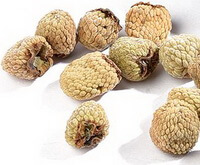 Characteristics of the Herb: The herb is an aggregate fruit composed of numerous small drupes, slightly conical or nearly spherical, with a blunt apex and flat base, 0.6–1.3 cm in height and 0.5–1.2 cm in diameter. The surface is celadon (sage green) or hazel (pale brown), densely covered with ash-gray (grayish-white) or celadon short pubescence. The persistent calyx is brown and 5-lobed; its apex is often broken. Numerous residual filaments remain on the top, and carpopodium scars (fruit-stalk marks) are present—or fine carpopodia remain attached—at the base. The small drupes are semilunar (half-moon-shaped), with a convex dorsal surface and a ventral surface bearing prominent ridge lines. The surface is brown, with grayish-white hairs on the dorsal surface and apical region, and reticulated concave lines on both sides of the ventral surface. The herb is lightweight and hard in texture, containing a single brown seed. It has a delicate fragrance and tastes slightly sour and astringent.
 Main value: The Rubus genus is rich in resources. The bark contains tannins and fibers; leaves are used for tea, sweeteners, and medicinal purposes; flowers serve as an important nectar source for honeybees; fruits are edible and medicinal, and are processed into beverages, jams, fermented products, sugar, vinegar, juice, etc.; seeds are used medicinally and for oil extraction; roots and root bark (rich in tannins) are employed as herbal medicines; the whole plant is used medicinally, and some species serve as ornamental shrubs. Locally, fruits are used to brew wine, make jams, and prepare juices and drinks.
 Botanical Description: Rubus coreanus Miq. is a shrub of the Rosaceae family (rose family), genus Rubus L., commonly known as Cha Tian Pao. It grows 1–3 m tall; stems are erect or arching, reddish-brown, and bear uncinate, flattened prickles. Compound leaves are imparipinnate, with 5–7 leaflets that are oval (egg-shaped), elliptic, or rhomboid-ovate, 3–6 cm long and 1.5–4 cm wide; apices are acute; bases are broadly cuneate or suborbicular; margins bear irregular, subulate, sharp serrations; the lower surface is celadon (sage green) and pubescent or floccose along the veins. Petioles are 2–4 cm long; small prickles are scattered along the rachis; stipules are linear.[I]
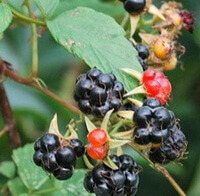 Fruits are subglobose (nearly spherical), 5–8 mm in diameter, dark red to atropurpureus (purple-black), glabrous or glabrescent; the endocarp (stone) is rugose. Its flowering period is from April to June, and fruiting occurs from June to August.
 URL QR code: