✵The article documents the herb Cherokee Rose Fruit, including its English name, Latin name, Pinyin name, properties and flavor, botanical source—namely, the single plant species Rosa laevigata Michx.—and provides a detailed introduction to the botanical features, growth characteristics, and ecological environment of this species; the macroscopic and microscopic characteristics of the herb Fructus Rosae Laevigatae; its pharmacological actions; medicinal efficacy; and administration guidelines.
Fructus Rosae Laevigatae (Cherokee Rose Fruit)
Pinyin Name: Jīn Yīnɡ Zǐ
English Name: Cherokee Rose Fruit
Latin Name:Fructus Rosae Laevigatae Properties and Flavor: Neutral; sour, sweet, and puckering
Brief Introduction:Fructus Rosae Laevigatae is the dried, ripe pseudocarp (receptacle-derived fruit) of Rosa laevigata Michx., used clinically as an astringent to treat seminal emission, enuresis, urinary frequency, and chronic diarrhea. It is commonly known as Cherokee Rose Fruit, Jīn Yīnɡ Zǐ, or Fructus Rosae Laevigatae.
Botanical Source: Classical herbal works define Fructus Rosae Laevigatae (Cherokee Rose Fruit) as the dried, ripe fruit of Rosa laevigata Michx., an evergreen climbing shrub in the genus Rosa L., family Rosaceae (rose family), order Rosales. The following describes this widely used species:
(1) Rosa laevigata Michx.
Botanical Description: Commonly known as Cherokee Rose or Jīn Yīnɡ Zǐ, this evergreen climbing shrub grows up to 5 meters tall. Branchlets are stout, bearing scattered recurved spines; they are glabrous but bear glandular hairs in the seedling stage, which gradually abscise with age. Stems are glabrous and armed with falcate spines (barbs) and bristles. Leaves are pinnately compound; petioles and rachises bear small prickles and bristles. Stipules (peraphylla) are lanceolate, free from the petiole, and caducous. Leaflets (foliolules) are coriaceous, usually three (rarely five), elliptic-ovate, obovate, or lanceolate-ovate, measuring 2–7 cm in length and 1.2–3.5 cm (or 1.5–4.5 cm) in width; apices are acute or acuminate; bases are orbicular (subrotund); margins are finely serrulate; surfaces are glabrous and glossy.
Flowers are solitary, grow in leaf axils or at the tips of lateral branches; they are white, 5–7 cm (or 5–9 cm) in diameter; pedicels measure 1.8–2.5 cm long (occasionally up to 3 cm); both pedicels and the hypanthium (floral tube) are densely covered with bristles externally; these bristles become needle-like spines as fruits develop. There are five sepals and five petals. Sepals are ovate-lanceolate, foliaceous at the apex, with pinnatilobate or entire margins; they bear bristles and glandular hairs, and their inner surface is densely pilose—slightly shorter than the petals. Petals are white, broadly obovate, with emarginate apices. Stamens are numerous; carpels are numerous, with separate, pilose styles shorter than the stamens; stigmas are clustered at the opening of the receptacle.
Fruits are pyriform (pear-shaped) or obovoid, rarely subsphaeroidal (nearly spherical), 2–4 cm long, yellowish-red to puce (purplish-brown), densely bristly externally; persistent sepals at the apex are elongated and reflexed; the carpopodium (fruit stalk) is ~3 cm long. Flowering occurs from April to June; fruiting, from July to November.
Ecological Environment: This shrub grows in sunny mountain fields, along field margins, in riverside thickets, and at altitudes of 100–1,600 meters above sea level.
Growth Characteristics: The shrub prefers a warm, dry climate. Cultivation requires well-drained, loose, fertile sandy loam soil.
Characteristics of the Herb: The herb is a pseudocarp developed from the floral receptacle, obovate in shape, 2–3.5 cm long and 1–2 cm in diameter. The surface is yellowish-red to brownish-red, slightly glossy, and bears numerous brown protrusions—remnants of shed spiny bristles. The persistent calyx at the apex is disc-shaped, with a slightly elevated center and a yellow stylopodium. The base is attenuated, bearing a residual carpopodium (fruit stalk). The herb is firm and hard. On longitudinal section, the hypanthium (calyx tube) wall is 1–2 mm thick; its inner wall is densely covered with yellow, glossy trichomes. Dozens of achenes are present—flat-fusiform (spindle-shaped), ~7 mm long, pale yellowish-brown, woody, and externally covered with yellowish trichomes. The herb has a slight odor and tastes sweet with mild puckering.
Pharmacological Actions: (1) Effects on the urinary system; (2) Effects on smooth muscle; (3) Prevention and treatment of atherosclerosis; reduction of serum cholesterol; significant reduction of lipoprotein levels; (4) Antipathogenic and bacteriostatic activity: the water decoction of Fructus Rosae Laevigatae inhibits the PR/8 strain of influenza virus, as well as other influenza virus strains—including Asian A 57-4, Lee (type B), C1233 (type C), and Sendai (type D). The water decoction of the root exhibits antibacterial activity and inhibits Staphylococcus aureus, Escherichia coli, and Pseudomonas aeruginosa.
Medicinal Efficacy: Arrests nocturnal emission, alleviates urinary frequency, stops uterine bleeding and abnormal leukorrhea, astringes the intestines to arrest diarrhea. It is indicated for spermatorrhea (nocturnal emission), enuresis (bedwetting), urinary frequency, metrorrhagia and metrostaxis, pathological leukorrhea, rectal prolapse, uterine prolapse, white turbidity, spleen-deficiency diarrhea and dysentery, chronic diarrhea, protracted dysentery, dyspnea with cough due to lung deficiency, spontaneous sweating, and night sweats, among others.
Administration of Fructus Rosae Laevigatae (Jīn Yīnɡ Zǐ):
Reference:
Administration Guide for Fructus Rosae Laevigatae (Jīn Yīnɡ Zǐ)
TCM Books:
(1) Internally: 6–12 grams; (2) Internally:water decoction, 1.5–3 qian (≈4.5–9 grams), or prepared as pills, powder, or ointment; (3) Internally: water decoction, 9–15 grams, or prepared as pills, powder, or ointment.
Article Link:
URL QR code:
References:
1.Introduction of Jin Ying Zi: Cherokee Rose Fruit

 ✵The article documents the herb Cherokee Rose Fruit, including its English name, Latin name, Pinyin name, properties and flavor, botanical source—namely, the single plant species Rosa laevigata Michx.—and provides a detailed introduction to the botanical features, growth characteristics, and ecological environment of this species; the macroscopic and microscopic characteristics of the herb Fructus Rosae Laevigatae; its pharmacological actions; medicinal efficacy; and administration guidelines.
 Pinyin Name: Jīn Yīnɡ Zǐ
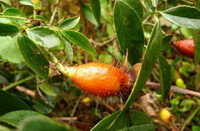 Botanical Description: Commonly known as Cherokee Rose or Jīn Yīnɡ Zǐ, this evergreen climbing shrub grows up to 5 meters tall. Branchlets are stout, bearing scattered recurved spines; they are glabrous but bear glandular hairs in the seedling stage, which gradually abscise with age. Stems are glabrous and armed with falcate spines (barbs) and bristles. Leaves are pinnately compound; petioles and rachises bear small prickles and bristles. Stipules (peraphylla) are lanceolate, free from the petiole, and caducous. Leaflets (foliolules) are coriaceous, usually three (rarely five), elliptic-ovate, obovate, or lanceolate-ovate, measuring 2–7 cm in length and 1.2–3.5 cm (or 1.5–4.5 cm) in width; apices are acute or acuminate; bases are orbicular (subrotund); margins are finely serrulate; surfaces are glabrous and glossy.
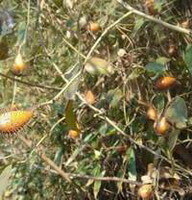 Flowers are solitary, grow in leaf axils or at the tips of lateral branches; they are white, 5–7 cm (or 5–9 cm) in diameter; pedicels measure 1.8–2.5 cm long (occasionally up to 3 cm); both pedicels and the hypanthium (floral tube) are densely covered with bristles externally; these bristles become needle-like spines as fruits develop. There are five sepals and five petals. Sepals are ovate-lanceolate, foliaceous at the apex, with pinnatilobate or entire margins; they bear bristles and glandular hairs, and their inner surface is densely pilose—slightly shorter than the petals. Petals are white, broadly obovate, with emarginate apices. Stamens are numerous; carpels are numerous, with separate, pilose styles shorter than the stamens; stigmas are clustered at the opening of the receptacle.
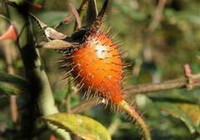 Fruits are pyriform (pear-shaped) or obovoid, rarely subsphaeroidal (nearly spherical), 2–4 cm long, yellowish-red to puce (purplish-brown), densely bristly externally; persistent sepals at the apex are elongated and reflexed; the carpopodium (fruit stalk) is ~3 cm long. Flowering occurs from April to June; fruiting, from July to November.
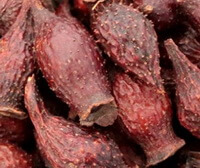 Characteristics of the Herb: The herb is a pseudocarp developed from the floral receptacle, obovate in shape, 2–3.5 cm long and 1–2 cm in diameter. The surface is yellowish-red to brownish-red, slightly glossy, and bears numerous brown protrusions—remnants of shed spiny bristles. The persistent calyx at the apex is disc-shaped, with a slightly elevated center and a yellow stylopodium. The base is attenuated, bearing a residual carpopodium (fruit stalk). The herb is firm and hard. On longitudinal section, the hypanthium (calyx tube) wall is 1–2 mm thick; its inner wall is densely covered with yellow, glossy trichomes. Dozens of achenes are present—flat-fusiform (spindle-shaped), ~7 mm long, pale yellowish-brown, woody, and externally covered with yellowish trichomes. The herb has a slight odor and tastes sweet with mild puckering.
 URL QR code: