Introduction of Shan Zhu Yu: Asiatic Cornelian Cherry Fruit
✵The article records the herb Asiatic Cornelian Cherry Fruit—its English name, Latin name, Pinyin name, properties and flavors, and its botanical source: the dried ripe fruit of Cornus officinalis Sieb. et Zucc. It provides a detailed introduction to the plant’s botanical features, growth characteristics and ecological environment, as well as the herb’s characteristics, pharmacological actions, medicinal efficacy, and administration guidelines.
Fructus Corni (Asiatic Cornelian Cherry Fruit)
Pinyin Name: Shān Zhū Yú
English Name: Asiatic Cornelian Cherry Fruit
Latin Name:Fructus Corni Properties and Flavors: Slightly warm in nature; sour in taste.
Brief Introduction:Fructus Corni is the dried, ripe sarcocarp of Cornus officinalis Sieb. et Zucc. It is used: (1) to nourish Liver and Kidney Yin, alleviating soreness and weakness of the lower back and knees, dizziness, and impotence; and (2) to astringe and arrest abnormal discharge—such as nocturnal emission, enuresis, metrorrhagia, and spontaneous sweating. The herb is commonly known as Fructus Corni, Asiatic Cornelian Cherry Fruit, Common Macrocarpium Fruit, Fruit of Macrocarpium, or Shān Zhū Yú.
Botanical Source: Classical and modern authoritative herbal works define Fructus Corni (Shān Zhū Yú) as the dried, ripe drupe of Cornus officinalis Sieb. et Zucc., a species of the Cornaceae family (dogwood family). It belongs to the genus Cornus, order Apiales. The Cornaceae family comprises approximately 14 genera and over 100 species worldwide; in China, it includes 8 genera and more than 50 species. Naturally distributed across temperate and subtropical mountainous regions of the Northern Hemisphere, it is predominantly cultivated and wild-harvested in China. In China, it thrives in cool, moist, leeward hills and mountains of the middle and lower reaches of the Yangtze and Yellow Rivers, at elevations of 600–1,400 m. It prefers warm-humid climates and exhibits shade tolerance, moderate light preference, and moisture resistance. This widely used species is described below:
(1) Cornus officinalis Sieb. et Zucc.
Botanical Description:Cornus officinalis Sieb. et Zucc. is a deciduous shrub or small tree of the Cornaceae family and Cornus genus. Synonyms include Macrocarpium officinale (Sieb. et Zucc.) Nakai. Common names are Asiatic Cornelian Cherry, Cornelian Dogwood, Common Macrocarpium, and Shān Zhū Yú. Mature height ranges from 4 to 10 m. Bark is taupe (grayish-brown). Branchlets are slender, cylindrical, glabrous or sparsely covered with adnate pubescence. Winter buds are apical and axillary, ovoid to lanceolate, densely covered with tawny (yellowish-brown) pubescence. Leaves are opposite, chartaceous, ovoid, elliptic, or ovate-elliptic (rarely ovate-lanceolate), 5.5–10 cm long and 2.5–4.5 cm wide; apex is acute to acuminate; base is cuneate, broadly cuneate, or subrotund; margins are entire. Upper surface is green and glabrous; lower surface is pale green (sometimes with sparse, appressed white pubescence), bearing clustered brownish or hazel-colored beard hairs in the axils. Midveins are prominent above and convex beneath, becoming nearly glabrous (glabrescent); lateral veins occur in 6–7 pairs, arched and recurved. Petioles are slender, cylindrical, 0.6–1.2 cm long, with a shallow groove on the upper surface and a rounded, slightly pubescent underside.
Inflorescences are terminal or axillary umbels. Each umbel bears four involucral bracts—ovoid, thick chartaceous to coriaceous, ~8 mm long, purplish, sparsely pubescent on both surfaces, and deciduous after flowering. Peduncles are stout, ~2 mm long, sparsely gray-pubescent. Flowers are small, hermaphroditic, and appear before leaf emergence. Calyx has four lobes—broadly triangular, equal to or longer than the floral disc (~0.6 mm), glabrous. Four petals are ligulate-lanceolate, ~3.3 mm long, yellow, and reflexed. Four stamens alternate with petals; filaments are subulate, anthers are elliptic and bilocular, ~1.8 mm long. The floral disc is cushion-shaped and glabrous. Ovary is inferior; receptacle is obovate, ~1 mm long, densely covered with appressed, sparse pubescence. Styles are cylindrical, ~1.5 mm long; stigma is truncate. Pedicels are slender, 0.5–1 cm long, densely covered with sparse pilose.
Fruits are oblong-ovoid drupes, 1.2–1.7 cm long and 5–7 mm in diameter, bright red to deep violet-red at maturity. The endocarp (stone) is bony, narrowly elliptic (~12 mm long), and marked with several irregular longitudinal ridges. Flowering occurs from March to April; fruiting from September to October.
Ecological Environment: The plant grows on forest edges or in forests, at altitudes of 400–1,500 meters above sea level, and rarely up to 2,100 meters. This species is mainly distributed in China.
Growth Characteristics: The plant prefers a warm and moist climate and requires partial to full sunlight. It is advisable to select fields with deep, fertile, well-drained sandy loam or loam soils for cultivation.
Characteristics of the Herb: The pericarp is irregularly flaky or saccate (cystic), about 1–1.5 cm long and 0.5–1 cm wide. The surface of fresh fruit berries is prunus (violet-red) and turns atropurpureus (purple-black) after prolonged storage; the berries become shriveled and glossy. Occasionally, fruit stalk scars are present at the base, and a circular, persistent calyx scar appears at the apex. The herb has a soft, moist, non-friable texture. It has a slight odor and tastes sour, puckering, and slightly bitter.
Medicinal efficacy: Tonifies the liver and kidneys, nourishes essence and qi, astringes and consolidates, and arrests leakage. It is indicated for dizziness, tinnitus, deafness, vertigo, soreness and pain in the lower back and knees, impotence (erectile dysfunction), spermatorrhea, enuresis, urinary frequency, uterine bleeding (metrorrhagia and metrostaxis), abnormal leukorrhea, spontaneous sweating and collapse, liver deficiency with alternating chills and fever, profuse sweating due to general debility, internal heat and wasting thirst (consumptive thirst), palpitations with scattered pulse, etc.
Administration of Fructus Corni (Shān Zhū Yú):
Reference:
Administration Guide for Fructus Corni (Shān Zhū Yú)
TCM Books:
(1) Internally: 6–12 grams; (2) Internally: water decoction, 1.5–3 qian (≈4.5–9 grams), or prepared as pills or powder; (3) Internally: water decoction, 5–10 grams, or prepared as pills or powder.
Contraindications, Precautions, and Adverse Reactions: Fructus Corni should not be combined with Radix Platycodonis, Radix Saposhnikoviae, or Radix Stephaniae Tetrandrae.
Article Link:
URL QR code:
References:
1.Introduction of Shan Zhu Yu: Asiatic Cornelian Cherry Fruit

 ✵The article records the herb Asiatic Cornelian Cherry Fruit—its English name, Latin name, Pinyin name, properties and flavors, and its botanical source: the dried ripe fruit of Cornus officinalis Sieb. et Zucc. It provides a detailed introduction to the plant’s botanical features, growth characteristics and ecological environment, as well as the herb’s characteristics, pharmacological actions, medicinal efficacy, and administration guidelines.
 Pinyin Name: Shān Zhū Yú
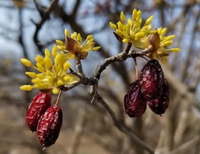 Botanical Source: Classical and modern authoritative herbal works define Fructus Corni (Shān Zhū Yú) as the dried, ripe drupe of Cornus officinalis Sieb. et Zucc., a species of the Cornaceae family (dogwood family). It belongs to the genus Cornus, order Apiales. The Cornaceae family comprises approximately 14 genera and over 100 species worldwide; in China, it includes 8 genera and more than 50 species. Naturally distributed across temperate and subtropical mountainous regions of the Northern Hemisphere, it is predominantly cultivated and wild-harvested in China. In China, it thrives in cool, moist, leeward hills and mountains of the middle and lower reaches of the Yangtze and Yellow Rivers, at elevations of 600–1,400 m. It prefers warm-humid climates and exhibits shade tolerance, moderate light preference, and moisture resistance. This widely used species is described below:
 Botanical Description: Cornus officinalis Sieb. et Zucc. is a deciduous shrub or small tree of the Cornaceae family and Cornus genus. Synonyms include Macrocarpium officinale (Sieb. et Zucc.) Nakai. Common names are Asiatic Cornelian Cherry, Cornelian Dogwood, Common Macrocarpium, and Shān Zhū Yú. Mature height ranges from 4 to 10 m. Bark is taupe (grayish-brown). Branchlets are slender, cylindrical, glabrous or sparsely covered with adnate pubescence. Winter buds are apical and axillary, ovoid to lanceolate, densely covered with tawny (yellowish-brown) pubescence. Leaves are opposite, chartaceous, ovoid, elliptic, or ovate-elliptic (rarely ovate-lanceolate), 5.5–10 cm long and 2.5–4.5 cm wide; apex is acute to acuminate; base is cuneate, broadly cuneate, or subrotund; margins are entire. Upper surface is green and glabrous; lower surface is pale green (sometimes with sparse, appressed white pubescence), bearing clustered brownish or hazel-colored beard hairs in the axils. Midveins are prominent above and convex beneath, becoming nearly glabrous (glabrescent); lateral veins occur in 6–7 pairs, arched and recurved. Petioles are slender, cylindrical, 0.6–1.2 cm long, with a shallow groove on the upper surface and a rounded, slightly pubescent underside.
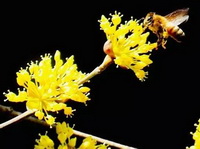 Inflorescences are terminal or axillary umbels. Each umbel bears four involucral bracts—ovoid, thick chartaceous to coriaceous, ~8 mm long, purplish, sparsely pubescent on both surfaces, and deciduous after flowering. Peduncles are stout, ~2 mm long, sparsely gray-pubescent. Flowers are small, hermaphroditic, and appear before leaf emergence. Calyx has four lobes—broadly triangular, equal to or longer than the floral disc (~0.6 mm), glabrous. Four petals are ligulate-lanceolate, ~3.3 mm long, yellow, and reflexed. Four stamens alternate with petals; filaments are subulate, anthers are elliptic and bilocular, ~1.8 mm long. The floral disc is cushion-shaped and glabrous. Ovary is inferior; receptacle is obovate, ~1 mm long, densely covered with appressed, sparse pubescence. Styles are cylindrical, ~1.5 mm long; stigma is truncate. Pedicels are slender, 0.5–1 cm long, densely covered with sparse pilose.
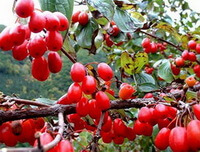 Fruits are oblong-ovoid drupes, 1.2–1.7 cm long and 5–7 mm in diameter, bright red to deep violet-red at maturity. The endocarp (stone) is bony, narrowly elliptic (~12 mm long), and marked with several irregular longitudinal ridges. Flowering occurs from March to April; fruiting from September to October.
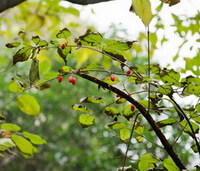 Ecological Environment: The plant grows on forest edges or in forests, at altitudes of 400–1,500 meters above sea level, and rarely up to 2,100 meters. This species is mainly distributed in China.
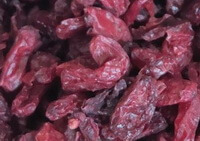 Characteristics of the Herb: The pericarp is irregularly flaky or saccate (cystic), about 1–1.5 cm long and 0.5–1 cm wide. The surface of fresh fruit berries is prunus (violet-red) and turns atropurpureus (purple-black) after prolonged storage; the berries become shriveled and glossy. Occasionally, fruit stalk scars are present at the base, and a circular, persistent calyx scar appears at the apex. The herb has a soft, moist, non-friable texture. It has a slight odor and tastes sour, puckering, and slightly bitter.
 Pharmacological Actions: (1) increases hepatic glycogen levels; (2) counteracts adrenaline-induced hyperglycemia; (3) enhances cellular and humoral immunity while inhibiting mononuclear phagocyte function; (4) exerts antishock effects; (5) exhibits anti-inflammatory activity, among others.
 URL QR code: