✵The article records the herb Arc Shell—its English name, Latin name, Pinyin name, properties and flavor—as well as its source: three shellfish species: (1) Arca subcrenata Lischke, (2) Arca granosa Linnaeus, and (3) Arca inflata Reeve. It provides a detailed introduction to the morphological features of these three shellfish species, their growth characteristics and ecological environments, as well as the characteristics of the herb Arc Shell, its pharmacological actions, medicinal efficacy, and administration guidelines.
Concha Arcae (Arc Shell)
Pinyin Name: Wǎ Lénɡ Zǐ
English Name: Arc Shell
Latin Name:Concha Arcae Properties and Flavor: Neutral in nature; salty in taste
Brief Introduction: The herb Concha Arcae is the shell of Arca subcrenata Lischke, Arca granosa Linnaeus, or Arca inflata Reeve, used to eliminate phlegm and soften hard masses for treating scrofula and goiter. It is commonly known as Concha Arcae, Arc Shell, or Wǎ Lénɡ Zǐ.
Animal Source: Herbal classical works define the herb Concha Arcae (Arc Shell) as the shell of the following species: (1) Arca subcrenata Lischke, (2) Arca granosa Linnaeus, and (3) Arca inflata Reeve. These are species of the genus Scapharca (or Anadara, depending on taxonomic revision), family Arcidae, order Taxodonta. The three commonly used species are introduced below:
(1) Arca subcrenata Lischke
Animal Description:Arca subcrenata Lischke is commonly known as Scapharca subcrenata (Lischke), or Máo Hān, Máo Gé, Xiě Bàng—a species of the genus Scapharca, family Arcidae, order Taxodonta. The shell is long-oval, solid and thick; shell length is about 54 mm, height is about 46 mm; the two valves are markedly expanded; width is 3/4–4/5 of height; the right valve is slightly smaller than the left; the dorsal surface ends are slightly angular; the beak is slightly anterior; the distance between the beaks of the two valves is moderate. The shell surface bears 30–35 radial ribs; rib crests are densely covered with small, square nodules—more distinct on the left valve. The shell surface is covered with a tan (chocolate brown) villiform periostracum; the periostracum is often easily torn and fall off, exposing a frequently whitish shell surface. The inner surface is white or sallow (grayish-yellow); the margins bear teeth and grooves corresponding to the radial ribs. The hinge line is straight, bearing approximately 50 hinge teeth: the median teeth are small and dense; the lateral teeth are large and sparse. The anterior adductor muscle scar is slightly small and horseshoe-shaped (U-shaped); the posterior adductor muscle scar is oval (egg-shaped).
Ecological Environment: This shellfish inhabits the intertidal zone down to sandy-muddy seabeds at depths of 4–20 meters, preferring areas near estuaries with slight freshwater inflow.
Life Habits: These three mollusks are common in coastal regions. They prefer sheltered inner bays with gentle tidal currents and freshwater input, as well as soft mudflats near rivers. They feed on algae and exhibit strong adaptability to salinity and temperature fluctuations in natural marine environments. Arca subcrenata Lischke is dioecious and begins spawning when ambient seawater temperature reaches approximately 25 °C (77 °F); peak spawning occurs at 27 °C (80.6 °F). Fertilization of sperm and eggs takes place externally in seawater.
Characteristics of the Herb: The shell is short and wide—2–4.5 cm in length and 1.5–4 cm in width—with 30–34 radial ribs bearing small nodules; the surface retains hairy periostracum. It possesses approximately 50 hinge teeth.
(2) Arca granosa Linnaeus
Animal Description:Arca granosa Linnaeus is also known as Anadara granosa (Linnaeus) and commonly called Ní Hān or Huī Gé (gray clam)—a species of the genus Anadara, family Arcidae, order Taxodonta. Its shell is oval (egg-shaped), very firm and thick; shell length is about 43 mm, height is about 36 mm; the two valves are markedly expanded; width is slightly less than height. The distance between the beaks is relatively large. Radial ribs are well developed—18–21 in number—with distinctly intermittent granular nodules; nodules are less pronounced along the shell margin. The inner surface is ash-gray (grayish-white); the margin bears deep grooves corresponding to the radial ribs. The hinge line is straight, bearing about 40 hinge teeth. The anterior adductor muscle scar is small and triangular; the posterior adductor muscle scar is large and nearly square. Hemoglobin is present in the blood, imparting a red color—hence the common name "blood cockle."
Ecological Environment: This shellfish inhabits soft mudflats in the mid- to lower intertidal zone; the subsurface mud layer is approximately 70 mm deep.
Life Habits: These three molluscan species are common in coastal regions. They inhabit sheltered inner bays with gentle tidal currents and freshwater input, as well as soft mudflats near rivers. They feed on algae and exhibit strong adaptability to salinity and temperature fluctuations in natural marine environments. Arca granosa Linnaeus is a multiple spawner; ovulation occurs 4–5 times annually in natural marine habitats. Fertilized eggs develop through the trochophore and veliger larval stages and metamorphose into benthic juveniles attached to the seafloor within approximately 2–3 weeks.
Arca granosa Linnaeus prefers soft mudflats in inner bays and estuaries with freshwater inflow. Its highest densities occur at the interface between the mid-intertidal and low-intertidal zones, where individuals remain buried. It lacks siphons; instead, only the posterior margin of the shell forms apertures on the sediment surface, enabling communication with the overlying water. The optimal salinity range is 10–28.8‰, and the tolerable water temperature range is 0–35 °C (32–95 °F). Arca granosa is a filter-feeding bivalve that consumes diatoms and organic detritus. It is protandrous hermaphroditic, with the main reproductive season occurring from July to September.
Characters of herbs: The shell is small—2–4.5 cm in length and 1.5–4 cm in width—with 18–20 radial ribs composed of intermittent granular protrusions. It bears approximately 40 hinge teeth.
(3) Arca inflata Reeve.
Animal Description:Arca inflata Reeve is also known as Scapharca inflata (Reeve) and commonly referred to as Kuí Hān or Dà Máo Gé—a species of the genus Anadara, family Arcidae, order Taxodonta. The shell is obliquely ovate, firm and thick. Typical dimensions are 80–104 mm in length and 62–85 mm in height; exceptionally large specimens reach up to 122 mm in length and 102 mm in height. The two valves are tightly clasped; the left valve is slightly larger than the right and markedly inflated. The beak is prominent and recurved (curving inward), extending slightly beyond the ligament area. The ligament is fusiform and covered by a thick, blackish-brown corneous periostracum. The dorsal margins are slightly obtuse; the anterior margin and periostracal edges are rounded. The posterior margin extends into a truncate shape. Radial ribs are broad, smooth, and orderly—42–48 in number (most commonly 43–44)—with no conspicuous nodules; annual growth lines are distinct. The shell surface is white, overlaid with tan (chocolate brown) fluffy periostracum; the periostracum often wears off near the beak, exposing a whitened apex. The interior surface is white. The hinge line is straight, bearing 60–70 hinge teeth: median teeth are small and upright; lateral teeth gradually increase in size and incline outward. The adductor muscle scars are prominent—the anterior scar is small and oval (egg-shaped); the posterior scar is large and pyriform (pear-shaped). The pallial line is distinct; the gills (ctenidia) are yellow-red. The shell margin is thickened and bears dentate projections corresponding to the radial rib grooves.
Ecological Environment: This species inhabits the subtidal zone—specifically deep muddy or sandy-muddy substrates at depths of 5–30 m—and occasionally occurs in intertidal rock crevices.
Life Habits: These three bivalve species are common in coastal areas. They inhabit sheltered inner bays with gentle tidal currents and freshwater input, as well as soft mudflats near rivers. They feed on algae and exhibit strong adaptability to salinity and temperature variations in natural marine environments.
Characteristics of the Herb: The shell is obliquely ovate; the left and right valves are similarly shaped, though the left valve is slightly larger. Length is approximately 8 cm; width is approximately 6 cm. The dorsal surface is prominently convex. The back bears 42–48 straight, tile-like radial ribs, with clear radiating ridges extending from the beak to the periphery. Alternating bands of taupe (grayish-brown) and white are visible; nodules are absent. The surface is covered with fine brown hairs. The interior surface is cream-white and smooth; the upper margin bears concavities corresponding to the rib impressions, forming approximately 70 serrated hinge teeth. The shell is dense and hard—capable of being crushed—and its fracture surface is white. The herb is odorless and tasteless.
Pharmacological Actions: Calcium carbonate in Concha Arcae neutralizes gastric acid.
Medicinal Efficacy: Reduces phlegm and dissolves accumulated blood stasis; softens hard masses and disperses nodules; invigorates blood circulation by eliminating stasis; relieves food retention (or Qi stagnation); alleviates gastric hyperacidity and stomachache. It is indicated for stubborn phlegm accumulation or conglomeration, chronic phlegm-damp cough, sticky and thick phlegm that is difficult to expectorate, phlegm retention, gastralgia (i.e., stomachache or stomach pain), gastric upset, acid regurgitation, abdominal masses, palpable abdominal lumps, goiters, scrofula (cervical lymphadenopathy, lymphoid tuberculosis), gingival atrophy (ulcerative gingivitis), wound bleeding, chilblains (pernio), scalds and burns, etc.
Administration of Concha Arcae (Wǎ Lénɡ Zǐ):
Reference:
Administration Guide for Concha Arcae (Wǎ Lénɡ Zǐ)
TCM Books:
(1) Internally: 9–15 grams; (2) Internally: water decoction (preferably prolonged boiling), 3–5 qián (≈9–15 grams); or prepared as pills or powder. External use: finely ground herb powder, mixed and applied topically. (3) Internally: water decoction, 9–15 grams; preferably crushed before decoction. Finely ground herb powder: 1–3 grams per dose; or prepared as pills or powder. External use: appropriate amount; calcined herb, finely ground into powder, mixed and applied topically.
Concha Arcae Usta (Calcined Arc Shell)
Pinyin Name: Duàn Wǎ Lénɡ
English Name: Calcined Arc Shell
Latin Name:Concha Arcae Usta Property and Flavor: Neutral; salty
Brief Introduction:Concha Arcae Usta is the calcined shell of Arca subcrenata Lischke, Arca granosa Linnaeus, or Arca inflata Reeve (family Arcidae), used as an antacid for treating acid regurgitation. It is commonly known as Concha Arcae Usta, Calcined Arc Shell, or Duàn Wǎ Lénɡ Zǐ.
Common official herbal monographs and authoritative herbal texts define Concha Arcae Usta (Calcined Arc Shell) as the calcined shell of the following species: (1) Arca subcrenata Lischke, (2) Arca granosa Linnaeus, and (3) Arca inflata Reeve. These species are described in the preceding entry "Concha Arcae (Arc Shell)".

 ✵The article records the herb Arc Shell—its English name, Latin name, Pinyin name, properties and flavor—as well as its source: three shellfish species: (1) Arca subcrenata Lischke, (2) Arca granosa Linnaeus, and (3) Arca inflata Reeve. It provides a detailed introduction to the morphological features of these three shellfish species, their growth characteristics and ecological environments, as well as the characteristics of the herb Arc Shell, its pharmacological actions, medicinal efficacy, and administration guidelines.
 Pinyin Name: Wǎ Lénɡ Zǐ
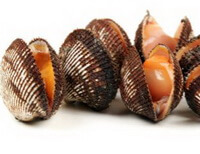 Animal Description: Arca subcrenata Lischke is commonly known as Scapharca subcrenata (Lischke), or Máo Hān, Máo Gé, Xiě Bàng—a species of the genus Scapharca, family Arcidae, order Taxodonta. The shell is long-oval, solid and thick; shell length is about 54 mm, height is about 46 mm; the two valves are markedly expanded; width is 3/4–4/5 of height; the right valve is slightly smaller than the left; the dorsal surface ends are slightly angular; the beak is slightly anterior; the distance between the beaks of the two valves is moderate. The shell surface bears 30–35 radial ribs; rib crests are densely covered with small, square nodules—more distinct on the left valve. The shell surface is covered with a tan (chocolate brown) villiform periostracum; the periostracum is often easily torn and fall off, exposing a frequently whitish shell surface. The inner surface is white or sallow (grayish-yellow); the margins bear teeth and grooves corresponding to the radial ribs. The hinge line is straight, bearing approximately 50 hinge teeth: the median teeth are small and dense; the lateral teeth are large and sparse. The anterior adductor muscle scar is slightly small and horseshoe-shaped (U-shaped); the posterior adductor muscle scar is oval (egg-shaped).
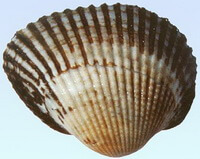 Ecological Environment: This shellfish inhabits the intertidal zone down to sandy-muddy seabeds at depths of 4–20 meters, preferring areas near estuaries with slight freshwater inflow.
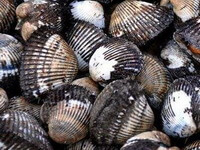 Characteristics of the Herb: The shell is short and wide—2–4.5 cm in length and 1.5–4 cm in width—with 30–34 radial ribs bearing small nodules; the surface retains hairy periostracum. It possesses approximately 50 hinge teeth.
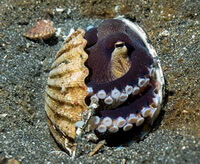 Animal Description: Arca granosa Linnaeus is also known as Anadara granosa (Linnaeus) and commonly called Ní Hān or Huī Gé (gray clam)—a species of the genus Anadara, family Arcidae, order Taxodonta. Its shell is oval (egg-shaped), very firm and thick; shell length is about 43 mm, height is about 36 mm; the two valves are markedly expanded; width is slightly less than height. The distance between the beaks is relatively large. Radial ribs are well developed—18–21 in number—with distinctly intermittent granular nodules; nodules are less pronounced along the shell margin. The inner surface is ash-gray (grayish-white); the margin bears deep grooves corresponding to the radial ribs. The hinge line is straight, bearing about 40 hinge teeth. The anterior adductor muscle scar is small and triangular; the posterior adductor muscle scar is large and nearly square. Hemoglobin is present in the blood, imparting a red color—hence the common name "blood cockle."
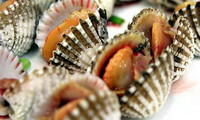 Ecological Environment: This shellfish inhabits soft mudflats in the mid- to lower intertidal zone; the subsurface mud layer is approximately 70 mm deep.
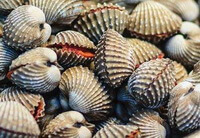 Arca granosa Linnaeus prefers soft mudflats in inner bays and estuaries with freshwater inflow. Its highest densities occur at the interface between the mid-intertidal and low-intertidal zones, where individuals remain buried. It lacks siphons; instead, only the posterior margin of the shell forms apertures on the sediment surface, enabling communication with the overlying water. The optimal salinity range is 10–28.8‰, and the tolerable water temperature range is 0–35 °C (32–95 °F). Arca granosa is a filter-feeding bivalve that consumes diatoms and organic detritus. It is protandrous hermaphroditic, with the main reproductive season occurring from July to September.
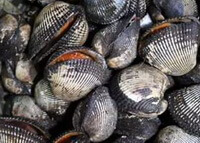 Animal Description: Arca inflata Reeve is also known as Scapharca inflata (Reeve) and commonly referred to as Kuí Hān or Dà Máo Gé—a species of the genus Anadara, family Arcidae, order Taxodonta. The shell is obliquely ovate, firm and thick. Typical dimensions are 80–104 mm in length and 62–85 mm in height; exceptionally large specimens reach up to 122 mm in length and 102 mm in height. The two valves are tightly clasped; the left valve is slightly larger than the right and markedly inflated. The beak is prominent and recurved (curving inward), extending slightly beyond the ligament area. The ligament is fusiform and covered by a thick, blackish-brown corneous periostracum. The dorsal margins are slightly obtuse; the anterior margin and periostracal edges are rounded. The posterior margin extends into a truncate shape. Radial ribs are broad, smooth, and orderly—42–48 in number (most commonly 43–44)—with no conspicuous nodules; annual growth lines are distinct. The shell surface is white, overlaid with tan (chocolate brown) fluffy periostracum; the periostracum often wears off near the beak, exposing a whitened apex. The interior surface is white. The hinge line is straight, bearing 60–70 hinge teeth: median teeth are small and upright; lateral teeth gradually increase in size and incline outward. The adductor muscle scars are prominent—the anterior scar is small and oval (egg-shaped); the posterior scar is large and pyriform (pear-shaped). The pallial line is distinct; the gills (ctenidia) are yellow-red. The shell margin is thickened and bears dentate projections corresponding to the radial rib grooves.
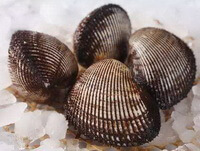 Ecological Environment: This species inhabits the subtidal zone—specifically deep muddy or sandy-muddy substrates at depths of 5–30 m—and occasionally occurs in intertidal rock crevices.
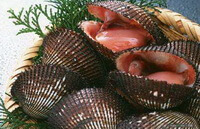 Characteristics of the Herb: The shell is obliquely ovate; the left and right valves are similarly shaped, though the left valve is slightly larger. Length is approximately 8 cm; width is approximately 6 cm. The dorsal surface is prominently convex. The back bears 42–48 straight, tile-like radial ribs, with clear radiating ridges extending from the beak to the periphery. Alternating bands of taupe (grayish-brown) and white are visible; nodules are absent. The surface is covered with fine brown hairs. The interior surface is cream-white and smooth; the upper margin bears concavities corresponding to the rib impressions, forming approximately 70 serrated hinge teeth. The shell is dense and hard—capable of being crushed—and its fracture surface is white. The herb is odorless and tasteless.
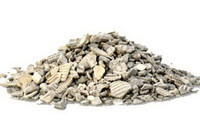 Pinyin Name: Duàn Wǎ Lénɡ
 URL QR code: