✵This article documents the herb Snakegourd Fruit, including its English name, Latin name, Pinyin name, property and flavor, botanical sources—two plant species: (1) Trichosanthes kirilowii Maxim. and (2) Trichosanthes rosthornii Harms.—along with detailed descriptions of their botanical features, growth characteristics, ecological environments, macroscopic and microscopic characteristics of the dried fruit, pharmacological actions, medicinal efficacy, and administration guidelines.
Fructus Trichosanthis (Snakegourd Fruit)
Pinyin Name: Guā Lóu
English Name: Snakegourd Fruit
Latin Name:Fructus Trichosanthis Property and Flavor: Cold; sweet, slightly bitter
Brief Introduction:Fructus Trichosanthis is the dried fruit of Trichosanthes kirilowii Maxim. or Trichosanthes rosthornii Harms. It is used: (1) to clear heat and resolve phlegm, thereby relieving cough and dyspnea caused by heat-phlegm; (2) to soothe the chest and alleviate angina pectoris; (3) to reduce swelling in the treatment of lung abscess, appendicitis, and mastitis; and (4) to moisten the intestines and promote bowel movement. The herb is commonly known as Fructus Trichosanthis, Snakegourd Fruit, or Guā Lóu.
Botanical Source:Fructus Trichosanthis (Snakegourd Fruit) is the dried fruit of Trichosanthes kirilowii Maxim. or Trichosanthes rosthornii Harms., both belonging to the genus Trichosanthes (family Cucurbitaceae, the cucumber, gourd, and squash family; order Cucurbitales). These two commonly used species are described below:
(1) Trichosanthes kirilowii Maxim.
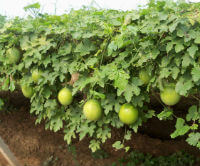
Botanical Description:Trichosanthes kirilowii Maxim. is a perennial climbing vine of the Cucurbitaceae family, commonly known as Guā Lóu. Stems reach up to 10 meters in length; the root tuber is columnar, thick, and hypertrophied, rich in starch. Stems are stout, much-branched, with prominent longitudinal ribs and grooves, and covered with white, spreading pubescence. Leaves are alternate; petioles measure 3–10 cm long, longitudinally striped, and densely pilose; tendrils are branched into 3–7 segments and pilose; leaf blades are chartaceous (papery), orbicular or subcordate in outline, averaging 5–20 cm in both length and width; they are typically 3–7-lobed to the midrib, rarely deeply divided or entire, bearing only unequal, coarse, irregular teeth; lobes are rhomboid-obovoid or oblong, with obtuse or acute apices; margins are usually shallowly lobed again; leaf bases are cordate, with sinus depth of 3–4 cm; the upper surface is dark green and rough; the lower surface is pale green, with long pilose-like bristles along both primary veins on both surfaces; palmate venation with five primary veins; veinlets form a reticulate pattern.
Flowers are dioecious. Male inflorescences are racemes, solitary or occasionally co-occurring with a single flower; racemes occur singly on upper shoots and branches, measuring 10–20 cm long, stout, with longitudinal ribs and grooves, and puberulent; each raceme bears 5–8 flowers at the apex; pedicels of solitary flowers are ~15 cm long; individual flower pedicels are ~3 mm long; bractlets are obovate or broadly ovate, 1.5–2.5 (occasionally up to 3) cm long and 1–2 cm wide, with coarse teeth in the middle and upper parts, stipitate at the base, and pubescent; the hypanthium (calyx tube) is fistulose (tubular), 2–4 cm long, widened apically to ~10 mm in diameter, ~5 mm in diameter in the middle and lower portions, and pubescent; calyx lobes are lanceolate, 10–15 mm long and 3–5 mm wide, entire; corolla is white, with obovate lobes ~20 mm long and ~18 mm wide; each lobe apex bears a single green, pointed tip and filiform tassels on both sides; corolla is pubescent; anthers are closely appressed, ~6 mm long and ~4 mm in diameter; filaments are separate, stout, and villous. Female flowers are solitary; pedicels are ~7.5 cm long and pubescent; the hypanthium is cylindrical, ~2.5 cm long and ~1.2 cm in diameter; calyx lobes and corolla resemble those of male flowers; ovary is elliptical, green, ~2 cm long; style is ~2 cm long; stigma is trifid.
Fruit stalks (carpopodia) are stout, 4–11 cm long; fruits are ellipsoid or nearly globose, 7–10.5 cm long, yellow-brown to orange-yellow at maturity. Seeds are ovate-elliptic, compressed, 11–16 mm long and 7–12 mm wide, pale yellow-brown, with a prominent marginal ridge. Flowering occurs from May to August; fruiting occurs from August to October.
Ecological Environment: This species typically grows in forests on slopes, shrublands, grasslands, and fields near villages, at elevations of 200–1,800 m above sea level. It is also widely cultivated within its natural distribution range.
Growth Characteristics: The plant prefers warm and humid climates. It is moderately cold-tolerant but drought-intolerant. Optimal cultivation sites receive full sun, have deep, loose, fertile sandy loam soils. Low-lying, saline, or alkaline soils are unsuitable for cultivation.
Characteristics of the Herb: The dried fruit is nearly spherical or broadly ellipsoidal, 7–10 cm long and 6–10 cm in diameter. The surface is salmon-colored or orange-yellow, wrinkled or relatively smooth; the apex bears a circular style remnant, and the base is slightly pointed, with residual carpopodia (fruit stalks). The texture is brittle and friable, easily fractured; the inner surface is yellowish-white, with reddish-yellow reticulate veins; the pulp is orange-yellow, viscous, and adheres to numerous seeds, forming a compact mass. The herb has a caramel-like aroma and tastes mildly sour and sweet.
Medicinal Efficacy: Clears heat and resolves phlegm; relieves chest constraint and dissipates nodules; moistens dryness and promotes bowel movement. Indicated for lung-heat cough, thick yellow phlegm, chest obstruction with cardiac pain, pathogenic accumulation in the chest causing distension and fullness, acute mastitis, pulmonary abscess, periappendiceal abscess, swelling and pain, and constipation.
Administration of Fructus Trichosanthis (Guā Lóu):
Reference:
Administration Guide for Fructus Trichosanthis (Guā Lóu)
TCM Books:
(1) Internally: 9–15 grams; (2) Internally: 9–12 grams, as a water decoction, or prepared as a powder. External use: appropriate amount; charred (carbonized) herb—prepared as a finely ground powder and applied topically.
(2) Trichosanthes rosthornii Harms.
Botanical Description:Trichosanthes rosthornii Harms. is a perennial climbing vine of the Cucurbitaceae family (cucumber, gourd, and squash family), commonly known as Shuāng Biān Guā Lóu. Its morphological features closely resemble those of Trichosanthes kirilowii Maxim., except that the plant is generally smaller; leaf blades are typically 3–7-parted almost to the base, with linear-lanceolate or oblanceolate lobes; lobulets are rare; bractlets of male flowers are small, usually 5–16 mm long and 5–11 mm wide; calyx lobes are linear; and the seed ridge is distant from the margin.
Ecological environment: This species grows in dense forests in valleys, thickets on mountain slopes, and grasslands at elevations of 400–1,850 m above sea level.
Radix Trichosanthis (Snake-gourd Root)
Pinyin Name: Tiān Huā Fěn
English Name: Snake-gourd Root
Latin Name:Radix Trichosanthis Property and Flavor: Slightly cold; sweet, slightly bitter
Brief Introduction:Radix Trichosanthis is the dried root of Trichosanthes kirilowii Maxim. or Trichosanthes rosthornii Harms. It is used to clear heat, promote fluid production, moisten the lungs, resolve toxins, and reduce swelling—indicated for thirst in febrile diseases and diabetes mellitus, as well as for boils, sores, and abscesses.
Botanical Source:Radix Trichosanthis (Snake-gourd Root) is the dried root of Trichosanthes kirilowii Maxim. or Trichosanthes rosthornii Harms., both belonging to the genus Trichosanthes (family Cucurbitaceae, the cucumber, gourd, and squash family; order Cucurbitales).
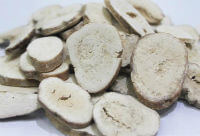
Characteristics of the Herb: The root of Trichosanthes kirilowii Maxim. is irregularly cylindrical, fusiform (spindle-shaped), or valvular (block-shaped), 8–40 cm long and 2–5 cm in diameter. The outer surface (exocarp) is yellowish-brown, bearing longitudinal wrinkles and transversely elongated lenticels; after removal of the exocarp, the surface becomes smooth, yellowish-white, with transverse wrinkles and patches of residual cork; yellow longitudinal stripes are visible on the longitudinal section. The texture is solid and firm; the fracture surface is yellowish-white and mealy (powdery), with conspicuous vascular bundles arranged in a slightly radial pattern. The herb has a faint odor and a slightly bitter taste.
The root of Trichosanthes rosthornii Harms.: the peeled root is light grayish-yellow to yellowish-brown; the fracture surface is light grayish-yellow and less mealy; the unpeeled root is taupe-brown with reticulate wrinkles.
Medicinal Efficacy: Clears heat and generates fluids; moistens the lungs and resolves phlegm; reduces swelling and expels pus. Indicated for thirst in febrile diseases, polydipsia and wasting-thirst syndrome (diabetes mellitus), lung-heat dry cough, and ulcerative or suppurative swellings.
Administration of Radix Trichosanthis (Tiān Huā Fěn):
Reference:
Administration Guide for Radix Trichosanthis (Tiān Huā Fěn)
TCM Books:
(1) Internally: 10–15 grams; (2) Internally: water decoction, 3–4 qian (approximately 9–12 grams), or prepared as pills or powder; external use: prepare as finely ground herb powder and apply topically; (3) Internally: 9–15 grams, water decoction, or prepared as pills or powder; external use: appropriate amount, prepare as finely ground herb powder and apply topically.
Contraindications, Precautions, and Adverse Reactions: Radix Trichosanthis should be used with caution during pregnancy and should not be combined with Aconiti species herbs.

 ✵This article documents the herb Snakegourd Fruit, including its English name, Latin name, Pinyin name, property and flavor, botanical sources—two plant species: (1) Trichosanthes kirilowii Maxim. and (2) Trichosanthes rosthornii Harms.—along with detailed descriptions of their botanical features, growth characteristics, ecological environments, macroscopic and microscopic characteristics of the dried fruit, pharmacological actions, medicinal efficacy, and administration guidelines.
 Pinyin Name: Guā Lóu
 Botanical Description: Trichosanthes kirilowii Maxim. is a perennial climbing vine of the Cucurbitaceae family, commonly known as Guā Lóu. Stems reach up to 10 meters in length; the root tuber is columnar, thick, and hypertrophied, rich in starch. Stems are stout, much-branched, with prominent longitudinal ribs and grooves, and covered with white, spreading pubescence. Leaves are alternate; petioles measure 3–10 cm long, longitudinally striped, and densely pilose; tendrils are branched into 3–7 segments and pilose; leaf blades are chartaceous (papery), orbicular or subcordate in outline, averaging 5–20 cm in both length and width; they are typically 3–7-lobed to the midrib, rarely deeply divided or entire, bearing only unequal, coarse, irregular teeth; lobes are rhomboid-obovoid or oblong, with obtuse or acute apices; margins are usually shallowly lobed again; leaf bases are cordate, with sinus depth of 3–4 cm; the upper surface is dark green and rough; the lower surface is pale green, with long pilose-like bristles along both primary veins on both surfaces; palmate venation with five primary veins; veinlets form a reticulate pattern.
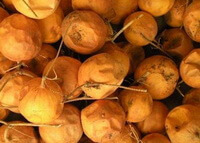 Characteristics of the Herb: The dried fruit is nearly spherical or broadly ellipsoidal, 7–10 cm long and 6–10 cm in diameter. The surface is salmon-colored or orange-yellow, wrinkled or relatively smooth; the apex bears a circular style remnant, and the base is slightly pointed, with residual carpopodia (fruit stalks). The texture is brittle and friable, easily fractured; the inner surface is yellowish-white, with reddish-yellow reticulate veins; the pulp is orange-yellow, viscous, and adheres to numerous seeds, forming a compact mass. The herb has a caramel-like aroma and tastes mildly sour and sweet.
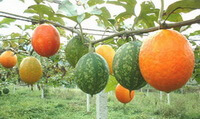 Botanical Description: Trichosanthes rosthornii Harms. is a perennial climbing vine of the Cucurbitaceae family (cucumber, gourd, and squash family), commonly known as Shuāng Biān Guā Lóu. Its morphological features closely resemble those of Trichosanthes kirilowii Maxim., except that the plant is generally smaller; leaf blades are typically 3–7-parted almost to the base, with linear-lanceolate or oblanceolate lobes; lobulets are rare; bractlets of male flowers are small, usually 5–16 mm long and 5–11 mm wide; calyx lobes are linear; and the seed ridge is distant from the margin.
 Pinyin Name: Tiān Huā Fěn
 URL QR code: