Introduction of Pang Da Hai: Boat-fruited Sterculia Seed
✵The article records the herb Boat-fruited Sterculia Seed, including its English name, Latin name, Pinyin name, properties and flavor, and botanical source—namely one plant species, (1) Sterculia lychnophora Hance—with a detailed introduction to the botanical features, growth characteristics, and ecological environment of this plant species; as well as the morphological characteristics of the herb, its pharmacological actions, medicinal efficacy, and administration guidelines.
Pinyin Name: Pànɡ Dà Hǎi
English Name: Boat-fruited Sterculia Seed
Latin Name:Semen Sterculiae Lychnophorae Properties and Flavor: Cold, sweet
Brief Introduction:Semen Sterculiae Lychnophorae is the dried ripe seed of Sterculia lychnophora Hance, used (1) to clear lung heat and relieve sore throat, hoarseness, and cough; and (2) to moisten the intestines and alleviate constipation.
Botanical Source:Semen Sterculiae Lychnophorae (Boat-fruited Sterculia Seed) is the dried ripe seed of Sterculia lychnophora Hance, a plant belonging to the genus Sterculia L. in the family Malvaceae (formerly in family Sterculiaceae) and order Malvales. It is also known as Boat-fruited Scaphium Seed, Seed of Boat-fruited Sterculia, or Pànɡ Dà Hǎi.
Classical herbal works define Semen Sterculiae Lychnophorae (Boat-fruited Sterculia Seed) as the dried ripe seed of (1) Sterculia lychnophora Hance. This commonly used species is introduced below:
(1) Sterculia lychnophora Hance.
Botanical Description:Sterculia lychnophora Hance is a deciduous tree reaching up to 40 meters in height. The bark is coarse and longitudinally fissured (pinstriped). Leaves are alternate; petioles are 5–15 cm long; leaf blades are coriaceous, oblong-ovoid or slightly triangular, 10–20 cm long and 6–12 cm wide; apex is obtuse or acute; base is rounded or subcordate; margin is entire or with three shallow sinuses; surfaces are smooth and glabrous; venation is subreticulate, with conspicuous veins on the abaxial surface.
Inflorescences are terminal or axillary panicles; flowers are monoecious; calyx is campanulate (bell-shaped), 7–10 mm long, deeply lobed with lanceolate, persistent lobes; outer surface is stellately pubescent. Male flowers possess 10–15 stamens; anthers and filaments are sparsely pubescent; sterile carpels are pubescent. Female flowers bear a single pistil composed of five pubescent carpels; ovary stalk is slender; stigma is 2–5-lobed; staminodes present as a cluster of filamentless anthers surrounding and inserted at the base of the ovary.
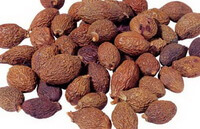
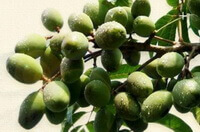
Fruit consists of 1–5 follicles, boat-shaped, up to 24 cm long and 5–6 cm wide at the base; dehiscing before maturity, each containing one seed. Seeds are elliptic to oblong or occasionally fusiform, 1.8–3 cm long and 1–1.6 cm in diameter; dark brown or yellow-brown; surface is sparsely wrinkled; hilum is ventral and deflexed.
Ecological Environment: The tree grows in tropical regions.
Growth Characteristics: Native to tropical areas, it thrives in introduced zones with an average annual temperature of 21–24.9 °C (69.8–76.8 °F). It prefers full sun and exhibits drought tolerance in maturity. Soil requirements are not stringent; it grows well in sandy loam, yellow loam, and lateritic soils. Well-drained, wind-protected sites are optimal for cultivation.
Characteristics of the Herb: The herb is elliptical, resembling the Chinese white olive, 2–3 cm long and 1.1–1.8 cm in diameter, slightly tapering at both ends. The surface is yellowish-brown to brown, slightly glossy, with irregular fine wrinkles; the base tapers slightly and bears a pale, circular hilum. The testa (outer layer of the seed coat) is extremely thin, brittle, and readily exfoliates. The mesosperm (middle layer of the seed coat) is thick, dark brown, and leptodermous; its texture is loose and friable, rapidly swelling into a sponge-like mass upon immersion in water—causing the testa to crack—and scattered resinous dots are visible on the fracture surface. The endothelium (inner layer of the seed coat) is reddish-brown, slightly coriaceous, and peels easily from the mesosperm; the endosperm is thickened and yellowish (light yellow). Two cotyledons are thin, yellow, closely appressed to the inner surface of the endosperm, and approximately equal in size to the endosperm. The herb has a faint odor and a slightly sweet taste; it becomes mucilaginous upon prolonged chewing.
Medicinal Efficacy: Clears heat and moistens the lung; soothes the throat and detoxifies. Indicated for dry cough without phlegm, sore throat, hoarseness or aphonia, tidal fever due to yin deficiency (bone-steaming fever), hemoptysis, epistaxis, hematochezia, conjunctival congestion (red eyes), toothache, and hemorrhoidal bleeding.
Administration of Semen Sterculiae Lychnophorae (Pànɡ Dà Hǎi):
Reference:
Administration Guide for Semen Sterculiae Lychnophorae (Pànɡ Dà Hǎi)
TCM Books:
(1) Internally: 2–3 seeds, soaked in hot water and taken as an infusion; or prepared as a decoction; (2) water decoction, 1.5–3 qián (about 4.5–9 grams), or brewed as tea; (3) 2–4 seeds (up to 10 seeds for severe cases), either decocted or infused in hot water; alternatively, prepared as a fine powder—administered at half the dose of the whole seed form.
Article Link:
URL QR code:
References:
1.Introduction of Pang Da Hai: Boat-fruited Sterculia Seed.

 ✵The article records the herb Boat-fruited Sterculia Seed, including its English name, Latin name, Pinyin name, properties and flavor, and botanical source—namely one plant species, (1) Sterculia lychnophora Hance—with a detailed introduction to the botanical features, growth characteristics, and ecological environment of this plant species; as well as the morphological characteristics of the herb, its pharmacological actions, medicinal efficacy, and administration guidelines.
 Pinyin Name: Pànɡ Dà Hǎi
 Botanical Description: Sterculia lychnophora Hance is a deciduous tree reaching up to 40 meters in height. The bark is coarse and longitudinally fissured (pinstriped). Leaves are alternate; petioles are 5–15 cm long; leaf blades are coriaceous, oblong-ovoid or slightly triangular, 10–20 cm long and 6–12 cm wide; apex is obtuse or acute; base is rounded or subcordate; margin is entire or with three shallow sinuses; surfaces are smooth and glabrous; venation is subreticulate, with conspicuous veins on the abaxial surface.
 Ecological Environment: The tree grows in tropical regions.
 URL QR code: