Introduction of Chuan Bei Mu: Tendrilleaf Fritillary Bulb
✵This article records the herb Tendrilleaf Fritillary Bulb—including its English name, Latin name, Pinyin name, properties and flavor, and botanical sources: five plant species—(1) Fritillaria cirrhosa D. Don, (2) Fritillaria unibracteata Hsiao et K. C. Hsia, (3) Fritillaria przewalskii Maxim. ex Batal., (4) Fritillaria delavayi Franch., and (5) Fritillaria cirrhosa D. Don var. ecirrhosa Franch. It provides a detailed introduction to the botanical features, growth characteristics, and ecological environments of these five species; the morphological features of the herb Tendrilleaf Fritillary Bulb; its pharmacological actions, medicinal efficacy, and administration guidelines.
Pinyin Name: Chuān Bèi Mǔ
English Name: Tendrilleaf Fritillary Bulb
Latin Name:Bulbus Fritillarie Cirrhosae Properties and Flavor: Slightly cold; bitter and sweet
Brief Introduction:Bulbus Fritillariae Cirrhosae is the dried bulb of Fritillaria cirrhosa D. Don, Fritillaria unibracteata Hsiao et K. C. Hsia, Fritillaria przewalskii Maxim. ex Batal., or Fritillaria delavayi Franch. It is used (1) to clear heat, resolve phlegm, and moisten the lungs—to relieve dry cough due to lung-heat and chronic cough with bloody sputum in cases of pulmonary tuberculosis—and (2) to dissipate nodules, for treating boils, sores, mastitis, and lung abscesses.
Botanical Source:Bulbus Fritillariae Cirrhosae (Tendrilleaf Fritillary Bulb) is the dried bulb of Fritillaria cirrhosa D. Don, Fritillaria unibracteata Hsiao et K. C. Hsia, Fritillaria przewalskii Maxim. ex Batal., or Fritillaria delavayi Franch. These are plants of the genus Fritillaria L., family Liliaceae (lily family), order Liliales. It is also known as Unibract Fritillary Bulb, Bulb of Unibract Fritillary, Bulb of Tendrilleaf Fritillary, Bulb of Przewalsk’s Fritillary, Bulb of Delavay’s Fritillary, or Chuān Bèi Mǔ.
Classical herbal works define Bulbus Fritillariae Cirrhosae (Tendrilleaf Fritillary Bulb) as the dried bulb of (1) Fritillaria cirrhosa D. Don, (2) Fritillaria unibracteata Hsiao et K. C. Hsia, (3) Fritillaria przewalskii Maxim. ex Batal., (4) Fritillaria delavayi Franch., and (5) Fritillaria cirrhosa D. Don var. ecirrhosa Franch. These five commonly used species are described below:
(1) Fritillaria cirrhosa D. Don
Botanical Description:Fritillaria cirrhosa D. Don is also known as Juǎn Yè Bèi Mǔ or Curled-Leaf Fritillary Bulb. It is a perennial herb exhibiting considerable morphological variation. The scaly bulbs are ovoid, composed of two scales, 1–1.5 cm in diameter. Leaves are usually opposite; occasionally, a few are scattered or whorled in the middle portion. Leaf blades are linear to linear-lanceolate, with the apex slightly recurved or uncurled.
Flowers are solitary and grow at the stem apex; they are purple to yellowish-green, often bearing small square markings, while a few exhibit spots or stripes. Each flower bears three foliate (leaf-like) bracts—long and narrow, 2–4 mm wide—and six tepals, 3–4 cm long. The outer floral whorl consists of three bracts, 1–1.4 cm wide; the inner floral whorl comprises three bracts, subobovate or ellipsoid-ovoid, up to 1.8 cm wide. Nectary fossae are distinctly protruding on the abaxial surface; stamens are approximately 3/5 the length of the tepals, with subbasal anthers and filaments bearing more or less papillae. Stigma lobes are 3–5 mm long.
The capsule fruit has ribs with narrow wings, 1–1.5 mm wide. Flowering occurs from May to July; fruiting occurs from August to October.
Ecological Environment: The plant grows in thickets, grasslands, along riverbanks, in valleys, and other moist habitats—including wetlands and rock crevices.
Growth Characteristics:Fritillaria cirrhosa prefers cool, temperate climates and grows in shrublands and grasslands of high-altitude, cold mountainous regions, at elevations of 1,600–3,000 meters. For cultivation, well-drained, deep, humus-rich sandy loam soil is preferred. Waterlogging and high temperatures should be avoided.
Characteristics of the Herb: The dried bulbs of Fritillaria unibracteata Hsiao et K. C. Hsia, Fritillaria cirrhosa D. Don, and Fritillaria przewalskii Maxim. ex Batal. are commercially classified as Song Bei and Qing Bei, based on morphological traits. The dried bulb of Fritillaria delavayi Franch. is known as Lu Bei. Song Bei and Qing Bei are of higher quality than Lu Bei; among them, Song Bei is superior to Qing Bei.
The dried bulb of Song Bei is conical or subglobose, with a pointed or slightly pointed apex, 0.3–0.8 cm in height and 3–9 mm in diameter. The smallest grains are termed Zhēn Zhū Bèi (Pearl Bulbs). The surface is whitish (nearly white). The outer layer consists of two scaly leaves: one is larger and slightly horseshoe-shaped (U-shaped); the other is smaller, lanceolate, and amplexicaul (stem-clasping). Several small scaly leaves are present internally. At the center of the basal plate lies a small, hard disc; a few fibrous root scars remain beneath it. Regardless of grain size, the bulb stands upright stably, and the apex remains intact (uncracked). The texture is hard and brittle (crisp), with abundant mealy (starchy) content; the fracture surface is white and granular, rich in powder. The herb has a faint odor and a slightly bitter taste.
The dried bulb of Qing Bei is oblate or slightly conical; many grains are distorted, measuring 0.4–1.4 cm in height and 0.4–1.6 cm in diameter. The surface is white to pale yellowish; the apex is fissured, flat or slightly pointed. The outer scaly leaves occur as two nearly equal-sized buds, closely appressed. The apex is fissured, revealing a central heart bud and two to three small scaly leaves; a thin, cylindrical stem remnant persists within the scaly leaves. The fracture surface is pinkish-white, granular, mealy, and firm. The herb is odorless and has a mild taste.
Pharmacological Actions: (1) Antitussive and expectorant effects; (2) Antihypertensive effect; (3) Inhibitory activity against Escherichia coli and Staphylococcus aureus.
Medicinal Efficacy: Clears heat and moistens the lungs; resolves phlegm and arrests cough. Indicated for lung-heat cough with dryness, dry cough with scant sputum, yin-deficiency cough due to overstrain, and cough with blood-tinged sputum.
Administration of Bulbus Fritillarie Cirrhosae (Chuān Bèi Mǔ):
Reference:
Administration Guide for Bulbus Fritillarie Cirrhosae (Chuān Bèi Mǔ)
TCM Books:
(1) Internally: 3–9 grams; (2) 1–3 qián (≈ 3–9 grams); (3) 3–9 grams, water decoction; Prepared as a water decoction; or finely powdered and formulated into pills or powders. External use: Apply an appropriate amount of finely ground herb powder topically.
Precautions: Contraindicated with Aconitum species (e.g., Radix Aconiti).
(2) Fritillaria unibracteata Hsiao et K. C. Hsia
Botanical Description:Fritillaria unibracteata Hsiao et K. C. Hsia is also known as Ān Zǐ Bèi Mǔ or Dark Purple Fritillary Bulb. It is a perennial herb, growing up to 15–25 cm in height. The scaly bulb is globose or conical, composed of two scales, 6–8 mm in diameter. The stem is erect, simple, and glabrous. One to two pairs of leaves on the lower part are opposite; one to two leaves on the upper part are scattered or opposite, sessile, linear to linear-lanceolate, 3.6–6.5 cm long and 3–7 mm wide; the apex is acute and not recurved.
Flowers are solitary and grow at the stem apex; they are dark purple (deep purple), often bearing yellow-brown square-shaped markings. There is one foliate (leaf-like) bract, with an apex that is not recurved. There are six tepals arranged in two whorls, 2.5–2.7 cm long: the three inner tepals are obovate-oblong, ~1 cm wide; the three outer tepals are nearly oblong, ~6 mm wide. The nectary fossae are slightly protuberant or inconspicuous; there are six stamens, approximately half the length of the perianth, with subbasal anthers; filaments bear papillae or are papilla-free; the stigma is trilobed, with short, divergent lobes measuring 0.5–1 mm in length.
The capsule fruit is oblong, 1–1.5 cm long and 1–1.2 cm wide, with six prominent ribs; the wings on the ribs are very narrow, ~1 mm wide. Flowering occurs in June; fruiting occurs in August.
Ecological Environment: Dark Purple Fritillary grows in grasslands at altitudes of 3,200–4,500 meters above sea level.
(3) Fritillaria przewalskii Maxim. ex Batal.
Botanical Description:Fritillaria przewalskii Maxim. ex Batal. is also known as Gān Sù Bèi Mǔ or Gansu Fritillary Bulb. It is a perennial herb, growing up to 20–40 cm in height. The scaly bulb is conical, composed of two scales, 6–13 mm in diameter. The lowest leaves are usually two and opposite; two to three leaves on the upper part are scattered; leaf blades are linear, 3–7 cm long and 3–4 mm wide; the apex is typically not recurved.
The flower is terminal and usually solitary (rarely two); it is pale yellow, marked with purple-black spots. There is one foliate (leaf-like) bract, with an apex that is slightly recurved or uncurled. Tepals are 2–3 cm long; the three inner tepals are 6–7 mm wide; nectary fossae are inconspicuous. Stamens are approximately half the length of the perianth; filaments bear papillae; stigma lobes are less than 1 mm long.
The capsule fruit has ribs with narrow wings, ~1 mm wide. Flowering occurs from June to July; fruiting occurs in August.
Ecological Environment:Fritillaria przewalskii grows in shrublands or grasslands at altitudes of 2,800–4,400 meters above sea level.
(4) Fritillaria delavayi Franch.
Botanical Description:Fritillaria delavayi Franch. is also known as Suō Shā Bèi Mǔ. It is a perennial herb, growing up to 17–35 cm in height. Scaly bulbs are oblong-ovoid, composed of two or three scales, 1–2 cm in diameter. Leaves are alternate; three to five leaves (including leaf-like bracts) are closely arranged in the middle or upper part of the plant; leaf blades are narrowly ovate to ovate-elliptic, 2–7 cm long and 1–3 cm wide; the apex is not recurved.
Flowers are terminal, broadly campanulate (bell-shaped), slightly pendulous, pale yellow, and marked with reddish-brown spots or square-shaped patches. The perianth is 3.2–4.5 cm long and 1.2–1.5 cm wide; the inner three tepals are slightly longer and wider than the outer three. Stamens are approximately half the length of the perianth; filaments lack papillae; stigma lobe length is ~1 mm.
The wings on the capsule fruit ribs are ~1 mm wide, and the persistent perianth often partially envelops the capsule fruit. Flowering occurs from June to July; fruiting occurs from August to September.
Ecological Environment:Fritillaria delavayi grows in rock crevices on sandy riverbanks, at altitudes of 3,800–4,700 meters above sea level.
Characteristics of the Herb: The dried bulb of Lu Bei is long-conical, resembling a horse tooth, with a pointed apex, 0.7–2.5 cm in height and 0.5–2.5 cm in diameter. The surface is whitish (nearly white) or light brownish-yellow, bearing brown spots arranged in tiger-stripe patterns—commonly termed Hǔ Pí Bèi (Tiger-Skin Bulbs). The two outer scaly leaves are nearly equal in size; the apex is fissured and slightly pointed; the base is slightly pointed or obtuse. The fracture surface is pinkish-white, mealy, and firm. The herb has a faint odor and a mild taste.
(5) Fritillaria cirrhosa D. Don var. ecirrhosa Franch.
Botanical Description:Fritillaria cirrhosa D. Don var. ecirrhosa Franch. is also known as Kāng Dìng Bèi Mǔ or Kang Ding Fritillary Bulb. The plant is similar to Fritillaria cirrhosa D. Don., but the plants and scaly bulbs are usually larger. One to two pairs of leaves on the lower part are opposite; most of the remaining leaves are scattered, and the leaf apex is not curled. One foliate bract is present, rarely three. Flowers bear conspicuous purple square spots.
Ecological Environment:Fritillaria cirrhosa D. Don var. ecirrhosa Franch. grows at altitudes of 3,500–4,100 meters above sea level in riverine forests or grasslands.
Article Link:
URL QR code:
References:
1.Introduction of Chuan Bei Mu: Tendrilleaf Fritillary Bulb.

 ✵This article records the herb Tendrilleaf Fritillary Bulb—including its English name, Latin name, Pinyin name, properties and flavor, and botanical sources: five plant species—(1) Fritillaria cirrhosa D. Don, (2) Fritillaria unibracteata Hsiao et K. C. Hsia, (3) Fritillaria przewalskii Maxim. ex Batal., (4) Fritillaria delavayi Franch., and (5) Fritillaria cirrhosa D. Don var. ecirrhosa Franch. It provides a detailed introduction to the botanical features, growth characteristics, and ecological environments of these five species; the morphological features of the herb Tendrilleaf Fritillary Bulb; its pharmacological actions, medicinal efficacy, and administration guidelines.
 Pinyin Name: Chuān Bèi Mǔ
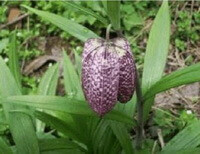 Classical herbal works define Bulbus Fritillariae Cirrhosae (Tendrilleaf Fritillary Bulb) as the dried bulb of (1) Fritillaria cirrhosa D. Don, (2) Fritillaria unibracteata Hsiao et K. C. Hsia, (3) Fritillaria przewalskii Maxim. ex Batal., (4) Fritillaria delavayi Franch., and (5) Fritillaria cirrhosa D. Don var. ecirrhosa Franch. These five commonly used species are described below:
 Botanical Description: Fritillaria cirrhosa D. Don is also known as Juǎn Yè Bèi Mǔ or Curled-Leaf Fritillary Bulb. It is a perennial herb exhibiting considerable morphological variation. The scaly bulbs are ovoid, composed of two scales, 1–1.5 cm in diameter. Leaves are usually opposite; occasionally, a few are scattered or whorled in the middle portion. Leaf blades are linear to linear-lanceolate, with the apex slightly recurved or uncurled.
 Ecological Environment: The plant grows in thickets, grasslands, along riverbanks, in valleys, and other moist habitats—including wetlands and rock crevices.
 Botanical Description: Fritillaria unibracteata Hsiao et K. C. Hsia is also known as Ān Zǐ Bèi Mǔ or Dark Purple Fritillary Bulb. It is a perennial herb, growing up to 15–25 cm in height. The scaly bulb is globose or conical, composed of two scales, 6–8 mm in diameter. The stem is erect, simple, and glabrous. One to two pairs of leaves on the lower part are opposite; one to two leaves on the upper part are scattered or opposite, sessile, linear to linear-lanceolate, 3.6–6.5 cm long and 3–7 mm wide; the apex is acute and not recurved.
 Ecological Environment: Dark Purple Fritillary grows in grasslands at altitudes of 3,200–4,500 meters above sea level.
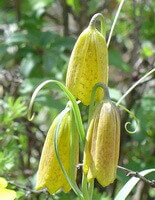 Botanical Description: Fritillaria przewalskii Maxim. ex Batal. is also known as Gān Sù Bèi Mǔ or Gansu Fritillary Bulb. It is a perennial herb, growing up to 20–40 cm in height. The scaly bulb is conical, composed of two scales, 6–13 mm in diameter. The lowest leaves are usually two and opposite; two to three leaves on the upper part are scattered; leaf blades are linear, 3–7 cm long and 3–4 mm wide; the apex is typically not recurved.
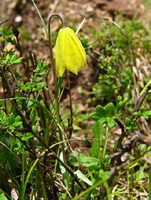 Ecological Environment: Fritillaria przewalskii grows in shrublands or grasslands at altitudes of 2,800–4,400 meters above sea level.
 Botanical Description: Fritillaria delavayi Franch. is also known as Suō Shā Bèi Mǔ. It is a perennial herb, growing up to 17–35 cm in height. Scaly bulbs are oblong-ovoid, composed of two or three scales, 1–2 cm in diameter. Leaves are alternate; three to five leaves (including leaf-like bracts) are closely arranged in the middle or upper part of the plant; leaf blades are narrowly ovate to ovate-elliptic, 2–7 cm long and 1–3 cm wide; the apex is not recurved.
 Ecological Environment: Fritillaria delavayi grows in rock crevices on sandy riverbanks, at altitudes of 3,800–4,700 meters above sea level.
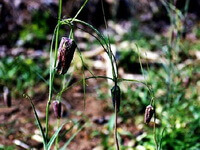 Botanical Description: Fritillaria cirrhosa D. Don var. ecirrhosa Franch. is also known as Kāng Dìng Bèi Mǔ or Kang Ding Fritillary Bulb. The plant is similar to Fritillaria cirrhosa D. Don., but the plants and scaly bulbs are usually larger. One to two pairs of leaves on the lower part are opposite; most of the remaining leaves are scattered, and the leaf apex is not curled. One foliate bract is present, rarely three. Flowers bear conspicuous purple square spots.
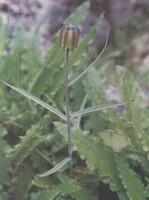 Ecological Environment: Fritillaria cirrhosa D. Don var. ecirrhosa Franch. grows at altitudes of 3,500–4,100 meters above sea level in riverine forests or grasslands.
 URL QR code: