Introduction of Yī Bèi Mǔ: Xinjiang Fritillary Bulb
✵This article documents the herb Xinjiang Fritillary Bulb—including its English name, Latin name, Pinyin name, properties and flavor, and botanical sources: two plant species, (1) Fritillaria walujewii Regel and (2) Fritillaria pallidiflora Schrenk—followed by detailed descriptions of the botanical features, growth characteristics, and ecological environments of both species; as well as the macroscopic characteristics, pharmacological actions, medicinal efficacy, and administration guidelines of the herb.
Pinyin Name: Yī Bèi Mǔ
English Name: Sinkiang Fritillary Bulb
Latin Name:Bulbus Fritillariae Pallidiflorae Properties and Flavor: Slightly cold, bitter, sweet
Brief Introduction:Bulbus Fritillariae Pallidiflorae is the dried bulb of Fritillaria walujewii Regel or Fritillaria pallidiflora Schrenk. It is used similarly to Bulbus Fritillariae Thunbergii (Thunberg Fritillary Bulb). Common names include Bulbus Fritillariae Pallidiflorae, Xinjiang Fritillary Bulb, and Yī Bèi Mǔ.
Botanical Source:Bulbus Fritillariae Pallidiflorae (Xinjiang Fritillary Bulb) is the dried bulb of Fritillaria walujewii Regel or Fritillaria pallidiflora Schrenk—perennial herbs belonging to the genus Fritillaria L., family Liliaceae (lily family), order Liliales. It is also known as Xinjiang Fritillary Bulb, Bulbus Fritillariae Pallidiflorae, or Yī Bèi Mǔ.
Classical herbal works define Bulbus Fritillariae Pallidiflorae (Xinjiang Fritillary Bulb) as the dried bulb of (1) Fritillaria walujewii Regel or (2) Fritillaria pallidiflora Schrenk. These two commonly used species are described below:
(1) Fritillaria walujewii Regel
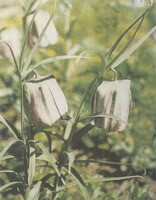
Botanical Description:Fritillaria walujewii Regel is also known as Xīn Jiāng Bèi Mǔ or Tiān Shān Bèi Mǔ. A perennial herb, it grows 25–40 cm tall. The squamous bulb is 1–1.5 cm in diameter and composed of several hypertrophied scales. Leaves are usually alternate, occasionally opposite or whorled; leaf blades are lanceolate to linear, 5–9 cm long and 3–10 mm wide—the upper part of the stem bears 3 whorled, foliaceous (leaf-like) bracts, and the bract apices are strongly recurved.
The solitary flower is terminal; it is campanulate (bell-shaped), with 6 tepals: the outer surface is grayish-purple, the inner surface is purplish-red (prunus-colored), marked with white or yellow square-shaped stripes; a sunken nectary is present at the upper base of the perianth. Stamens are approximately half the length of the tepals; the style is slightly longer than the ovary; the stigma is trilobed, with lobes about one-quarter the length of the style.
The capsule is 1.8–3 cm long, with wings 4–5 mm wide along the margins. Flowering occurs from May to June; fruiting occurs from July to August.
Growth Characteristics: The plant prefers a cool, moist climate; it is cold-tolerant but sensitive to excessive humidity. Bulbs are susceptible to frost damage below −10 °C. The optimal growth temperature range is 5–20 °C. Soil requirements are not stringent, but deep, loose, humus-rich, well-drained sandy loam is ideal for cultivation.
Ecological Environment: It grows in forest understories or on grassy slopes at altitudes of 1,300–2,000 m above sea level.
Characteristics of the Herb: The bulb of Fritillaria walujewii Regel is oblate or conical, 0.5–1.5 cm high and 0.6–1.2 cm in diameter. The surface is whitish or light yellowish-brown and smooth. The two outer scale leaves are nearly equal in size—or one is slightly larger—and closely clasped. The apex is bluntly rounded, slightly expanded and fissured; the base is blunt, bearing either one larger inner scale leaf or a residual stem with a bud primordium. The texture is firm and dense; the fracture surface is white and mealy. It has a slight odor and a bitter taste.
Medicinal efficacy: Clears lung heat, resolves phlegm, and dissipates nodules. Indicated for cough due to lung-heat, sticky sputum with chest oppression, paroxysmal cough with hemoptysis, scrofula, and carbuncles or swellings.
Administration of Bulbus Fritillariae Pallidiflorae (Yī Bèi Mǔ):
Reference:
Administration Guide for Bulbus Fritillariae Pallidiflorae (Yī Bèi Mǔ)
TCM Books:
(1) Internally:3–9 grams, decocted in water; (2) 3–9 grams, decocted in water; (3) 3–9 grams, water decoction; Also administered as finely powdered herb, prepared into pills or powders.
Precautions: Contraindicated with Aconitum species (e.g., Radix Aconiti).
(2) Fritillaria pallidiflora Schrenk.
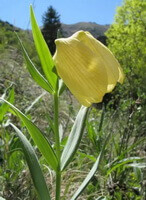
Botanical Description:Fritillaria pallidiflora Schrenk is also known as Yī Bèi Mǔ or Yī Lì Bèi Mǔ. A perennial herb, it grows 30–60 cm tall. Its squamous bulb consists of two scales, 1.5–3.5 cm in diameter; the upper portion of each scale extends into a long membranous tip, and the scale epidermis is thick. Leaves are usually alternate, occasionally nearly opposite or whorled; leaf blades transition from narrowly ovate (lower stem) to lanceolate (upper stem), measuring 7–12 cm in length and 2–3.5 cm in width; the apex is straight or only slightly recurved.
It bears 1–4 flowers, yellowish with dark red spots internally; each flower has 1–3 foliaceous (leaf-like) bracts with non-recurved apices. There are 6 tepals—spatulate-oblong, 3–4 cm long and 1.2–1.6 cm wide—yellowish in color; the nectary gland is elevated (protuberant) on the abaxial surface. Stamens are approximately two-thirds the length of the tepals; anthers are basifixed, inserted near the base of the filaments; filaments lack papillae; stigma lobes measure ~2 mm in length.
The capsule is 1.8–3 cm long, with broad marginal wings 4–5 mm wide. Flowering occurs from May to June; fruiting occurs from July to August.
Growth Characteristics: The plant prefers a cool, moist climate and is cold-tolerant but intolerant of high humidity. Squamous bulbs are susceptible to frost damage below −10 °C. The optimal growth temperature range is 5–20 °C. Soil requirements are not stringent, but deep, loose, humus-rich sandy loam with good drainage is ideal for cultivation.
Ecological Environment: It grows in damp forest habitats or on grassy slopes at altitudes of 1,300–1,780 m above sea level.
Characteristics of the Herb: The bulb of Fritillaria pallidiflora Schrenk is oval, oblate, or oval-conical, 0.8–1.8 cm in height and 1–2.3 cm in diameter. The surface is whitish (almost white) or yellowish (light yellow), slightly rough, and sometimes bears visible yellow-brown spots or patches. The two outer scale leaves are cordate or crescent-shaped, hypertrophied and thickened, nearly equal in size—or one is slightly larger and clasps the other. The apex is slightly tapering, rarely cleft. The texture of the herb is slightly loose and fragile; the fracture surface is white and powdery. The herb has a faint odor and a bitter taste.
Article Link:
URL QR code:
References:
1.Introduction of Yī Bèi Mǔ: Xinjiang Fritillary Bulb

 ✵This article documents the herb Xinjiang Fritillary Bulb—including its English name, Latin name, Pinyin name, properties and flavor, and botanical sources: two plant species, (1) Fritillaria walujewii Regel and (2) Fritillaria pallidiflora Schrenk—followed by detailed descriptions of the botanical features, growth characteristics, and ecological environments of both species; as well as the macroscopic characteristics, pharmacological actions, medicinal efficacy, and administration guidelines of the herb.
 Pinyin Name: Yī Bèi Mǔ
 Botanical Description: Fritillaria walujewii Regel is also known as Xīn Jiāng Bèi Mǔ or Tiān Shān Bèi Mǔ. A perennial herb, it grows 25–40 cm tall. The squamous bulb is 1–1.5 cm in diameter and composed of several hypertrophied scales. Leaves are usually alternate, occasionally opposite or whorled; leaf blades are lanceolate to linear, 5–9 cm long and 3–10 mm wide—the upper part of the stem bears 3 whorled, foliaceous (leaf-like) bracts, and the bract apices are strongly recurved.
 Ecological Environment: It grows in forest understories or on grassy slopes at altitudes of 1,300–2,000 m above sea level.
 Botanical Description: Fritillaria pallidiflora Schrenk is also known as Yī Bèi Mǔ or Yī Lì Bèi Mǔ. A perennial herb, it grows 30–60 cm tall. Its squamous bulb consists of two scales, 1.5–3.5 cm in diameter; the upper portion of each scale extends into a long membranous tip, and the scale epidermis is thick. Leaves are usually alternate, occasionally nearly opposite or whorled; leaf blades transition from narrowly ovate (lower stem) to lanceolate (upper stem), measuring 7–12 cm in length and 2–3.5 cm in width; the apex is straight or only slightly recurved.
 Ecological Environment: It grows in damp forest habitats or on grassy slopes at altitudes of 1,300–1,780 m above sea level.
 URL QR code: