Introduction of Píng Bèi Mǔ: Ussuri Fritillary Bulb
✵This article documents the herb Ussuri Fritillary Bulb, including its English name, Latin name, Pinyin name, properties and flavor, botanical source—namely one plant species, (1) Fritillaria ussuriensis Maxim.—and provides a detailed description of the botanical features, growth characteristics, and ecological environment of this species, as well as the morphological characteristics of the herb Ussuri Fritillary Bulb, its pharmacological actions, medicinal efficacy, and administration guidelines.
Pinyin Name: Pínɡ Bèi Mǔ
English Name: Ussuri Fritillary Bulb
Latin Name:Bulbus Fritillarie Ussuriensis Properties and Flavor: Slightly cold; bitter and sweet
Brief Introduction:Bulbus Fritillariae Ussuriensis is the dried bulb of Fritillaria ussuriensis Maxim., used to clear lung heat, arrest cough, and resolve phlegm—indicated for cough with sticky or blood-streaked sputum.
Botanical Source:Bulbus Fritillariae Ussuriensis (Ussuri Fritillary Bulb) is the dried bulb of Fritillaria ussuriensis Maxim., a species of the genus Fritillaria L., family Liliaceae (lily family), order Liliales. It is also known as Bulbus Fritillariae Ussuriensis or Píng Bèi Mǔ.
Herbal classical workshop define Bulbus Fritillariae Ussuriensis (Ussuri Fritillary Bulb) as the dried bulb of (1) Fritillaria ussuriensis Maxim. This commonly used species is described below:
(1) Fritillaria ussuriensis Maxim.
Botanical Description:Fritillaria ussuriensis Maxim. is also known as Píng Bèi Mǔ. It is a herbaceous plant growing 40–60 cm tall. Scaly bulbs are 1–1.4 cm thick, composed of two thickened, spoon-shaped scales, with a few bulblets surrounding them. Leaves arise above the base, arranged whorled or opposite; a few are scattered above the mid-stem. Leaves are strap-shaped, 9–15 cm long and 2–6 mm wide, with an uncurled or slightly incurved apex.
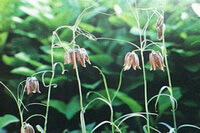
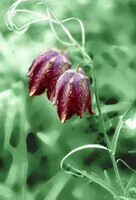
One to three pendulous, terminal flowers; perianth purple with yellow square markings. Apical flowers bear four to six leaf-like bracts; bract apices are strongly recurved. Perianth is campanulate (bell-shaped); six tepals, oblong-obovate, obtuse; nectaries located above the base; six stamens, approximately 3/5 the length of the tepals; style is papillose; stigma is deeply trilobed.
Capsule is broadly obovate, with rounded ribs. Flowering period: May–June.
Ecological Environment: The plant grows in fertile forest soils.
Growth Characteristics: The plant prefers cold, cool, and humid climates; it is cold-tolerant but drought- and heat-sensitive, surviving temperatures as low as −37 °C (−34.6 °F). Above-ground parts wither when ambient temperature reaches 28 °C (82.4 °F). The growing period—from seedling emergence to senescence—is approximately 60 days. Cultivation is best conducted in deep, loose, moist, humus-rich sandy loam soil.
Characteristics of the Herb: The herb is oblate, 0.5–1 cm high and 0.6–2 cm in diameter. Surface color is creamy white (milky white) or pale yellowish white. The outer layer consists of two thickened, hypertrophied scale leaves—similar in size, or one is slightly larger—often slightly flattened or concave at the apex, sometimes faintly fissured; central scales are small. Texture is solid, firm, and brittle (crisp); fracture surface is mealy (powdery). Odor is slight; taste is bitter.
Pharmacological Actions: (1) Anti-ulcer effect; (2) Other effects: central nervous system inhibition, expectorant activity, and hypotensive action.
Medicinal efficacy: Clears heat and moistens the lung, resolves phlegm, and relieves cough. Indicated for lung-heat-induced dry cough, dry cough with scant phlegm, yin-deficiency cough due to overstrain, hemoptysis, scrofula, and acute mastitis.
Administration of Bulbus Fritillariae Ussuriensis (Píng Bèi Mǔ):
Reference:
Administration Guide of Bulbus Fritillarie Ussuriensis (Pínɡ Bèi Mǔ)
TCM Books:
(1) Internally: 3–9 grams; (2) 3–9 grams, water decoction; or as finely ground herb powder: 1–2 grams, taken with water; also prepared into pills or powders.
Precautions: Should not be combined with herbs containing Aconitum species (e.g., Aconiti Radix, Aconiti Kusnezoffii Radix).
Article Link:
URL QR code:
References:
1.Introduction of Píng Bèi Mǔ: Ussuri Fritillary Bulb

 ✵This article documents the herb Ussuri Fritillary Bulb, including its English name, Latin name, Pinyin name, properties and flavor, botanical source—namely one plant species, (1) Fritillaria ussuriensis Maxim.—and provides a detailed description of the botanical features, growth characteristics, and ecological environment of this species, as well as the morphological characteristics of the herb Ussuri Fritillary Bulb, its pharmacological actions, medicinal efficacy, and administration guidelines.
 Pinyin Name: Pínɡ Bèi Mǔ
 Botanical Source: Bulbus Fritillariae Ussuriensis (Ussuri Fritillary Bulb) is the dried bulb of Fritillaria ussuriensis Maxim., a species of the genus Fritillaria L., family Liliaceae (lily family), order Liliales. It is also known as Bulbus Fritillariae Ussuriensis or Píng Bèi Mǔ.
 Botanical Description: Fritillaria ussuriensis Maxim. is also known as Píng Bèi Mǔ. It is a herbaceous plant growing 40–60 cm tall. Scaly bulbs are 1–1.4 cm thick, composed of two thickened, spoon-shaped scales, with a few bulblets surrounding them. Leaves arise above the base, arranged whorled or opposite; a few are scattered above the mid-stem. Leaves are strap-shaped, 9–15 cm long and 2–6 mm wide, with an uncurled or slightly incurved apex.
 Ecological Environment: The plant grows in fertile forest soils.
 URL QR code: