✵This article documents Water-plantain Rhizome—including its English name, Latin name, Pinyin name, properties and flavor—its botanical source, Alisma orientale (Sam.) Juz., and provides a detailed description of the plant’s botanical features, growth characteristics, ecological environment, macroscopic and microscopic characteristics of the herb, pharmacological actions, medicinal efficacy, and administration guidelines.
Rhizoma Alismatic (Water-plantain Rhizome)
Pinyin Name: Zé Xiè
English Name: Water-plantain Rhizome
Latin Name:Rhizoma Alismatic Properties and Flavor: Cold; bland (tasteless) and sweet
Brief Introduction:Rhizoma Alismatis is the dried tuber of Alisma orientale (Sam.) Juz. It is used (1) to promote diuresis in oliguria and edema; (2) to drain dampness in diarrhea and leukorrhea; and (3) to clear heat in bladder damp-heat syndrome. It is commonly known as Rhizoma Alismatis, Water-plantain Rhizome, or Zé Xiè.
Botanical Source: Classical herbal works and official pharmacopoeias define Rhizoma Alismatis (Water-plantain Rhizome) as the dried tuber of Alisma orientale (Sam.) Juz., a perennial herb of the genus Alisma, family Alismataceae (water-plantain family), order Alismatales. This widely used species is described below:
(1) Alisma orientale (Sam.) Juz.
Botanical Description:Alisma orientale (Sam.) Juz. is also known as Alisma plantago-aquatica L. var. orientale (Sam.) Sam., a member of the Alismataceae family and genus Alisma. Common names include Oriental water-plantain, Asian water-plantain, and Ze Xie. A perennial marsh plant, it grows 50–100 cm tall. Its underground tubers are subspherical (nearly spherical), up to 4.5 cm in diameter, with brown bark and numerous dense fibrous roots. Leaves are basal; petioles reach 50 cm in length, with a sheath-like base 5–20 mm wide; leaf blades are broadly elliptic to ovate (egg-shaped), 5–18 cm long and 2–10 cm wide, with an acuminate or mucronate apex, a broad cuneate, rounded, or slightly cordate base, entire margins, and smooth surfaces on both sides; venation consists of 5–7 prominent veins.
Scapes (flower stalks) arise from the leaf rosette, measuring 10–100 cm in length. Inflorescences typically branch into 3–5 whorls; branches bear lanceolate or linear bracts; verticillate branches often re-branch, forming a conical compound umbel. Pedicels vary in length. Bracteoles are lanceolate to linear and acute. The calyx comprises 3 broad-ovate, green or slightly purplish sepals, 2–3 mm long, persistent. Petals are obovate, membranous, smaller than the sepals, white, and deciduous. There are 6 stamens. Numerous free pistils are present; ovaries are obovate and flattened laterally, with lateral styles.
Achenes are numerous, flattened and obovate, 1.5–2 mm long and ~1 mm wide, with two shallow dorsal grooves, brown in color, and bearing persistent styles. Flowering occurs from June to August; fruiting from July to September.
Ecological Environment: The plant grows naturally on marsh margins and is also cultivated.
Growth Characteristics:Alisma orientale prefers a warm, humid climate. Seedlings require partial shade; mature plants thrive in full sun and are cold-sensitive. It is best cultivated at altitudes below 800 m above sea level. Ideal cultivation sites are paddy fields with ample sunlight, rich humus content, slightly clayey soil, and reliable water supply. It should not be grown in cold, waterlogged paddy fields with excessive sandy loam or low soil temperature. Rotation with high-value crops—rather than rice or medium-maturity rice—is recommended.
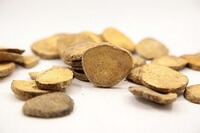
Characteristics of the Herb: The tubers are subspherical, elliptic, or ovate (egg-shaped), 2–7 cm long and 2–6 cm in diameter. The surface is yellowish-white or light yellowish-brown, bearing irregular transverse circular shallow grooves and numerous minute protruding fibrous root scars; some specimens show nodular bud scars at the base. The texture is solid and firm; the fracture surface is yellowish-white, powdery, and dotted with fine pores. The herb has a faint odor and a slightly bitter taste.
Pharmacological actions: (1) Diuretic effect; (2) Antiplatelet aggregation effect; (3) Hypolipidemic, hypocholesterolemic, and antiatherosclerotic effects; (4) Antihypertensive and hypoglycemic effects; (5) Inhibitory activity against Staphylococcus aureus, Streptococcus pneumoniae, and Mycobacterium tuberculosis, among others.
Medicinal efficacy: Promotes diuresis, clears damp-heat, drains dampness, clears heat, and treats stranguria. It is indicated for dysuria (difficulty in urination), edema with distension and swelling, diarrhea, oliguria, vomiting, dysentery, phlegm-damp retention, dizziness, beriberi, painful heat stranguria (pyretic stranguria with pain), gonorrhea, spermatorrhea (nocturnal emission), hematuria (blood in urine), and hyperlipidemia (elevated blood cholesterol levels).
Administration of Rhizoma Alismatic (Zé Xiè):
Reference:
Administration Guide for Rhizoma Alismatic (Zé Xiè)
TCM Books:
(1) Internally: 6–9 grams; (2) Internally: water decoction, 2–4 qián (≈6–12 grams), or prepared as pills or powder; (3) Internally: water decoction, 6–12 grams, or prepared as pills or powder.
Precautions and Adverse Reactions: Contraindicated with Hippopus spp. (sea clams) and Meretrix spp. (clams), should not combine with them.

 ✵This article documents Water-plantain Rhizome—including its English name, Latin name, Pinyin name, properties and flavor—its botanical source, Alisma orientale (Sam.) Juz., and provides a detailed description of the plant’s botanical features, growth characteristics, ecological environment, macroscopic and microscopic characteristics of the herb, pharmacological actions, medicinal efficacy, and administration guidelines.
 Pinyin Name: Zé Xiè
 Botanical Source: Classical herbal works and official pharmacopoeias define Rhizoma Alismatis (Water-plantain Rhizome) as the dried tuber of Alisma orientale (Sam.) Juz., a perennial herb of the genus Alisma, family Alismataceae (water-plantain family), order Alismatales. This widely used species is described below:
 Botanical Description: Alisma orientale (Sam.) Juz. is also known as Alisma plantago-aquatica L. var. orientale (Sam.) Sam., a member of the Alismataceae family and genus Alisma. Common names include Oriental water-plantain, Asian water-plantain, and Ze Xie. A perennial marsh plant, it grows 50–100 cm tall. Its underground tubers are subspherical (nearly spherical), up to 4.5 cm in diameter, with brown bark and numerous dense fibrous roots. Leaves are basal; petioles reach 50 cm in length, with a sheath-like base 5–20 mm wide; leaf blades are broadly elliptic to ovate (egg-shaped), 5–18 cm long and 2–10 cm wide, with an acuminate or mucronate apex, a broad cuneate, rounded, or slightly cordate base, entire margins, and smooth surfaces on both sides; venation consists of 5–7 prominent veins.
 Scapes (flower stalks) arise from the leaf rosette, measuring 10–100 cm in length. Inflorescences typically branch into 3–5 whorls; branches bear lanceolate or linear bracts; verticillate branches often re-branch, forming a conical compound umbel. Pedicels vary in length. Bracteoles are lanceolate to linear and acute. The calyx comprises 3 broad-ovate, green or slightly purplish sepals, 2–3 mm long, persistent. Petals are obovate, membranous, smaller than the sepals, white, and deciduous. There are 6 stamens. Numerous free pistils are present; ovaries are obovate and flattened laterally, with lateral styles.
 Growth Characteristics: Alisma orientale prefers a warm, humid climate. Seedlings require partial shade; mature plants thrive in full sun and are cold-sensitive. It is best cultivated at altitudes below 800 m above sea level. Ideal cultivation sites are paddy fields with ample sunlight, rich humus content, slightly clayey soil, and reliable water supply. It should not be grown in cold, waterlogged paddy fields with excessive sandy loam or low soil temperature. Rotation with high-value crops—rather than rice or medium-maturity rice—is recommended.
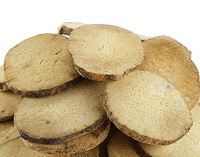 Characteristics of the Herb: The tubers are subspherical, elliptic, or ovate (egg-shaped), 2–7 cm long and 2–6 cm in diameter. The surface is yellowish-white or light yellowish-brown, bearing irregular transverse circular shallow grooves and numerous minute protruding fibrous root scars; some specimens show nodular bud scars at the base. The texture is solid and firm; the fracture surface is yellowish-white, powdery, and dotted with fine pores. The herb has a faint odor and a slightly bitter taste.
 URL QR code: