✵The article documents the herb Calabash Gourd, including its English name, Latin name, Pinyin name, properties and flavor, and botanical source—the plant species Lagenaria siceraria (Molina) Standl.—along with a detailed introduction to the botanical features, growth characteristics, and ecological environment of this species; the morphological characteristics of the herb Calabash Gourd; its pharmacological actions; medicinal efficacy; and administration guidelines.
Pericarpium Lagenariae (Calabash Gourd)
Pinyin Name: Hú Lu
English Name: Calabash Gourd; Semen lagenariae sicerariae Latin Name:Pericarpium lagenariae or Pericarpium lagenariae depressae Properties and Flavor: Neutral in nature; sweet and bland (tasteless).
Brief Introduction: The herb Pericarpium lagenariae consists of the dried pericarp of Lagenaria siceraria (Molina) Standl. It acts as a diuretic for treating severe edema and ascites. It is commonly known as Pericarpium lagenariae, Calabash Gourd, or Hú Lú.
Botanical Source: Classical herbal works define Pericarpium lagenariae (Calabash Gourd) as the dried pericarp of Lagenaria siceraria (Molina) Standl., a plant belonging to the genus Lagenaria, family Cucurbitaceae (cucumber, gourd, squash, and related cucurbits), order Cucurbitales. This widely used species is described below:
(1) Lagenaria siceraria (Molina) Standl.
Botanical Description:Lagenaria siceraria (Molina) Standl. is also known as Cucurbita siceraria Molina, commonly called calabash or Hú Lú. It is an annual climbing herb; stems and branches are longitudinally furrowed and covered with sticky pubescence, which gradually diminishes with age, resulting in a glabrescent surface.
Petioles are slender, 16–20 cm long, pubescent, and bear two glands at the apex. Leaf blades are ovate-cordate or reniform-ovate, measuring approximately 10–35 cm in both length and width; they are either undivided or 3–5-lobed, with 5–7 palmate veins; the apex is acute; the margin is irregularly serrated; the base is cordate, with recurved, shallowly incised lobes that are semicircular or orbicular, 1–3 cm deep and 2–6 cm wide; both surfaces are puberulent—denser on the abaxial surface and along the veins. Tendrils are slender, initially puberulent, then becoming glabrescent and ultimately smooth and glabrous; the distal portion is dichotomously branched.
The plant is monoecious, bearing solitary male and female flowers.
Male flowers: pedicels are slender and slightly longer than the petioles; pedicels, calyx, and corolla are all puberulent. The calyx tube is funnelform (funnel-shaped), ~2 cm long; lobes are lanceolate, ~5 mm long. The corolla is white, with crisped lobes measuring 3–4 cm in length and 2–3 cm in width; the apex is emarginate with a small mucro; five veins extend into each lobe. There are three stamens; filaments are 3–4 mm long; anthers are oblong, 8–10 mm long, with flexed anther cells.
The pedicel of the female flower is slightly shorter than or nearly equal in length to the petiole; calyx and corolla resemble those of the male flower, though the calyx tube is shorter (2–3 mm long). The ovary is constricted at the center and densely covered with sticky pubescence; the style is short and stout; there are three stigmas, each enlarged and bifurcated (two-lobed).
Fruit is green when young, turning white to yellowish upon maturity. Due to long-term cultivation, fruit morphology exhibits considerable variation across cultivars: some are dumbbell-shaped—constricted in the middle, with the upper portion larger than the lower—and may reach tens of centimeters in length; others are small gourds (~10 cm long); still others are oblate, cylindrical, or arytenoid. The pericarp becomes woody at full maturity. Seeds are white, obovate or triangular; the apex is truncate or bilobed (rarely crenate); they measure ~20 mm in length. Flowering occurs in summer; fruiting, in autumn.
Ecological Environment: The plant is cultivated throughout China and widely grown in tropical to temperate regions worldwide. Archaeological evidence—including Stone Age calabash fossils—has been unearthed in China, Thailand (Asia), Mexico and Peru (South America), and Egypt. In ancient China, this plant was already present nearly 10,000 years ago. Excavations at the Hemudu Neolithic site in Zhejiang Province indicate that calabash cultivation began in China over 7,000 years ago; its use as a water container predates both pottery and bronze ware.
Growth Characteristics:Lagenaria siceraria prefers warm, sheltered environments and requires ample space for vigorous growth. Young plants are sensitive to cold. Immature fruits have pale green skin and white flesh. Calabash is harvested as a vegetable when immature. The plant is intolerant of low temperatures, thrives in full sunlight, and has no strict soil requirements; however, deep, humus-rich loam with good fertility and water-holding capacity is optimal for cultivation.
Characteristics of the Herb: The dried pericarp is dumbbell-shaped or oval, constricted in the middle, with enlarged upper and lower portions. The lower portion is smaller and ovoid (egg-shaped), attached to a carpopodium (fruit stalk); the upper portion is larger and nearly spherical, bearing a stylopodium (receptacular remnant) at the apex. The surface is yellowish-brown to whitish and smooth. The texture is firm and hard. The herb has a faint odor and a mild taste.

 ✵The article documents the herb Calabash Gourd, including its English name, Latin name, Pinyin name, properties and flavor, and botanical source—the plant species Lagenaria siceraria (Molina) Standl.—along with a detailed introduction to the botanical features, growth characteristics, and ecological environment of this species; the morphological characteristics of the herb Calabash Gourd; its pharmacological actions; medicinal efficacy; and administration guidelines.
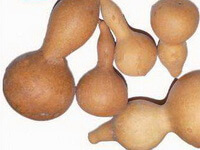 Pinyin Name: Hú Lu
 Botanical Description: Lagenaria siceraria (Molina) Standl. is also known as Cucurbita siceraria Molina, commonly called calabash or Hú Lú. It is an annual climbing herb; stems and branches are longitudinally furrowed and covered with sticky pubescence, which gradually diminishes with age, resulting in a glabrescent surface.
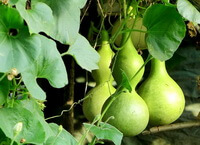 The plant is monoecious, bearing solitary male and female flowers.
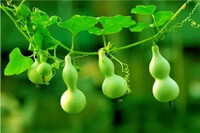 Fruit is green when young, turning white to yellowish upon maturity. Due to long-term cultivation, fruit morphology exhibits considerable variation across cultivars: some are dumbbell-shaped—constricted in the middle, with the upper portion larger than the lower—and may reach tens of centimeters in length; others are small gourds (~10 cm long); still others are oblate, cylindrical, or arytenoid. The pericarp becomes woody at full maturity. Seeds are white, obovate or triangular; the apex is truncate or bilobed (rarely crenate); they measure ~20 mm in length. Flowering occurs in summer; fruiting, in autumn.
 Growth Characteristics: Lagenaria siceraria prefers warm, sheltered environments and requires ample space for vigorous growth. Young plants are sensitive to cold. Immature fruits have pale green skin and white flesh. Calabash is harvested as a vegetable when immature. The plant is intolerant of low temperatures, thrives in full sunlight, and has no strict soil requirements; however, deep, humus-rich loam with good fertility and water-holding capacity is optimal for cultivation.
 URL QR code:

