✵The article records the herb Mole Cricket, including its English name, Latin name, Pinyin name, properties and flavor, source—two insect species: (1) Gryllotalpa unispina Saussure and (2) Gryllotalpa africana Palisot et Beauvois—with a detailed introduction to the morphological features of these two insect species, their growth characteristics and ecological habitats, as well as the features of the herb Mole Cricket, its pharmacological actions, medicinal efficacy, and administration guidelines.
Gryllotalpa (Mole Cricket)
Pinyin Name: Lóu Gū
English Name: Mole Cricket
Latin Name: Gryllotalpa
Properties and Flavor: Cold, salty, slightly toxic
Brief Introduction: The herb Gryllotalpa is the dried whole body of Gryllotalpa unispina Saussure or Gryllotalpa africana Palisot et Beauvois, used as a diuretic for treating severe edema, ascites, and urinary retention. It is commonly known as Gryllotalpa, Mole Cricket, Chinese Mole Cricket, African Mole Cricket, or Lóu Gū.
Animal Source: Classical herbal works define the herb Gryllotalpa (Mole Cricket) as the dried whole body of (1) Gryllotalpa unispina Saussure or (2) Gryllotalpa africana Palisot et Beauvois. These insects belong to the family Gryllotalpidae (order Orthoptera). The two commonly used species are described below:
(1) Gryllotalpa unispina Saussure
Insect Description:Gryllotalpa unispina Saussure is commonly known as Gryllotalpa unispina, Huá Běi Lóu Gū, mole cricket, or Tǔ Gǒu (meaning “soil dog”).
Adult: The female adult is 45–50 mm long; the male adult is 39–45 mm long. Its shape resembles that of Gryllotalpa africana, but the body color ranges from yellowish-brown to dark brown. The center of the pronotum bears a single cordate red spot. The inner edge of the metathoracic tibia bears one movable spine. The abdomen is nearly cylindrical: the dorsal surface is dark brown, the ventral surface is yellowish-brown, and the caudal filaments (cerci) are approximately as long as the body.
Egg: Oval. Eggs at oviposition measure 1.6–1.8 mm in width and 1.1–1.3 mm in length; just before hatching, they enlarge to 2.4–2.8 mm in length and 1.5–1.7 mm in width. They are yellowish-white upon laying, turn tawny (yellowish-brown) during development, and become charcoal gray shortly before hatching.
Nymphs: Resemble adults but are smaller. They are cream-white upon emergence, turn yellowish-brown after two instars, and attain adult coloration after five or six instars.
Main Differences between Gryllotalpa unispina Saussure and Gryllotalpa africana: G. unispina is larger (3.9–4.5 cm in body length), exhibits slightly lighter coloration, has a more distinctly cylindrical abdomen, and possesses a movable spine on the inner edge of the metathoracic tibia—though this spine may occasionally be reduced or absent.
Ecological Environment: This species is distributed throughout China. Gryllotalpa unispina is an omnivorous insect that damages a wide variety of horticultural plants—including ornamental flowers, fruit trees, forest trees, tuberous and bulbous crops, and reeds—primarily by feeding on underground plant parts. Both adults and nymphs feed on seedling roots and young stems; additionally, they excavate subterranean tunnels, severing root–shoot connections and causing seedling death, which leads to patchy emergence and poor stand establishment in nurseries.
Characteristics of the Herb: The dried whole insect is slightly larger (3.9–4.5 cm long), with comparatively lighter body coloration, a cylindrical abdomen, and a movable spine on the inner edge of the metathoracic tibia.
(2) Gryllotalpa africana Palisot et Beauvois
Insect Description:Gryllotalpa africana Palisot et Beauvois is commonly known as Nán Fāng Lóu Gū (meaning “Southern Gryllotalpa”) or Fēi Zhōu Lóu Gū (meaning “African Gryllotalpa”). The adult is pale yellowish-brown to dark brown; the entire body is densely covered with short, soft hairs. Adult body length ranges from 2.8 to 3.3 cm; the overall coloration is taupe, and the abdominal color is comparatively lighter. The head is conical and darkish brown; antennae are filiform. Compound eyes are oval (egg-shaped) and yellowish-brown. Mouthparts are mandibulate (chewing type). The pronotum is hardened and enlarged, oval (egg-shaped), with a longitudinal, sunken groove running centrally along its dorsal surface. Forewings are grayish-brown, leathery, soft, and short—yellowish-brown in color; hind wings are large, membranous, transparent, pale yellow, fan-shaped, and extend beyond the abdominal apex. The abdominal tip bears one pair of caudal filaments (cerci). The forelegs are adapted for digging; the hind tibiae bear four spines on their dorsal and medial surfaces. Male adults measure 2.8–3.2 cm in length; females measure 3.2–3.4 cm. The posterior plate of the prothorax is peltate (shield-shaped) and features a fusiform, finely hairy region centrally located. Forewings are yellowish-brown and lack articulators; hind wings are folded longitudinally into a narrow strip, slightly exceeding the abdominal apex.
Ecological Environment: Southern Gryllotalpa inhabits courtyards, fields, and damp habitats—especially areas heavily amended with organic fertilizer. It is nocturnal and strongly phototactic. Its distribution includes China, Oceania, and Hawaii.
Gryllotalpa africana Palisot et Beauvois is a globally significant pest. It is omnivorous; both adults and nymphs feed on crops. They consume various tree seedlings and freshly harvested seeds, and excavate subterranean tunnels that dislodge seedlings—causing severe economic losses in nurseries.
Growth Characteristics: Southern Gryllotalpa inhabits courtyards, fields, and moist habitats—particularly areas where abundant organic fertilizer has been applied. Populations are dense and numerous under such conditions. It shelters during daylight hours and emerges at night; exhibits strong positive phototaxis; is most active in spring and autumn; frequently emerges nocturnally to burrow from the soil surface into tunnels; rests in burrows by day; and is capable of flight.
Characteristics of the Herb: Specimens are often fragmented; intact individuals measure 2–3.3 cm in length and 4–10 mm in width. The head is tea-brown, mottled with dark brown; compound eyes are black and glossy; membranous wings and legs are frequently fragmented; three to four spines occur on the dorsal inner edge of the metathoracic tibia. The abdomen is nearly fusiform (spindle-shaped), annulated (segmented), shriveled, and pale yellow. The herb has a soft texture and crumbles easily; when crushed, it emits a distinctive odor.
Pharmacological Actions: (1) Diuretic effect.
Medicinal Efficacy: Promotes diuresis and alleviates fluid retention; treats stranguria (painful or difficult urination); facilitates bowel movement; reduces swelling (anti-edematous effect); and detoxifies. Indications include edema, urolithiasis (urolithic stranguria), dysuria, scrofula (lymph node tuberculosis), carbuncles, furuncles, and malignant sores.
Administration of Gryllotalpa (Lóu Gū):
Reference:
Administration Guide for Gryllotalpa (Lóu Gū)
TCM Books:
(1) Internally:water decoction, 1–1.5 qian (approximately 3–4.5 grams); or powdered herb. External: Finely ground powder applied topically, or insufflated into the nasal cavity. (2) Internally:water decoction, 3–4.5 grams; powdered herb, 1–2 grams. External: Apply an appropriate amount of finely ground powder as a topical paste or dusting.
Precautions and Adverse Reactions: Gryllotalpa is contraindicated during pregnancy.

 ✵The article records the herb Mole Cricket, including its English name, Latin name, Pinyin name, properties and flavor, source—two insect species: (1) Gryllotalpa unispina Saussure and (2) Gryllotalpa africana Palisot et Beauvois—with a detailed introduction to the morphological features of these two insect species, their growth characteristics and ecological habitats, as well as the features of the herb Mole Cricket, its pharmacological actions, medicinal efficacy, and administration guidelines.
 Pinyin Name: Lóu Gū
 Insect Description: Gryllotalpa unispina Saussure is commonly known as Gryllotalpa unispina, Huá Běi Lóu Gū, mole cricket, or Tǔ Gǒu (meaning “soil dog”).
 Adult: The female adult is 45–50 mm long; the male adult is 39–45 mm long. Its shape resembles that of Gryllotalpa africana, but the body color ranges from yellowish-brown to dark brown. The center of the pronotum bears a single cordate red spot. The inner edge of the metathoracic tibia bears one movable spine. The abdomen is nearly cylindrical: the dorsal surface is dark brown, the ventral surface is yellowish-brown, and the caudal filaments (cerci) are approximately as long as the body.
 Egg: Oval. Eggs at oviposition measure 1.6–1.8 mm in width and 1.1–1.3 mm in length; just before hatching, they enlarge to 2.4–2.8 mm in length and 1.5–1.7 mm in width. They are yellowish-white upon laying, turn tawny (yellowish-brown) during development, and become charcoal gray shortly before hatching.
 Ecological Environment: This species is distributed throughout China. Gryllotalpa unispina is an omnivorous insect that damages a wide variety of horticultural plants—including ornamental flowers, fruit trees, forest trees, tuberous and bulbous crops, and reeds—primarily by feeding on underground plant parts. Both adults and nymphs feed on seedling roots and young stems; additionally, they excavate subterranean tunnels, severing root–shoot connections and causing seedling death, which leads to patchy emergence and poor stand establishment in nurseries.
 Insect Description: Gryllotalpa africana Palisot et Beauvois is commonly known as Nán Fāng Lóu Gū (meaning “Southern Gryllotalpa”) or Fēi Zhōu Lóu Gū (meaning “African Gryllotalpa”). The adult is pale yellowish-brown to dark brown; the entire body is densely covered with short, soft hairs. Adult body length ranges from 2.8 to 3.3 cm; the overall coloration is taupe, and the abdominal color is comparatively lighter. The head is conical and darkish brown; antennae are filiform. Compound eyes are oval (egg-shaped) and yellowish-brown. Mouthparts are mandibulate (chewing type). The pronotum is hardened and enlarged, oval (egg-shaped), with a longitudinal, sunken groove running centrally along its dorsal surface. Forewings are grayish-brown, leathery, soft, and short—yellowish-brown in color; hind wings are large, membranous, transparent, pale yellow, fan-shaped, and extend beyond the abdominal apex. The abdominal tip bears one pair of caudal filaments (cerci). The forelegs are adapted for digging; the hind tibiae bear four spines on their dorsal and medial surfaces. Male adults measure 2.8–3.2 cm in length; females measure 3.2–3.4 cm. The posterior plate of the prothorax is peltate (shield-shaped) and features a fusiform, finely hairy region centrally located. Forewings are yellowish-brown and lack articulators; hind wings are folded longitudinally into a narrow strip, slightly exceeding the abdominal apex.
 Ecological Environment: Southern Gryllotalpa inhabits courtyards, fields, and damp habitats—especially areas heavily amended with organic fertilizer. It is nocturnal and strongly phototactic. Its distribution includes China, Oceania, and Hawaii.
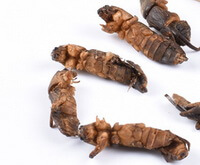 Characteristics of the Herb: Specimens are often fragmented; intact individuals measure 2–3.3 cm in length and 4–10 mm in width. The head is tea-brown, mottled with dark brown; compound eyes are black and glossy; membranous wings and legs are frequently fragmented; three to four spines occur on the dorsal inner edge of the metathoracic tibia. The abdomen is nearly fusiform (spindle-shaped), annulated (segmented), shriveled, and pale yellow. The herb has a soft texture and crumbles easily; when crushed, it emits a distinctive odor.
 URL QR code: