Introduction of Fan Bai Cao: Diverse-color Cinquefoil
✵The article records the herb Diverse-Color Cinquefoil—its English name, Latin name, Pinyin name, properties and flavor, botanical source—a single plant species, Potentilla discolor Bunge, and provides a detailed introduction to the botanical features, growth characteristics, and ecological environment of this species, as well as the morphological characteristics of the herb, its pharmacological actions, medicinal efficacy, and administration guidelines.
Pinyin Name: Fān Bái Cǎo
English Name: Diverse-color Cinquefoil
Latin Name:Herba Potentillae Discoloris Properties and Flavor: Neutral; slightly bitter and sweet
Brief Introduction:Herba Potentillae Discoloris is the dried whole plant of Potentilla discolor Bunge, used to treat enteritis, dysentery, pharyngitis, and gastrointestinal bleeding. It is commonly known as Herba Potentillae Discoloris, Diverse-Color Cinquefoil, or Fān Bái Cǎo.
Botanical Source: Classical herbal works define Herba Potentillae Discoloris (Diverse-Color Cinquefoil) as the dried whole plant of Potentilla discolor Bunge—a species of the genus Potentilla L., family Rosaceae (rose family), order Rosales. The following commonly used species is described:
(1) Potentilla discolor Bunge
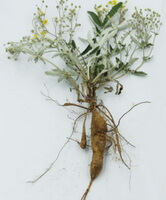
Botanical Description:Potentilla discolor Bunge is commonly known as potentilla discolor, diverse-color cinquefoil, or Fān Bái Cǎo. It is a perennial herb. The root is stout, and the lower part is often hypertrophied and fusiform (spindle-shaped). Pedicels are erect, ascending, or slightly spreading, 10–45 cm tall, and densely covered with white tomentum. Basal leaves are imparipinnate with 2–4 pairs of leaflets (foliolules), which are opposite or alternate; petioles are densely covered with white woolly hairs, sometimes bearing long pilose hairs; leaflets are sessile and opposite or alternate; stipules are membranous, brown, and externally densely covered with white pilose hairs; leaflets are oblong or oblong-lanceolate, 1–5 cm long and 5–8 mm wide, with obtuse (rarely acute) apices; the upper surface is dark green and sparsely covered with white woolly hairs (often becoming glabrate), while the lower surface is densely covered with white or hoary (grayish-white) woolly hairs. One or two cauline leaves are present, each with 3–5 palmately arranged leaflets; stipules are herbaceous, oval or broadly ovate, with incised-dentate margins, and the lower surface is densely covered with white woolly hairs.
Flowers are hermaphroditic; inflorescences are cymose; pedicels are 1–2.5 cm long and woolly; flowers are 1–2 cm in diameter; sepals are triangular-ovate; calyx lobes are lanceolate, shorter than the sepals, and externally covered with white woolly hairs; petals are yellow, obovate, with emarginate or obtuse apices, and longer than the sepals; the style is subapical, the stylopodium is papillate and inflated, and the stigma is slightly enlarged.
Achenes are subreniform, approximately 1 mm wide, and smooth. Flowering and fruiting occur from May to September.
Ecological Environment: The plant grows in wastelands, barren lands, mountain valleys, gullies, hillside and mountainside grasslands, grassy marshes, and open forests, at altitudes of 100–1,850 m above sea level.
Growth Characteristics: The plant prefers a mild and humid climate. It thrives best in loose, fertile, sandy loam soil. It favors slightly acidic to neutral, well-drained sandy loam; tolerates moist soils and exhibits drought resistance. It is also suitable for mild, relatively dry climates.
Characteristics of the Herb: The tuberous root is fusiform (spindle-shaped) or cylindrical; a few are slender and elongated, with irregularly twisted longitudinal grooves, 3–8 cm long and 0.4–1 cm in diameter; the surface is yellowish-brown or reddish-brown; the periderm is smooth; the texture is hard and brittle; the fracture surface is flat and grayish-white or yellowish-white. Basal leaves are tufted; imparipinnate compound leaves are shriveled and curled; when flattened, they measure 4–13 cm in length and bear 3–9 leaflets (foliolules), which are short-petiolulate or sessile, rectangular-circular or narrowly oblong-oval; terminal leaflets are relatively larger; the upper surface is dark green or grayish-green; the lower surface bears dense white tomentum; the margin is incised-dentate. The herb has a faint odor and tastes sweet and slightly astringent.
Pharmacological Actions: (1) Inhibitory effect against Shigella dysenteriae and Shigella flexneri. (2) The herb exhibits no anti-amoebic activity in vitro. (3) Its constituents—including fumaric acid, gallic acid, protocatechuic acid, quercetin, naringenin, kaempferol, and m-benzoic acid—demonstrate antibacterial activity against Shigella dysenteriae and Shigella flexneri; among these, gallic acid and quercetin are the most potent.
Medicinal Efficacy: Clears heat and resolves toxicity; alleviates dysentery; stops bleeding (hemostasis); cools the blood to stop bleeding; reduces swelling (detumescence). Indicated for diarrhea and dysentery due to damp-heat, malaria, lung-heat-induced cough and wheezing, pulmonary abscess, hemoptysis, epistaxis, blood-heat-induced hematochezia, metrorrhagia and metrostaxis, carbuncles and sores, scrofula, and tuberculosis.
Administration of Herba Potentillae Discoloris (Fān Bái Cǎo):
Reference:
Administration Guide for Herba Potentillae Discoloris (Fān Bái Cǎo)
TCM Books:
(1) Internally: 9–15 grams; use with caution in pregnant women. (2) Internally: water decoction, 3–5 qián (≈9–15 grams); fresh herb, 1–2 liǎng (≈30–60 grams); or wine maceration. External use: crush and apply topically. (3) Internally: water decoction, 10–15 grams; or wine maceration. External use: appropriate amount—fumigation and wash with decoction, or crush fresh herb and apply topically.
Article Link:
URL QR code:
References:
1.Introduction of Fan Bai Cao: Diverse-color Cinquefoil

 ✵The article records the herb Diverse-Color Cinquefoil—its English name, Latin name, Pinyin name, properties and flavor, botanical source—a single plant species, Potentilla discolor Bunge, and provides a detailed introduction to the botanical features, growth characteristics, and ecological environment of this species, as well as the morphological characteristics of the herb, its pharmacological actions, medicinal efficacy, and administration guidelines.
 Pinyin Name: Fān Bái Cǎo
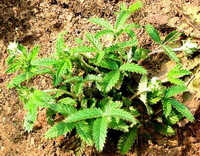 Botanical Description: Potentilla discolor Bunge is commonly known as potentilla discolor, diverse-color cinquefoil, or Fān Bái Cǎo. It is a perennial herb. The root is stout, and the lower part is often hypertrophied and fusiform (spindle-shaped). Pedicels are erect, ascending, or slightly spreading, 10–45 cm tall, and densely covered with white tomentum. Basal leaves are imparipinnate with 2–4 pairs of leaflets (foliolules), which are opposite or alternate; petioles are densely covered with white woolly hairs, sometimes bearing long pilose hairs; leaflets are sessile and opposite or alternate; stipules are membranous, brown, and externally densely covered with white pilose hairs; leaflets are oblong or oblong-lanceolate, 1–5 cm long and 5–8 mm wide, with obtuse (rarely acute) apices; the upper surface is dark green and sparsely covered with white woolly hairs (often becoming glabrate), while the lower surface is densely covered with white or hoary (grayish-white) woolly hairs. One or two cauline leaves are present, each with 3–5 palmately arranged leaflets; stipules are herbaceous, oval or broadly ovate, with incised-dentate margins, and the lower surface is densely covered with white woolly hairs.
 Flowers are hermaphroditic; inflorescences are cymose; pedicels are 1–2.5 cm long and woolly; flowers are 1–2 cm in diameter; sepals are triangular-ovate; calyx lobes are lanceolate, shorter than the sepals, and externally covered with white woolly hairs; petals are yellow, obovate, with emarginate or obtuse apices, and longer than the sepals; the style is subapical, the stylopodium is papillate and inflated, and the stigma is slightly enlarged.
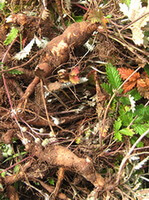 Ecological Environment: The plant grows in wastelands, barren lands, mountain valleys, gullies, hillside and mountainside grasslands, grassy marshes, and open forests, at altitudes of 100–1,850 m above sea level.
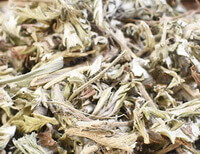 Characteristics of the Herb: The tuberous root is fusiform (spindle-shaped) or cylindrical; a few are slender and elongated, with irregularly twisted longitudinal grooves, 3–8 cm long and 0.4–1 cm in diameter; the surface is yellowish-brown or reddish-brown; the periderm is smooth; the texture is hard and brittle; the fracture surface is flat and grayish-white or yellowish-white. Basal leaves are tufted; imparipinnate compound leaves are shriveled and curled; when flattened, they measure 4–13 cm in length and bear 3–9 leaflets (foliolules), which are short-petiolulate or sessile, rectangular-circular or narrowly oblong-oval; terminal leaflets are relatively larger; the upper surface is dark green or grayish-green; the lower surface bears dense white tomentum; the margin is incised-dentate. The herb has a faint odor and tastes sweet and slightly astringent.
 URL QR code: