✵This article records the herb Purslane Herb—including its English name, Latin name, Pinyin name, properties and flavor—as well as its botanical source: a single plant species, Portulaca oleracea L. It provides a detailed introduction to the botanical features, growth characteristics, and ecological environment of this species; the morphological characteristics of the herb Purslane Herb; its pharmacological actions; medicinal efficacy; and administration guidelines.
Herba Portulacae (Purslane Herb)
Pinyin Name: Mǎ Chǐ Xiàn
English Name: Purslane Herb
Latin Name:Herba Portulacae Properties and Flavor: Cold, sour
Brief Introduction:Herba Portulacae is the dried aerial part of Portulaca oleracea L. (family Portulacaceae), used internally to treat dysentery with bloody stools and externally for boils, sores, eczema, erysipelas, and snake or insect bites. It is commonly known as Herba Portulacae, Purslane Herb, or Mǎ Chǐ Xiàn.
Botanical Source:Herba Portulacae (Purslane Herb) is the dried aerial part of Portulaca oleracea L., a species in the genus Portulaca, family Portulacaceae (purslane family), order Caryophyllales. This commonly used species is described below:
(1) Portulaca oleracea L.
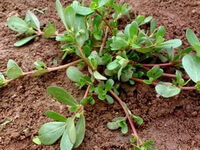
Botanical Description:Portulaca oleracea L. belongs to the family Portulacaceae and genus Portulaca. It is commonly known as common purslane, verdolaga, red root, pursley, or Mǎ Chǐ Xiàn. An annual succulent herb—thick, fleshy, and glabrous—growing up to 10–30 cm tall. Stems are cylindrical; the lower portion is prostrate, the upper portion is ascending or erect, much-branched; the sunny side often exhibits maroon (brownish-red) pigmentation. Leaves are alternate or subopposite; obovate, oblong, or spatulate (spoon-shaped), 1–3 cm long and 5–15 mm wide; apex is obtuse, sometimes emarginate; base tapering into a short petiole; upper surface is green, lower surface is dull red.
Flowers are hermaphroditic, small, and yellow; typically 3–5 flowers occur in terminal clusters. Involucral bracts number 4–5, triangular-ovate. There are 2 sepals (calyx lobes), opposite, ovate, approximately 4 cm long and wide. Petals number 5, primrose-yellow (pale yellow), obovate; their bases fused with the sepals and attached to the ovary. Stamens number 8–12; anthers are yellow. One pistil; ovary is semi-inferior; style is 4- to 6-lobed, linear, extending beyond the stamens.
Capsule fruit is short conical, ~5 mm long, brown; operculum (fruit cap) dehisces by lid. Seeds are black, ~1 mm in diameter, with finely punctate surfaces. Flowering occurs from May to August; fruiting from July to October.
Ecological Environment: The plant grows in sunny locations—such as fields, abandoned yards, and roadsides.
Growth Characteristics:Portulaca oleracea prefers warm, humid climates and exhibits strong adaptability and drought tolerance. It can be cultivated on hillsides or flat land in ordinary soils.
Characteristics of the Herb: The whole herb is shriveled and curled into balls. Stems are cylindrical, 10–25 cm long and 1–3 mm in diameter; surface is yellow-brown to brown, bearing prominent spirally twisted longitudinal grooves. Leaves are fragile and easily detached; intact leaves are obovate, greenish-brown, 1–2.5 cm long and 0.5–1.5 cm wide; apex is truncate or emarginate; margin is entire. Flowers are infrequent and yellow, with 3–5 per branch tip. Capsules are conical (~5 mm long), cap-shaped, and dehiscent by lid, containing numerous minute black seeds. The herb has a faint odor and tastes slightly sour and mucilaginous.
Pharmacological Actions: (1) Inhibitory effects against Shigella spp. (dysentery bacilli), Escherichia coli, Staphylococcus aureus, etc.—particularly pronounced against Shigella dysenteriae; (2) Constricts rabbit aorta, depresses myocardial contractility, and increases blood pressure in rats; (3) Enhances contraction of isolated guinea pig ileum in vitro; exerts uterotonic effect; (4) Diuretic effect; (5) Increases serum potassium levels.
Medicinal Efficacy: Clears heat and drains dampness via diuresis; clears heat and detoxifies; cools the blood and detoxifies; cools the blood and stops dysentery; invigorates blood circulation and reduces swelling; eliminates dampness; and treats stranguria. It is indicated for bacillary dysentery; heat-damp dysentery with bloody stools; dysentery with pus and blood; acute gastroenteritis; acute appendicitis; mastitis; hemorrhoidal bleeding; hemorrhoids; hematuria with stranguria; pyretic stranguria; hematochezia; uterine bleeding; anuria; leukorrhea (including white, yellowish, or reddish varieties); metrorrhagia; and metrostaxis. For topical use: malignant boils, carbuncles, erysipelas, snake or insect bites, eczema, scrofula, acute eczema, herpes zoster, tinea capitis, etc.
Administration of Herba Portulacae (Mǎ Chǐ Xiàn):
Reference:
Administration Guide for Herba Portulacae (Mǎ Chǐ Xiàn)
TCM Books:
(1) Internally: 9–15 grams; fresh herb, 30–60 grams. External use: appropriate amount, mashed and applied topically to the affected area. (2) Internally: water decoction, 3–5 qian (approximately 9–15 grams); fresh herb, 2–4 liang (approximately 60–120 grams); or fresh juice taken orally. External use: appropriate amount, mashed and applied topically; or charred herb ground into fine powder and applied topically; or wash with water decoction. (3) Internally: water decoction, 10–15 grams; fresh herb, 30–60 grams; or fresh juice taken orally. External use: appropriate amount, mashed and applied topically; or charred herb ground into fine powder and applied topically; or wash with water decoction.
Contraindications, Precautions, and Adverse Reactions: Herba Portulacae should not be combined with turtle shell (Carapax Testudinis) in decoction preparation.

 ✵This article records the herb Purslane Herb—including its English name, Latin name, Pinyin name, properties and flavor—as well as its botanical source: a single plant species, Portulaca oleracea L. It provides a detailed introduction to the botanical features, growth characteristics, and ecological environment of this species; the morphological characteristics of the herb Purslane Herb; its pharmacological actions; medicinal efficacy; and administration guidelines.
 Pinyin Name: Mǎ Chǐ Xiàn
 Botanical Description: Portulaca oleracea L. belongs to the family Portulacaceae and genus Portulaca. It is commonly known as common purslane, verdolaga, red root, pursley, or Mǎ Chǐ Xiàn. An annual succulent herb—thick, fleshy, and glabrous—growing up to 10–30 cm tall. Stems are cylindrical; the lower portion is prostrate, the upper portion is ascending or erect, much-branched; the sunny side often exhibits maroon (brownish-red) pigmentation. Leaves are alternate or subopposite; obovate, oblong, or spatulate (spoon-shaped), 1–3 cm long and 5–15 mm wide; apex is obtuse, sometimes emarginate; base tapering into a short petiole; upper surface is green, lower surface is dull red.
 Capsule fruit is short conical, ~5 mm long, brown; operculum (fruit cap) dehisces by lid. Seeds are black, ~1 mm in diameter, with finely punctate surfaces. Flowering occurs from May to August; fruiting from July to October.
 Characteristics of the Herb: The whole herb is shriveled and curled into balls. Stems are cylindrical, 10–25 cm long and 1–3 mm in diameter; surface is yellow-brown to brown, bearing prominent spirally twisted longitudinal grooves. Leaves are fragile and easily detached; intact leaves are obovate, greenish-brown, 1–2.5 cm long and 0.5–1.5 cm wide; apex is truncate or emarginate; margin is entire. Flowers are infrequent and yellow, with 3–5 per branch tip. Capsules are conical (~5 mm long), cap-shaped, and dehiscent by lid, containing numerous minute black seeds. The herb has a faint odor and tastes slightly sour and mucilaginous.
 URL QR code: