✵The article records the herb nutmeg, including its English name, Latin name, Pinyin name, properties and flavor, and its botanical source—namely, the single plant species Myristica fragrans Houtt. It offers a detailed introduction to the botanical features, growth characteristics, and ecological environment of this species, as well as the characteristics of the herb nutmeg, its pharmacological actions, medicinal efficacy, and administration guidelines.
Semen Myristicae (Nutmeg)
Pinyin Name: Ròu Dòu Kòu
English Name: Nutmeg
Latin Name:Semen Myristicae Properties and Flavor: Warm in nature; pungent in taste
Brief Introduction:Semen Myristicae is the dried kernel of Myristica fragrans Houtt., used as an antidiarrheal agent by warming the spleen and stomach for the treatment of chronic diarrhea. It is commonly known as Semen Myristicae, nutmeg, or Ròu Dòu Kòu.
Botanical Source: Traditional Chinese Medicine (TCM) herbal classics define Semen Myristicae (Ròu Dòu Kòu) as the seed—or more precisely, the dried kernel—of plants belonging to the genus Myristica L. in the family Myristicaceae. The primary species is (1) Myristica fragrans Houtt. Standard herbal references in the United States define nutmeg (and mace) as derived from (1) Myristica fragrans Houtt.: "The kernel is dried to produce nutmeg, and the aril is dried to produce mace. Steam distillation of both yields an essential oil." European herbal references similarly define nutmeg as the seed of (1) Myristica fragrans Houtt. This species belongs to the genus Myristica Gronovius (often cited as Myristica L.), family Myristicaceae (nutmeg family), order Magnoliales (not Rosales). This widely used species is described below:
(1) Myristica fragrans Houtt.
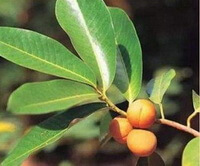
Botanical Description:Myristica fragrans Houtt. is an evergreen tree of the family Myristicaceae (nutmeg family) and genus Myristica L. It is commonly known as Myristica fragrans Houtt., Myristica fragrans, nutmeg (Myristica), nux moschata, mace (macis, muscade), or Ròu Dòu Kòu. It grows up to 15 meters tall, occasionally reaching 20 meters. Leaves are alternate and coriaceous; petioles measure 4–10 mm (sometimes cited as 6–12 mm); leaf blades are elliptic, elliptic-lanceolate, or oblong-lanceolate, 3.5–7 cm long (or 5–15 cm long), coriaceous, with a short-acuminate apex and cuneate base; margins are entire; both surfaces are glabrous; lateral veins occur in 8–10 pairs; the upper surface is pale yellowish-brown, while the lower surface is darker with reddish-brown veins.
Flowers are unisexual and dioecious, arranged in axillary racemes. Male inflorescences are 1–3 cm long, bearing 3–20 flowers (rarely 1–2); individual flowers are 4–5 mm long, with 3–4 tepals (perianth lobes) that are triangular-ovate and densely covered with taupe (grayish-brown) pubescence; anthers number 9–12, strap-shaped, with filaments fused into a terete (cylindrical) column. Female inflorescences are longer than male ones; peduncles are thick and bear 1–2 flowers; flowers are ~6 mm long, with 3 tepals densely puberulent; the ovary is elliptic and densely covered with rust-colored pubescence; the style is extremely short; the stigma is 2-lobed.
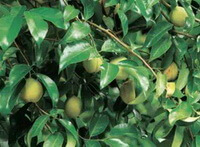
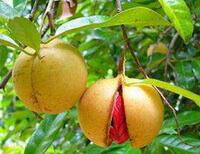
Fruits are usually solitary, short-stipitate, pyriform (pear-shaped) or subsphaeroidal (nearly spherical), 5–7 cm long, faint yellow or salmon-colored (orange-red); at maturity, they dehisce vertically into two valves, exposing a scarlet, pulpy aril. Each fruit contains one seed; the testa (seed coat) is russet (reddish-brown); the endosperm is firm and hard.
Nutmeg is known by many names, including Myristica fragrans, mace, muscadier, muskatbaum, myristica, noz moscada, nuez moscada, and nux moschata.
The nutmeg tree is most commonly used as a culinary spice and is derived from the fruit of a tropical evergreen tree growing up to 50 ft (~15.24 m) tall. It is native to Southeast Asia and New Guinea. The bark is smooth and grayish-brown; young branches and leaves are green. The oblong, pulpy fruit—called the "nutmeg apple"—contains a seed from which nutmeg is obtained. Both the dried seed (nutmeg) and its essential oil are used medicinally.
The nutmeg tree is a large evergreen native to the Banda Islands in the Moluccas and attains a height of about 18 meters. It begins fruiting 15–20 years after planting. The fruit resembles an apricot in color and size and splits open at maturity, revealing brilliant red arils surrounding the brown seed. Upon drying, the red arils turn orange and become commercial mace. The seed is also dried until the kernel inside rattles freely.
The tree is about 25 feet (7.62 m) tall, with greyish-brown, smooth bark and abundant yellow sap. Branches are arranged in whorls; leaves are alternate, grow on petioles approximately 1 inch (2.54 cm) long, elliptical, glabrous, with an obtuse base and acuminate apex, aromatic, dark green and glossy above, paler beneath, and 4–6 inches (10.16–15.24 cm) long. Flowers are dioecious and small, arranged in axillary racemes. Peduncles and pedicels are glabrous. Male flowers occur in clusters of three to five on a single peduncle. The calyx is urceolate, thick and succulent, covered with indistinct reddish pubescence and dingy pale-yellow coloration, and divided into three erect teeth. Female flowers resemble male flowers closely, except that the pedicel is often solitary. The fruit is a pendulous, globose drupe composed of a succulent pericarp—the mace aril—surrounding the hard endocarp, and a wrinkled kernel containing ruminated endosperm. When fresh, the aril is brilliant scarlet; when dried, it becomes more corneous, brittle (crisp), and yellowish-brown. The seed—or nutmeg—is firm, fleshy, whitish, traversed by reddish-brown veins, and rich in volatile oil. The tree does not flower until it is nine years old, begins fruiting thereafter, and continues to bear fruit for up to seventy-five years with minimal care. In the Banda Islands, there are three annual harvests: the principal one is in July or August, the second is in November, and the third is in March or April. Fruits are harvested using a pole fitted with a barbed hook. The mace is carefully separated from the nut, and both are dried separately. The official medicinal parts are the dried kernel (nutmeg) and the dried aril (mace).
Ecological Environment: The plant is native to the Maluku Islands and is widely cultivated in tropical regions. It is primarily grown in parts of Southeast Asia and Brazil. The species has been introduced to China and is cultivated there.
Growth Characteristics: The plant thrives in tropical and subtropical climates. Its optimal growth temperature range is 25–30 °C (77–86 °F); cold tolerance is low, and cold injury occurs below 6 °C (42.8 °F). Annual rainfall should be 1,700–2,300 mm, with good drainage to prevent waterlogging. Young trees prefer partial shade, whereas mature trees require full sun. Cultivation is best carried out in deep, loose, fertile, well-drained loam soil.
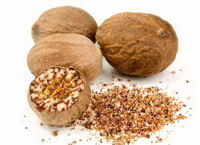
Characteristics of the Herb: The kernel is ovoid, oval, or elliptical, measuring 2–3.5 cm in length and 1.5–2.5 cm in width. The surface is taupe-brown (grayish-brown) to dark brown, with reticulated grooves and often coated with a thin layer of white lime powder. The hilum is located at the broader end as a light-colored, circular protrusion; the chalaza lies in a dark, concave region at the narrower end; and the raphe appears as a prominent longitudinal groove connecting both ends. The texture is firm and hard, difficult to fracture. On the fractured surface, brown or dark brown endosperm is visible, extending inward and interwoven with pale endosperm to form marble-like streaks. In longitudinal section, a small cavity is visible at the broader end, containing a minute, desiccated embryo and contorted cotyledons. The herb possesses a strong aromatic odor and tastes pungent and slightly bitter.
Pharmacological Actions: (1) Sedative and hypnotic effects; (2) Antibacterial activity: its constituent methylisoeugenol inhibits Staphylococcus aureus and Diplococcus pneumoniae (now classified as Streptococcus pneumoniae); malabarone B exhibits potent antibacterial activity against Staphylococcus aureus, Bacillus subtilis, and Streptococcus durans; (3) Other effects: stimulation of gastrointestinal motility and reduction of serum glutamic-pyruvic transaminase (ALT) levels, among others.
Medicinal Efficacy: Warms the middle energizer and regulates Qi; descends rebellious Qi; promotes Qi circulation; aids digestion; astringes the intestines and arrests diarrhea. It is indicated for deficiency-cold patterns of the spleen and stomach (e.g., Spleen-Yang deficiency, cold-damp spleen deficiency), intractable chronic diarrhea, deficiency-type diarrhea, cold-damp dysentery, poor appetite, nausea and vomiting (anorexia with emesis), dyspepsia, abdominal distension and pain, and epigastric fullness and discomfort.
Administration of Semen Myristicae (Ròu Dòu Kòu):
Reference:
Administration Guide for Semen Myristicae (Ròu Dòu Kòu)
TCM Books:
(1) Internally: 3–10 grams; (2) Internally: water decoction, 0.5–2 qián (≈1.5–6 grams); or prepared as pills or powders; (3) Internally: water decoction, 1.5–6 grams; or formulated into pills or powders.

 ✵The article records the herb nutmeg, including its English name, Latin name, Pinyin name, properties and flavor, and its botanical source—namely, the single plant species Myristica fragrans Houtt. It offers a detailed introduction to the botanical features, growth characteristics, and ecological environment of this species, as well as the characteristics of the herb nutmeg, its pharmacological actions, medicinal efficacy, and administration guidelines.
 Pinyin Name: Ròu Dòu Kòu
 Botanical Description: Myristica fragrans Houtt. is an evergreen tree of the family Myristicaceae (nutmeg family) and genus Myristica L. It is commonly known as Myristica fragrans Houtt., Myristica fragrans, nutmeg (Myristica), nux moschata, mace (macis, muscade), or Ròu Dòu Kòu. It grows up to 15 meters tall, occasionally reaching 20 meters. Leaves are alternate and coriaceous; petioles measure 4–10 mm (sometimes cited as 6–12 mm); leaf blades are elliptic, elliptic-lanceolate, or oblong-lanceolate, 3.5–7 cm long (or 5–15 cm long), coriaceous, with a short-acuminate apex and cuneate base; margins are entire; both surfaces are glabrous; lateral veins occur in 8–10 pairs; the upper surface is pale yellowish-brown, while the lower surface is darker with reddish-brown veins.
 Flowers are unisexual and dioecious, arranged in axillary racemes. Male inflorescences are 1–3 cm long, bearing 3–20 flowers (rarely 1–2); individual flowers are 4–5 mm long, with 3–4 tepals (perianth lobes) that are triangular-ovate and densely covered with taupe (grayish-brown) pubescence; anthers number 9–12, strap-shaped, with filaments fused into a terete (cylindrical) column. Female inflorescences are longer than male ones; peduncles are thick and bear 1–2 flowers; flowers are ~6 mm long, with 3 tepals densely puberulent; the ovary is elliptic and densely covered with rust-colored pubescence; the style is extremely short; the stigma is 2-lobed.
 Fruits are usually solitary, short-stipitate, pyriform (pear-shaped) or subsphaeroidal (nearly spherical), 5–7 cm long, faint yellow or salmon-colored (orange-red); at maturity, they dehisce vertically into two valves, exposing a scarlet, pulpy aril. Each fruit contains one seed; the testa (seed coat) is russet (reddish-brown); the endosperm is firm and hard.
 The tree is about 25 feet (7.62 m) tall, with greyish-brown, smooth bark and abundant yellow sap. Branches are arranged in whorls; leaves are alternate, grow on petioles approximately 1 inch (2.54 cm) long, elliptical, glabrous, with an obtuse base and acuminate apex, aromatic, dark green and glossy above, paler beneath, and 4–6 inches (10.16–15.24 cm) long. Flowers are dioecious and small, arranged in axillary racemes. Peduncles and pedicels are glabrous. Male flowers occur in clusters of three to five on a single peduncle. The calyx is urceolate, thick and succulent, covered with indistinct reddish pubescence and dingy pale-yellow coloration, and divided into three erect teeth. Female flowers resemble male flowers closely, except that the pedicel is often solitary. The fruit is a pendulous, globose drupe composed of a succulent pericarp—the mace aril—surrounding the hard endocarp, and a wrinkled kernel containing ruminated endosperm. When fresh, the aril is brilliant scarlet; when dried, it becomes more corneous, brittle (crisp), and yellowish-brown. The seed—or nutmeg—is firm, fleshy, whitish, traversed by reddish-brown veins, and rich in volatile oil. The tree does not flower until it is nine years old, begins fruiting thereafter, and continues to bear fruit for up to seventy-five years with minimal care. In the Banda Islands, there are three annual harvests: the principal one is in July or August, the second is in November, and the third is in March or April. Fruits are harvested using a pole fitted with a barbed hook. The mace is carefully separated from the nut, and both are dried separately. The official medicinal parts are the dried kernel (nutmeg) and the dried aril (mace).
 Ecological Environment: The plant is native to the Maluku Islands and is widely cultivated in tropical regions. It is primarily grown in parts of Southeast Asia and Brazil. The species has been introduced to China and is cultivated there.
 Growth Characteristics: The plant thrives in tropical and subtropical climates. Its optimal growth temperature range is 25–30 °C (77–86 °F); cold tolerance is low, and cold injury occurs below 6 °C (42.8 °F). Annual rainfall should be 1,700–2,300 mm, with good drainage to prevent waterlogging. Young trees prefer partial shade, whereas mature trees require full sun. Cultivation is best carried out in deep, loose, fertile, well-drained loam soil.
 Characteristics of the Herb: The kernel is ovoid, oval, or elliptical, measuring 2–3.5 cm in length and 1.5–2.5 cm in width. The surface is taupe-brown (grayish-brown) to dark brown, with reticulated grooves and often coated with a thin layer of white lime powder. The hilum is located at the broader end as a light-colored, circular protrusion; the chalaza lies in a dark, concave region at the narrower end; and the raphe appears as a prominent longitudinal groove connecting both ends. The texture is firm and hard, difficult to fracture. On the fractured surface, brown or dark brown endosperm is visible, extending inward and interwoven with pale endosperm to form marble-like streaks. In longitudinal section, a small cavity is visible at the broader end, containing a minute, desiccated embryo and contorted cotyledons. The herb possesses a strong aromatic odor and tastes pungent and slightly bitter.
 URL QR code: