✵The article documents the herb Chinese Gall, including its English name, Latin name, Pinyin name, properties and flavor, and botanical sources—three plant species: (1) Rhus chinensis Mill., (2) Rhus potaninii Maxim., and (3) Rhus punjabensis Stewart var. sinica (Diels) Rehder et Wilson. It provides a detailed introduction to the botanical features, growth characteristics, and ecological environments of these three species; the characteristics of Chinese Gall; its pharmacological actions; medicinal efficacy; and administration guidelines.
Galla Chinensis (Chinese Gall)
Pinyin Name: Wǔ Bèi Zǐ
English Name: Chinese Gall
Latin Name:Galla Chinensis Properties and Flavor: Cold in nature; sour and puckering in taste
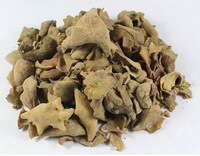
Brief Introduction:Galla Chinensis is a gall induced primarily by the aphid Melaphis chinensis (Bell) Baker on the leaves of sumac species—including Rhus chinensis Mill., Rhus potaninii Maxim., and Rhus punjabensis Stewart var. sinica (Diels) Rehder et Wilson. It is used internally as an astringent to treat persistent cough, night sweats, chronic diarrhea, hematochezia, and enuresis; and externally for burns, traumatic bleeding, hemorrhoids, and oral ulcers. It is commonly known as Chinese Gall or Wǔ Bèi Zǐ.
Botanical Source: Classical herbal works define Galla Chinensis (Chinese Gall) as the gall formed predominantly by the aphid Melaphis chinensis (Bell) Baker on the leaves of sumac species: (1) Rhus chinensis Mill., (2) Rhus potaninii Maxim., and (3) Rhus punjabensis Stewart var. sinica (Diels) Rehder et Wilson. These are shrubs or small trees belonging to the genus Rhus in the Anacardiaceae family (the cashew family), order Sapindales. The three principal host species are described below:
(1) Rhus chinensis Mill.
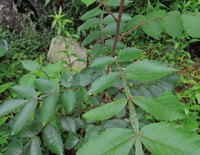
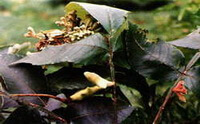
Botanical Description: Also known as Schinus indicus Burm. f., Rhus semialata Murr., and Rhus javanica Thunb., it is commonly called Yán Fū Zǐ. A deciduous small tree or shrub, 2–10 m tall. Branchlets are tan (chocolate brown), densely covered with rust-colored pilose pubescence, and bear circular, small lenticels. Leaves are compound, alternate, odd-pinnate (imparipinnate), with rachis and petioles often winged; leaflets number 5–13, sessile; laminae are chartaceous (papery), polymorphic—commonly oval, elliptic-ovate, or oblong, 6–12 cm long and 3–7 cm wide. Apex is acute; base is rounded; margin is coarsely serrate or crenate; upper surface is dark green; lower surface is pinkish-green and glaucous; sparsely pilose along the midvein or nearly glabrous above; lower surface is densely covered with rust-colored pilose pubescence.
Panicles are large, terminal, and much-branched. Male inflorescences reach 30–40 cm in length; female inflorescences are shorter and densely rust-colored pilose. Flowers are small, polygamous, yellowish-white. Calyx lobes of male flowers are ovate-oblong (~1 mm long); petals are obovate-oblong (~2 mm long), revolute during anthesis; stamens exserted, filaments are linear, anthers are oval. Calyx lobes of female flowers are shorter (~0.6 mm); petals are elliptic-ovate (~1.6 mm long); floral disc is glabrous; ovary is oval (~1 mm long), densely white puberulent; 3 styles, stigma is capitate.
Drupes are globose (nearly spherical), slightly compressed, ~4–5 mm in diameter, covered with nodulose pilose and glandular hairs, turning red at maturity; endocarps (stones) are ~3–4 mm in diameter. Flowering occurs from August to September; fruiting in October.
Ecological Environment: Grows in scrubland and open forests on limestone hills, at elevations of 350–2,300 m above sea level.
(2) Rhus potaninii Maxim.
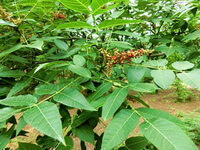
Botanical Description: Also known as Schinus indicus Burm. f., commonly called Qīng Fū Yáng. A deciduous tree, 5–8 m tall. Bark is taupe (grayish-brown); branchlets glabrous. Leaves are odd-pinnate, with 3–5 pairs of leaflets; rachis is unwinged and puberulent; leaflets are ovate-oblong or oblong-lanceolate, 5–10 cm long and 2–4 cm wide; apex is acuminate; base somewhat is deflexed and suborbicular; margin is entire; both surfaces are puberulent, or nearly glabrous along the midvein; leaflets are short-stipitate.
Panicles are terminal, 10–20 cm long, and puberulent; bracts are subulate, ~1 mm long, puberulent; flowers are white, 2.5–3 mm in diameter; pedicels are ~1 mm long, puberulent; calyx is puberulent externally, with oval lobes ~1 mm long; both surfaces of the lobes are puberulent, and the margins bear fine cilia; petals are oval or ovate-oblong, 1.5–2 mm long and ~1 mm wide; both surfaces are puberulent, margins are ciliate, apex is revolute during anthesis; filaments are linear (~2 mm long), shorter in female flowers; anthers are oval; floral disc is thick and glabrous; ovary is globose, ~0.7 mm in diameter, densely covered with white tomentum.
Drupes are subspherical (nearly spherical), slightly compressed, ~3–4 mm in diameter, covered with nodulose pilose and glandular hairs, turning red at maturity, and containing a single seed.
Ecological Environment: The tree grows in open forests or scrublands on mountain slopes, at elevations of 900–2,500 m above sea level.
(3) Rhus punjabensis Stewart var. sinica (Diels) Rehder et Wilson.
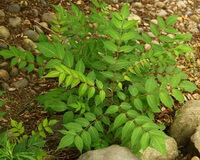
Botanical Description: Commonly known as Hóng Fū Yáng, this is a deciduous tree or small tree, 7–12 m tall. Branchlets are pubescent. Bark is taupe (grayish-brown). Compound leaves are odd-pinnate (imparipinnate), with 7–11 leaflets—up to 17 in some cases; the rachis bears narrow wings proximally, or is fully winged in seedlings; leaflets are sessile; laminae are ovate-oblong to oblong-oval, 7–12 cm long; apex is acuminate; base is rounded or subcordate; margin is entire; abaxial veins are pubescent.
Panicles are terminal, 11–20 cm long, with spreading branches, densely tomentose; flowers are small, white, ~3 mm in diameter; pedicels are short, ~1 mm long; calyx is sparsely puberulent externally, with narrowly triangular lobes ~1 mm long and ~0.5 mm wide; margins are ciliate; petals are oblong, ~2 mm long and ~1 mm wide; both surfaces are puberulent; margins are ciliate; apex is revolute during anthesis; filaments are linear (~2 mm long), puberulent on the middle and lower portions, shorter in female flowers (~1 mm long); anthers are oval; floral disc is thick, violet-red, and glabrous; ovary is globose, ~1 mm in diameter, densely white-pilose; male flowers possess a sterile ovary.
Drupes are subspherical, slightly compressed, ~4 mm in diameter, turning dark violet-red at maturity, and covered with nodulose pilose and glandular hairs. Seeds are small. Flowering occurs in May; fruiting from September to October.
Ecological Environment: The tree grows in scrublands or dense forests on limestone hills, at elevations of 460–3,000 m above sea level.
Collection: Collected in autumn; only intact, uncracked galls are selected. They are typically boiled in water until the surface turns grayish or translucent, then removed and sun-dried or air-dried.
Medicinal Parts: The galls are rhomboid, nodular, or branched in shape, 2.5–9 cm long; grayish-brown to ash-gray; velvety to the touch; thickness ≤2 mm; brittle and easily fractured; fracture surface smooth, lustrous, and horn-like; often adherent with aphid remains and excrement. Odor is peculiar; taste is strongly acidic. Higher-grade herb material is larger, whole, grayish-brown, and branchless.
Characteristics of the Herb: Some literature distinguishes "Gut Galla" as the gall induced by aphids on Rhus potaninii Maxim. or Rhus punjabensis Stewart var. sinica (Diels) Rehder et Wilson. These two types are collectively termed Gut Galla. In contrast, galls formed on Rhus chinensis Mill. are designated Horn Galla.
1. Horn Galla: The herb consists of rhomboid, oval, or fusiform (spindle-shaped) galls, 2.5–9 cm long and 1.5–4 cm (or 2–5 cm) in diameter, often bearing irregular angular branches. Surface is sallow (grayish-yellow) or light yellowish-brown, covered with soft, ash-gray, smooth pubescence. Texture is hard and brittle; fractures are hollow, with a keratoid, glossy surface; wall thickness is 1–2 mm (or 2–3 mm); inner wall is smooth, bearing numerous blackish-brown dead aphids, black powdery aphid eggs, and excrement; occasionally featuring 1–2 pairs of isolated white fibrous bands, each bearing many dead aphids; inner wall also contains a white, creamy or crystalline powdery substance. Odor is distinctive; taste is intensely puckering. Superior-grade herb material is large, intact, grayish-brown, and branchless.
2. Gut Galla: The herb is oblong or fusiform (spindle-shaped), slightly flattened, lacks angular branches, has a dark gray to yellowish-green surface, exhibits numerous shallow vertical veins, is sparsely pilose, and has a wall thickness of approximately 3 mm.
Pharmacological Actions: (1) Antidiarrheal; (2) Detoxifying; (3) Antibacterial effect: In vitro tests show that the herb exhibits marked antibacterial or bactericidal activity against Staphylococcus aureus, Streptococcus spp., Streptococcus pneumoniae, Salmonella typhi, Salmonella paratyphi, Shigella dysenteriae, Bacillus anthracis, Corynebacterium diphtheriae, and Pseudomonas aeruginosa. A 100% aqueous decoction, tested by the agar well-diffusion method, demonstrates inhibitory effects against Pseudomonas aeruginosa, Shigella dysenteriae, Proteus vulgaris, Escherichia coli, Salmonella typhi, Salmonella enteritidis, Bacillus anthracis, Corynebacterium diphtheriae, Staphylococcus aureus, beta-hemolytic streptococci, and Streptococcus pneumoniae. Its bacteriostatic action is not attributable to tannic acid but rather to its protein-coagulating effect, among other mechanisms.
Medicinal Efficacy: Astringes the lung and clears fire (to arrest chronic cough and eliminate heat); astringes the intestines and alleviates diarrhea; controls nocturnal emission; arrests spontaneous and night sweats (antiperspirant action); stops bleeding (hemostasis); dries dampness and promotes wound healing (astringent sores); and detoxifies (acts as an antidote). It is indicated for chronic cough due to lung deficiency, phlegm-heat cough, chronic diarrhea, protracted dysentery, rectal prolapse, night sweats, spontaneous sweating, consumptive thirst (xiao ke), spermatorrhea, leukorrhea (white turbidity), hematochezia, hemorrhoids, epistaxis (nasal bleeding), bleeding from the orifices or subcutaneous tissues, metrorrhagia and metrostaxis, various hemorrhagic conditions, bleeding wounds, carbuncles, furuncles, pyogenic infections, damp-rotten skin lesions, trichiasis (in-turned eyelashes), etc.
Administration of Galla Chinensis (Wǔ Bèi Zǐ):
Reference:
Administration Guide for Galla Chinensis (Wǔ Bèi Zǐ)
TCM Books:
(1) Internally: 3–6 grams; topical use: appropriate amount. (2) Internally: finely powdered herb, 0.5–2 qián (≈1.5–6 grams); or prepared as pills or powders. Topical use: fumigation and wash with aqueous decoction; finely powdered herb applied topically by dusting or paste application. (3) Internally: water decoction, 3–10 grams; finely powdered herb, 1.5–6 g; prepared as pills or powders. Topical use: appropriate amount; fumigation and wash with aqueous decoction; finely powdered herb applied by dusting or paste application.
Contraindications, Precautions, and Adverse Reactions: Galla Chinensis should be avoided in cases of cough due to exogenous wind-cold invasion or excess lung heat, and in diarrhea or dysentery caused by unresolved pathogenic stagnation.

 ✵The article documents the herb Chinese Gall, including its English name, Latin name, Pinyin name, properties and flavor, and botanical sources—three plant species: (1) Rhus chinensis Mill., (2) Rhus potaninii Maxim., and (3) Rhus punjabensis Stewart var. sinica (Diels) Rehder et Wilson. It provides a detailed introduction to the botanical features, growth characteristics, and ecological environments of these three species; the characteristics of Chinese Gall; its pharmacological actions; medicinal efficacy; and administration guidelines.
 Pinyin Name: Wǔ Bèi Zǐ
 Botanical Description: Also known as Schinus indicus Burm. f., Rhus semialata Murr., and Rhus javanica Thunb., it is commonly called Yán Fū Zǐ. A deciduous small tree or shrub, 2–10 m tall. Branchlets are tan (chocolate brown), densely covered with rust-colored pilose pubescence, and bear circular, small lenticels. Leaves are compound, alternate, odd-pinnate (imparipinnate), with rachis and petioles often winged; leaflets number 5–13, sessile; laminae are chartaceous (papery), polymorphic—commonly oval, elliptic-ovate, or oblong, 6–12 cm long and 3–7 cm wide. Apex is acute; base is rounded; margin is coarsely serrate or crenate; upper surface is dark green; lower surface is pinkish-green and glaucous; sparsely pilose along the midvein or nearly glabrous above; lower surface is densely covered with rust-colored pilose pubescence.
 Botanical Description: Also known as Schinus indicus Burm. f., commonly called Qīng Fū Yáng. A deciduous tree, 5–8 m tall. Bark is taupe (grayish-brown); branchlets glabrous. Leaves are odd-pinnate, with 3–5 pairs of leaflets; rachis is unwinged and puberulent; leaflets are ovate-oblong or oblong-lanceolate, 5–10 cm long and 2–4 cm wide; apex is acuminate; base somewhat is deflexed and suborbicular; margin is entire; both surfaces are puberulent, or nearly glabrous along the midvein; leaflets are short-stipitate.
 Botanical Description: Commonly known as Hóng Fū Yáng, this is a deciduous tree or small tree, 7–12 m tall. Branchlets are pubescent. Bark is taupe (grayish-brown). Compound leaves are odd-pinnate (imparipinnate), with 7–11 leaflets—up to 17 in some cases; the rachis bears narrow wings proximally, or is fully winged in seedlings; leaflets are sessile; laminae are ovate-oblong to oblong-oval, 7–12 cm long; apex is acuminate; base is rounded or subcordate; margin is entire; abaxial veins are pubescent.
 Collection: Collected in autumn; only intact, uncracked galls are selected. They are typically boiled in water until the surface turns grayish or translucent, then removed and sun-dried or air-dried.
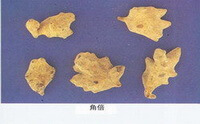 Characteristics of the Herb: Some literature distinguishes "Gut Galla" as the gall induced by aphids on Rhus potaninii Maxim. or Rhus punjabensis Stewart var. sinica (Diels) Rehder et Wilson. These two types are collectively termed Gut Galla. In contrast, galls formed on Rhus chinensis Mill. are designated Horn Galla.
 URL QR code: