✵The article records the herb Terminalia Fruit, including its English name, Latin name, Pinyin name, properties and flavor, botanical sources—two plant species: (1) Terminalia chebula Retz. and (2) Terminalia chebula Retz. var. tomentella (Kurz.) C.B. Clarke—along with detailed descriptions of the botanical features, growth characteristics, and ecological environments of these two species; the characteristics of the herb Terminalia Fruit; its pharmacological actions; medicinal efficacy; and administration guidelines.
Fructus Chebulae (Terminalia Fruit)
Pinyin Name: Hē Zǐ
English Name: Terminalia Fruit
Latin Name:Fructus Chebulae Properties and Flavor: Warm in nature; bitter, sour, and astringent
Brief Introduction:Fructus Chebulae is the dried, ripe fruit of Terminalia chebula Retz. or Terminalia chebula Retz. var. tomentella (Kurz.) C.B. Clarke. It is used as an antidiarrheal and antitussive agent for treating chronic diarrhea or dysentery, persistent cough, and hoarseness. The herb is commonly known as Fructus Chebulae, Terminalia Fruit, or Hē Zǐ.
Botanical Source: Traditional herbal classics define Fructus Chebulae (Hē Zǐ) as the dried, ripe fruit of two plant species in the Combretaceae family: (1) Terminalia chebula Retz. and (2) Terminalia chebula Retz. var. tomentella (Kurz.) C.B. Clarke. Both belong to the genus Terminalia Linn., family Combretaceae (white mangrove family), order Myrtales (formerly in order Myrtiflorae). These two commonly used species are described below:
(1) Terminalia chebula Retz.
Botanical Description:Terminalia chebula Retz. is a tree of the Combretaceae family (white mangrove family) and genus Terminalia. It is commonly known as Terminalia chebula or Máo Hē Zǐ. It grows up to 30 meters tall. Branches are glabrate; lenticels are thin and elongated, white or pale yellow; young shoots (twigs) are yellowish-brown and tomentose. Leaves are alternate or subopposite; petioles are stout, 1.8–2.3 cm long, bearing 2–4 glands located 1–5 mm from the apex; leaf blades are ovate (egg-shaped) or elliptic, 7–14 cm long and 4.5–8.5 cm wide; the apex is mucronate; the base is blunt or cuneate and slightly asymmetrical; margins are entire or slightly undulate; both surfaces are glabrous and densely covered with minute, appressed, hair-like points.
Inflorescences are axillary or terminal spikes, sometimes forming panicles; flowers are hermaphroditic; the hypanthium (floral tube) is cyathiform (cup-shaped), pale green with yellowish tinges, ~3.5 mm long, with triangular, ~1-mm-long 5-dentate lobes; the outer surface is glabrous, while the inner surface is covered with yellowish-brown pubescence; petals are absent; stamens number ten, exserted beyond the calyx; anthers are small and elliptic; the ovary is inferior, unilocular, cylindrical, ~1 mm long, pubescent, turning dark brown upon drying; the style is long, thick, and conical.
Drupes are ovate (egg-shaped) or elliptic, 2.4–4.5 cm long and 1.9–2.3 cm in diameter; immature fruits are bluish-green (cyan), coarse and rough, glabrous; mature fruits turn dark brown and typically bear five blunt longitudinal ridges. Flowering occurs in May; fruiting extends from July to September.
Ecological Environment: Terminalia chebula grows in open forests at altitudes of 800–1,800 meters above sea level, commonly found along roadsides or near villages.
Growth Characteristics: The plant prefers warm, humid, high-temperature climates. It is tolerant of drought and mild frost and requires ample sunlight. It is predominantly distributed at altitudes of 950–1,850 meters. Annual rainfall in its main producing regions ranges from 1,000 to 1,500 mm. Soil requirements are not stringent, but loose, fertile, well-drained loam is optimal for cultivation.
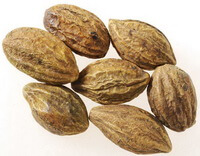
Characteristics of the Herb: The fruits are oblong or ovate, 2–4 cm long and 2–2.5 cm in diameter. The surface is yellowish-brown or dark brown, slightly glossy, bearing 5–6 longitudinal ridges and irregular wrinkles; the base exhibits a circular carpopodium (fruit-stalk scar). The texture is firm and compact. The pulp is 0.2–0.4 cm thick and yellowish-brown or tawny. The endocarp (stone) is 1.5–2.5 cm long and 1–1.5 cm in diameter, pale yellow, coarse and rough, hard and dense. The seed is narrowly fusiform (spindle-shaped), ~1 cm long and 0.2–0.4 cm in diameter; the testa (seed coat) is yellowish-brown; cotyledons are two, white, overlapping, and helically coiled. The herb has a faint odor and a taste that is initially sour and astringent, followed by a subtle sweetness.
(2) Terminalia chebula Retz. var. tomentella (Kurz.) C.B.Clarke
Botanical Description:Terminalia chebula Retz. var. tomentella (Kurz.) C. B. Clarke is a tree of the Combretaceae family (white mangrove family) and genus Terminalia. It is commonly known as Terminalia chebula Retz. var. tomentella (Kurz.), Róng Máo Hē Zǐ ("Fluffy Terminalia chebula"), or Wēi Máo Hē Zǐ ("Puberulent Terminalia chebula"). It is recognized as a botanical variety of Terminalia chebula Retz., distinguished by several morphological features.
The distinguishing characteristics of this variety, compared with Terminalia chebula Retz., include: (i) young shoots and young leaves are flat and densely covered with copper-colored, appressed pubescence; (ii) bracts are longer than the flowers; (iii) the calyx is glabrous on the exterior; and (iv) the fruit is ovate and less than 2.5 cm long. Flowering occurs from June to August; fruiting extends from August to October.
It is a tree reaching 10–15 m in height—rarely up to 23 m—with a trunk diameter of up to 60 cm. Young shoots are densely covered with silvery, short, appressed hairs that persist into maturity; older branches bear conspicuous lenticels. Young buds are clothed in copper-colored hairs; bracts are yellowish-green. Leaves are opposite or subopposite; leaf blades are ovate (egg-shaped) or oblong-lanceolate, 10–17 cm long and 4.5–6.5 cm wide; the apex is acuminate or blunt; both surfaces are densely covered with silvery, appressed hairs that persist until leaf senescence; margins are entire; lateral veins occur in 6–10 pairs; petioles are 2.2–3.1 cm long, covered with silvery, appressed hairs, and bear two glands located approximately 4 mm above the leaf base.
Inflorescences are terminal spikes, ~2 cm long and branched; bracteoles (bractlets) are lanceolate-spatulate, ~2 mm long, olivaceous (yellowish-green), and covered with brown hairs; flowers are small and subsessile; the calyx is urceolate (urn-shaped), ~1.2 mm long, glabrous externally; filaments are short.
Fruits are ovate, turning black upon drying, wrinkled, 2.6–2.9 cm long and 1.2–1.4 cm wide; the apex is acuminate.
Ecological Environment: The plant grows on sunny slopes, forest margins, or in bamboo groves, at altitudes of 800–1,100 meters above sea level.
Pharmacological Actions: (1) Antibacterial activity: effective against 4–5 strains of Shigella dysenteriae (formerly Bacillus dysenteriae); aqueous decoctions inhibit various Shigella strains, with strongest effects against Pseudomonas aeruginosa and Corynebacterium diphtheriae; moderate activity against Staphylococcus aureus, Escherichia coli, Streptococcus pneumoniae, hemolytic streptococci, Proteus vulgaris, and Salmonella enterica (formerly Bacterium aertryke); (2) antitumor activity; (3) antidiarrheal effect; (4) spasmolytic effect on smooth muscle; (5) anti-influenza viral activity (inactivation of influenza virus).
Medicinal Efficacy: Astringent; arrests diarrhea; astringes the Lung to relieve cough; clears Heat and soothes the throat; directs Qi downward. Indications include chronic diarrhea; protracted dysentery; hematochezia; rectal prolapse; metrorrhagia and metrostaxis; pathological leukorrhea; spermatorrhea; frequent urination; dyspnea with cough due to Lung deficiency; cough with phlegm; intractable chronic cough; chronic cough with aphonia; pharyngodynia and hoarseness.
Administration of Fructus Chebulae (Hē Zǐ):
Reference:
Administration Guide for Fructus Chebulae (Hē Zǐ)
TCM Books:
(1) Internally: 3–10 grams; (2) Internally: water decoction, 1–3 qián (approximately 3–9 grams); or prepared as pills or powder. External use: fumigation and wash with decoction; (3) Internally: water decoction, 3–6 grams; or prepared as pills or powder.

 ✵The article records the herb Terminalia Fruit, including its English name, Latin name, Pinyin name, properties and flavor, botanical sources—two plant species: (1) Terminalia chebula Retz. and (2) Terminalia chebula Retz. var. tomentella (Kurz.) C.B. Clarke—along with detailed descriptions of the botanical features, growth characteristics, and ecological environments of these two species; the characteristics of the herb Terminalia Fruit; its pharmacological actions; medicinal efficacy; and administration guidelines.
 Pinyin Name: Hē Zǐ
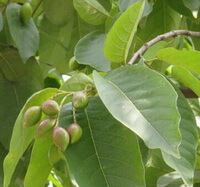 Botanical Description: Terminalia chebula Retz. is a tree of the Combretaceae family (white mangrove family) and genus Terminalia. It is commonly known as Terminalia chebula or Máo Hē Zǐ. It grows up to 30 meters tall. Branches are glabrate; lenticels are thin and elongated, white or pale yellow; young shoots (twigs) are yellowish-brown and tomentose. Leaves are alternate or subopposite; petioles are stout, 1.8–2.3 cm long, bearing 2–4 glands located 1–5 mm from the apex; leaf blades are ovate (egg-shaped) or elliptic, 7–14 cm long and 4.5–8.5 cm wide; the apex is mucronate; the base is blunt or cuneate and slightly asymmetrical; margins are entire or slightly undulate; both surfaces are glabrous and densely covered with minute, appressed, hair-like points.
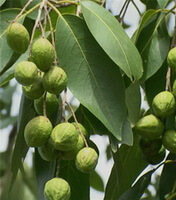 Drupes are ovate (egg-shaped) or elliptic, 2.4–4.5 cm long and 1.9–2.3 cm in diameter; immature fruits are bluish-green (cyan), coarse and rough, glabrous; mature fruits turn dark brown and typically bear five blunt longitudinal ridges. Flowering occurs in May; fruiting extends from July to September.
 Characteristics of the Herb: The fruits are oblong or ovate, 2–4 cm long and 2–2.5 cm in diameter. The surface is yellowish-brown or dark brown, slightly glossy, bearing 5–6 longitudinal ridges and irregular wrinkles; the base exhibits a circular carpopodium (fruit-stalk scar). The texture is firm and compact. The pulp is 0.2–0.4 cm thick and yellowish-brown or tawny. The endocarp (stone) is 1.5–2.5 cm long and 1–1.5 cm in diameter, pale yellow, coarse and rough, hard and dense. The seed is narrowly fusiform (spindle-shaped), ~1 cm long and 0.2–0.4 cm in diameter; the testa (seed coat) is yellowish-brown; cotyledons are two, white, overlapping, and helically coiled. The herb has a faint odor and a taste that is initially sour and astringent, followed by a subtle sweetness.
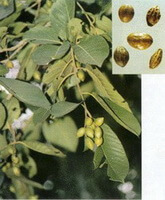 Botanical Description: Terminalia chebula Retz. var. tomentella (Kurz.) C. B. Clarke is a tree of the Combretaceae family (white mangrove family) and genus Terminalia. It is commonly known as Terminalia chebula Retz. var. tomentella (Kurz.), Róng Máo Hē Zǐ ("Fluffy Terminalia chebula"), or Wēi Máo Hē Zǐ ("Puberulent Terminalia chebula"). It is recognized as a botanical variety of Terminalia chebula Retz., distinguished by several morphological features.
 URL QR code: