✵The article documents the herb Spiny Amomum Fruit, including its English name, Latin name, Pinyin name, properties and flavor, and botanical sources—three plant species: (1) Amomum villosum Lour., (2) Amomum villosum Lour. var. xanthioides (Wall. ex Baker) T. L. Wu et Senjen, and (3) Amomum longiligulare T. L. Wu—with a detailed introduction to the botanical features, growth characteristics, and ecological environments of these species; the characteristics of the herb Spiny Amomum Fruit; its pharmacological actions, medicinal efficacy, and administration guidelines.
Fructus Amomi (Spiny Amomum Fruit)
Pinyin Name: Shā Rén
English Name: Spiny Amomum Fruit
Latin Name:Fructus Amomi Properties and Flavor: Warm; pungent
Brief Introduction:Fructus Amomi is the dried, ripe fruit of Amomum villosum Lour., Amomum villosum Lour. var. xanthioides (Wall. ex Baker) T. L. Wu et Senjen, or Amomum longiligulare T. L. Wu. It is used (1) to resolve dampness—particularly in cases of damp accumulation in the spleen and stomach; (2) to warm the middle jiao—especially for vomiting and diarrhea due to spleen- and stomach-deficiency-cold; and (3) to stabilize the fetus in cases of threatened abortion. The herb is commonly known as Fructus Amomi, Spiny Amomum Fruit, or Shā Rén.
Botanical source: Classical herbal works define Fructus Amomi as the dried, mature fruit of Zingiberaceae family plants belonging to the genus Amomum, specifically: (1) Amomum villosum Lour., (2) Amomum villosum Lour. var. xanthioides (Wall. ex Baker) T. L. Wu et Senjen, or (3) Amomum longiligulare T. L. Wu. These are perennial herbs of the Zingiberaceae (ginger) family and the order Zingiberales. The three commonly used species are described below:
(1) Amomum villosum Lour.
Botanical Description:Amomum villosum Lour. is a perennial herb of the Zingiberaceae family (ginger family) and the genus Amomum. It is commonly known as Amomum villosum or Yáng Chūn Shā. The plant grows upright to a height of 1.2–2.0 meters. Rhizomes are cylindrical and procumbent, bearing membranous, sheathed scales at the nodes. Buds are cardinal red (cochineal) and subulate. Stems are erect and terete (cylindrical). Leaves are sessile or subsessile; the paraphyll (ligule) is semicircular, 3–5 mm long, reddish-brown or occasionally green. Leaves are arranged in two vertical rows; leaf blades are narrowly oblong-ovate or lanceolate, 15–40 cm long and 2–5 cm wide, with an acuminate or caudate apex and an attenuate or orbicular base; margins are entire; both surfaces are glabrous, though the lower surface may bear minute trichomes.
Scapes arise from the rhizomes, 7–15 cm long; peduncles are 3–10 cm long and pubescent. Lodicules (inner floral bracts) are membranous, elliptic, brown or green, 0.8–2.5 cm long, with a blunt apex and a connate, fistulose (tubular) base. Inflorescences are elliptic spikes; phyllaries (involucral bracts) are membranous, oblong-ovate, ~1.8 cm long and ~0.6 cm wide. Flower bracts are tubular, white, ~1.1 cm long, membranous, and bifid at the apex. The calyx is tubular, white, ~1.7 cm long, with three shallow apical teeth. The corolla tube is slender and elongated, white, 1.8–2.0 cm long. The labellum is spatulate (spoon-shaped), rounded, white, 1.6–2.0 cm long and wide; its central portion is slightly thickened and primrose yellow (pale yellow) or greenish-yellow—sometimes with reddish spots; the apex is bifid and reflexed. Two lateral staminodes arise at the base of the labellum and bear papillae. There is one fertile stamen, ~1 cm long; the anther is ~6 mm long; the septum appendage is trifid—the anterior lobes are semicircular and reflexed, while the lateral lobes are narrow and small; filaments are flattened and slightly shorter than the anther. The ovary is densely covered with white, soft hairs (villous).
The fruit is a capsule, elliptic, 1.5–2.0 cm long and ~1.5 cm in diameter, bearing unbranched, soft spines, and is reddish-brown. Seeds are numerous, aggregated into compact masses, and emit a strong fragrance. Flowering occurs from March to May; fruiting occurs from July to September.
Ecological Environment:Amomum villosum Lour. grows in humus-rich, shady, and damp habitats—particularly in valley forests—in warm-climate regions, or under cultivation.
Growth Characteristics:Amomum villosum prefers tropical and subtropical monsoon forests—particularly in South Asia—with warm, humid climates. It is not cold-tolerant and can only withstand brief exposure to low temperatures; prolonged exposure to −3 °C (26.6 °F) results in plant death. The average annual temperature in its native production areas ranges from 19–22 °C (66.2–71.6 °F); annual rainfall exceeds 1,000 mm, and relative humidity remains above 90%. The plant is highly sensitive to drought and waterlogging. It requires partial shade and thrives under diffuse light. Optimal cultivation sites include mountain ravines with intact forest cover, locations adjacent to perennial streams, and environments rich in pollinating insects. Well-drained loam or sandy loam soils—with deep profiles, loose texture, and strong water- and nutrient-retention capacity—are recommended. Heavy clay or excessively sandy soils should be avoided.
Characteristics of the Herb: The fruit is elliptic, orbicular-ovate, or ovoid (egg-shaped), bearing three inconspicuous, blunt ridges; it measures 1.2–2.5 cm in length and 0.8–1.8 cm in diameter. The surface is reddish-brown to brownish-brown and densely covered with curved, spine-like protrusions. Longitudinal vascular bundles are faintly visible as ridge lines. Persistent perianth remnants occur at the apex, and fruit-stalk scars (carpopodia) are present at the base. The pericarp is thin and splits longitudinally with ease; the inner surface is pale brown. Prominent longitudinal vascular bundles and thin septa divide the fruit into three locules (axile placentation); each locule contains 6–20 seeds, which aggregate into compact masses. Seeds are irregularly polyhedral, 2–5 mm long and 1.5–4 mm in diameter. Their surface ranges from reddish-brown to dark brown, bearing irregular wrinkles and covered by a pale brown, membranous aril. The hilum is concave at the smaller end; the chalaza lies at the larger end; and the raphe forms a sunken longitudinal groove. The herb possesses a strong, aromatic odor and tastes pungent, slightly cool, and mildly bitter.
Pharmacological Actions: (1) Anti-ulcer activity; (2) inhibition of gastric acid secretion; (3) promotion of gastrointestinal motility; (4) antiplatelet aggregation; (5) excitatory effect on isolated guinea pig ileum.
Medicinal Efficacy: Resolves dampness and stimulates appetite; regulates Qi; warms the spleen and alleviates diarrhea; harmonizes the stomach; strengthens spleen function; regulates Qi; and stabilizes the fetus. It is indicated for: turbid-damp obstruction of the middle jiao; dampness-Qi stagnation; epigastric distension with anorexia; abdominal pain and Qi distension; spleen- and stomach-deficiency-cold; gastric Qi stagnation; food retention (dyspepsia); poor appetite; vomiting and diarrhea; nausea and vomiting; diaphragmatic obstruction (choking diaphragm); intractable vomiting (pernicious vomiting); abdominal pain with diarrhea; cold-type diarrhea; cold-type dysentery; and threatened abortion.
Administration of Fructus Amomi (Shā Rén):
Reference:
Administration Guide for Fructus Amomi (Shā Rén)
TCM Books:
(1) Internally: 3–6 grams, added in the late of decoction; (2) Internally: water decoction, 0.5–2 qián (≈1.5–6 grams), prepared as pills or powders; decoction time should be brief; (3) Internally: water decoction, 3–6 grams, added later; also formulated as pills or powders.
(2) Amomum villosum Lour. var. xanthioides T.L. Wu et Senjen.
Botanical Description:Amomum villosum Lour. var. xanthioides (Wall. ex Baker) T. L. Wu et Senjen—also known as Amomum xanthioides Wall. ex Baker—is a perennial herb of the Zingiberaceae (ginger) family and the genus Amomum. Common names include Cocklebur-like Amomum, Green Shell Amomum, Lǜ Ké Shā, and Suǒ Shā. Plants grow upright to 1.5–3 m tall. Rhizomes are procumbent and occasionally hypertrophied. Stems are erect. Leaves are linear-lanceolate, 15.3–35 cm long and 4–7 cm wide, with an acute or acuminate, caudate apex and a gradually tapering, entire base; both surfaces are glabrous. Leaf sheaths are coriaceous and smooth; the paraphyll (ligule) is 4 mm long and coriaceous.
Scapes (flower stalks) are covered with silky pubescence and bear scale leaves; scales are obovate-oblong with acute apices. Inflorescences are globose spikes. Flower bracts are small and oblong, 1.8–2 cm long, and glabrous. The calyx is tubular, ~2 cm long. Corolla lobes are oblong, ~1 cm long. The labellum is spatulate, longer than the corolla lobes, ~1.8 cm wide, bifid at the apex, and bears broad, claw-like bases. The anther is glabrous, ~5.5 mm long; the septum appendage is semilunar (half-moon-shaped), with auriform lateral lobes.
The fruit is a capsule—firm, hard, oblong-ovoid or subtriangular-globose—approximately 2 cm in diameter, bearing spines and colored brown. Flowering occurs from May to June; fruiting occurs from August to September.
The external features of Amomum villosum Lour. var. xanthioides T. L. Wu et Senjen are very similar to those of Amomum villosum Lour.; the differences are as follows: the bud and paraphyll (ligule) of this variety are predominantly green and remain green even when the fruit is mature. Its flowering period is from April to May, and the fruiting period is from July to September.
Ecological Environment:Amomum villosum Lour. var. xanthioides T. L. Wu et Senjen grows in damp places in forests.
Characteristics of the Herb: The fruit is oval (egg-shaped), ovoid, or elliptic; it has subtle three blunt edges, measures 1.2–2.2 cm in length and 1.0–1.6 cm in diameter; the surface is brown, yellow-brown, or tan (chocolate brown); and it is densely covered with slightly flattened, spinous protrusions. The inner surface of the pericarp is primrose yellow (pale yellow) or brownish-yellow; each locule contains 8–22 seeds. The seeds are irregularly polygonal, 2–4 mm long and 2–4 mm in diameter; their surface is pale brown or brown, with regular wrinkles. The herb has a fragrant aroma and tastes pungent, cool, and slightly bitter.
(3) Amomum longiligulare T.L. Wu
Botanical Description:Amomum longiligulare T. L. Wu is a plant of the Zingiberaceae family (ginger family) and the genus Amomum. It is commonly known as Amomum longiligulare, Longiligulate Amomum Fruit, or Hai Nan Sha. The plant grows up to 1–1.5 meters tall and has procumbent rhizomes. Leaf blades are linear or linear-lanceolate, 20–30 cm long and 2.5–3 cm wide; the apex bears a caudate, slender tip; the base tapers; both surfaces are glabrous. Petioles are about 5 mm long; the paraphyll (ligule) is lanceolate, 2–4.5 cm long, membranous, and glabrous.
Peduncles are 1–3 cm long and covered with persistent scales approximately 5 mm long; bracts are lanceolate, 2–2.5 cm long and brown; bracteoles are about 2 cm long and envelop the calyx tube; the calyx tube is 2–2.2 cm long, white, and apically 3-dentate; the corolla tube is slightly longer, with oblong lobes about 1.5 cm long; the labellum is round-spatulate (spoon-shaped), about 2 cm long and wide, white, with a protruding, bifid yellow apex; the mid-vein is raised and purple; stamens are about 1 cm long; the septum appendage is trifid, with semicircular apical lobes and orbicular lateral lobes.
The capsule fruit is oval (egg-shaped) and bluntly trigonous, 1.5–2.2 cm long and 0.8–1.2 cm wide; it is covered with flaky, partite, short, soft spines less than 1 mm long; the seeds are puce (purplish-brown) and covered with pale brown, membranous arils. Its flowering period is from April to June, and the fruiting period is from June to September.
Differences between Amomum longiligulare T. L. Wu and Amomum villosum Lour. include: the paraphyll (ligule) is exceptionally long, measuring 2–4.5 cm; the fruit exhibits conspicuous blunt three edges; the pericarp is thick and hard; and it is covered with flaky, branched, short soft spines—features that make it easily distinguishable. Its flowering period is from April to June, and the fruiting period is from June to September.
Ecological Environment:Amomum longiligulare T. L. Wu grows in valley jungles or is cultivated.
Characteristics of the Herb: The fruit is oval (egg-shaped), elliptic, fusiform-elliptic (spindle-shaped elliptic), or pear-shaped, with conspicuous blunt three edges; it measures 1–2 cm in length and 0.7–1.7 cm in diameter; the surface is taupe (dust-colored) or taupe-brown and covered with flaky, branched, short spines; the pericarp is thick and hard; the inner surface is reddish-brown; each locule contains 4–24 seeds; the seeds are polygonal, 2.5–4 mm long and 1.5–2 mm in diameter; their surface is reddish-brown or dark brown and bears irregular wrinkles. The herb has a mild, faint odor.

 ✵The article documents the herb Spiny Amomum Fruit, including its English name, Latin name, Pinyin name, properties and flavor, and botanical sources—three plant species: (1) Amomum villosum Lour., (2) Amomum villosum Lour. var. xanthioides (Wall. ex Baker) T. L. Wu et Senjen, and (3) Amomum longiligulare T. L. Wu—with a detailed introduction to the botanical features, growth characteristics, and ecological environments of these species; the characteristics of the herb Spiny Amomum Fruit; its pharmacological actions, medicinal efficacy, and administration guidelines.
 Pinyin Name: Shā Rén
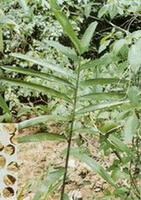 Botanical Description: Amomum villosum Lour. is a perennial herb of the Zingiberaceae family (ginger family) and the genus Amomum. It is commonly known as Amomum villosum or Yáng Chūn Shā. The plant grows upright to a height of 1.2–2.0 meters. Rhizomes are cylindrical and procumbent, bearing membranous, sheathed scales at the nodes. Buds are cardinal red (cochineal) and subulate. Stems are erect and terete (cylindrical). Leaves are sessile or subsessile; the paraphyll (ligule) is semicircular, 3–5 mm long, reddish-brown or occasionally green. Leaves are arranged in two vertical rows; leaf blades are narrowly oblong-ovate or lanceolate, 15–40 cm long and 2–5 cm wide, with an acuminate or caudate apex and an attenuate or orbicular base; margins are entire; both surfaces are glabrous, though the lower surface may bear minute trichomes.
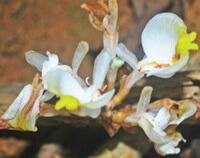 Scapes arise from the rhizomes, 7–15 cm long; peduncles are 3–10 cm long and pubescent. Lodicules (inner floral bracts) are membranous, elliptic, brown or green, 0.8–2.5 cm long, with a blunt apex and a connate, fistulose (tubular) base. Inflorescences are elliptic spikes; phyllaries (involucral bracts) are membranous, oblong-ovate, ~1.8 cm long and ~0.6 cm wide. Flower bracts are tubular, white, ~1.1 cm long, membranous, and bifid at the apex. The calyx is tubular, white, ~1.7 cm long, with three shallow apical teeth. The corolla tube is slender and elongated, white, 1.8–2.0 cm long. The labellum is spatulate (spoon-shaped), rounded, white, 1.6–2.0 cm long and wide; its central portion is slightly thickened and primrose yellow (pale yellow) or greenish-yellow—sometimes with reddish spots; the apex is bifid and reflexed. Two lateral staminodes arise at the base of the labellum and bear papillae. There is one fertile stamen, ~1 cm long; the anther is ~6 mm long; the septum appendage is trifid—the anterior lobes are semicircular and reflexed, while the lateral lobes are narrow and small; filaments are flattened and slightly shorter than the anther. The ovary is densely covered with white, soft hairs (villous).
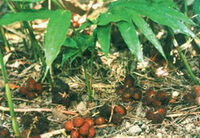 The fruit is a capsule, elliptic, 1.5–2.0 cm long and ~1.5 cm in diameter, bearing unbranched, soft spines, and is reddish-brown. Seeds are numerous, aggregated into compact masses, and emit a strong fragrance. Flowering occurs from March to May; fruiting occurs from July to September.
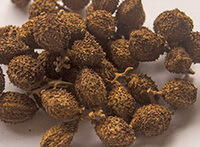 Ecological Environment: Amomum villosum Lour. grows in humus-rich, shady, and damp habitats—particularly in valley forests—in warm-climate regions, or under cultivation.
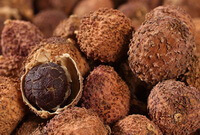 Characteristics of the Herb: The fruit is elliptic, orbicular-ovate, or ovoid (egg-shaped), bearing three inconspicuous, blunt ridges; it measures 1.2–2.5 cm in length and 0.8–1.8 cm in diameter. The surface is reddish-brown to brownish-brown and densely covered with curved, spine-like protrusions. Longitudinal vascular bundles are faintly visible as ridge lines. Persistent perianth remnants occur at the apex, and fruit-stalk scars (carpopodia) are present at the base. The pericarp is thin and splits longitudinally with ease; the inner surface is pale brown. Prominent longitudinal vascular bundles and thin septa divide the fruit into three locules (axile placentation); each locule contains 6–20 seeds, which aggregate into compact masses. Seeds are irregularly polyhedral, 2–5 mm long and 1.5–4 mm in diameter. Their surface ranges from reddish-brown to dark brown, bearing irregular wrinkles and covered by a pale brown, membranous aril. The hilum is concave at the smaller end; the chalaza lies at the larger end; and the raphe forms a sunken longitudinal groove. The herb possesses a strong, aromatic odor and tastes pungent, slightly cool, and mildly bitter.
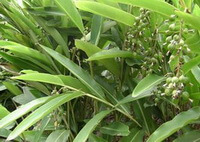 Botanical Description: Amomum villosum Lour. var. xanthioides (Wall. ex Baker) T. L. Wu et Senjen—also known as Amomum xanthioides Wall. ex Baker—is a perennial herb of the Zingiberaceae (ginger) family and the genus Amomum. Common names include Cocklebur-like Amomum, Green Shell Amomum, Lǜ Ké Shā, and Suǒ Shā. Plants grow upright to 1.5–3 m tall. Rhizomes are procumbent and occasionally hypertrophied. Stems are erect. Leaves are linear-lanceolate, 15.3–35 cm long and 4–7 cm wide, with an acute or acuminate, caudate apex and a gradually tapering, entire base; both surfaces are glabrous. Leaf sheaths are coriaceous and smooth; the paraphyll (ligule) is 4 mm long and coriaceous.
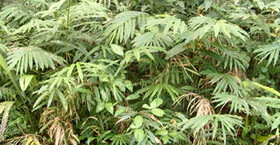 Ecological Environment: Amomum villosum Lour. var. xanthioides T. L. Wu et Senjen grows in damp places in forests.
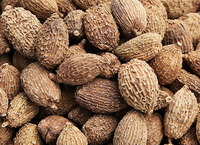 Characteristics of the Herb: The fruit is oval (egg-shaped), ovoid, or elliptic; it has subtle three blunt edges, measures 1.2–2.2 cm in length and 1.0–1.6 cm in diameter; the surface is brown, yellow-brown, or tan (chocolate brown); and it is densely covered with slightly flattened, spinous protrusions. The inner surface of the pericarp is primrose yellow (pale yellow) or brownish-yellow; each locule contains 8–22 seeds. The seeds are irregularly polygonal, 2–4 mm long and 2–4 mm in diameter; their surface is pale brown or brown, with regular wrinkles. The herb has a fragrant aroma and tastes pungent, cool, and slightly bitter.
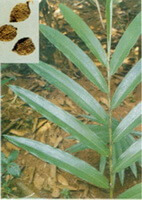 Botanical Description: Amomum longiligulare T. L. Wu is a plant of the Zingiberaceae family (ginger family) and the genus Amomum. It is commonly known as Amomum longiligulare, Longiligulate Amomum Fruit, or Hai Nan Sha. The plant grows up to 1–1.5 meters tall and has procumbent rhizomes. Leaf blades are linear or linear-lanceolate, 20–30 cm long and 2.5–3 cm wide; the apex bears a caudate, slender tip; the base tapers; both surfaces are glabrous. Petioles are about 5 mm long; the paraphyll (ligule) is lanceolate, 2–4.5 cm long, membranous, and glabrous.
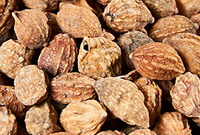 Characteristics of the Herb: The fruit is oval (egg-shaped), elliptic, fusiform-elliptic (spindle-shaped elliptic), or pear-shaped, with conspicuous blunt three edges; it measures 1–2 cm in length and 0.7–1.7 cm in diameter; the surface is taupe (dust-colored) or taupe-brown and covered with flaky, branched, short spines; the pericarp is thick and hard; the inner surface is reddish-brown; each locule contains 4–24 seeds; the seeds are polygonal, 2.5–4 mm long and 1.5–2 mm in diameter; their surface is reddish-brown or dark brown and bears irregular wrinkles. The herb has a mild, faint odor.
 URL QR code: