✵The article records the herb White Mustard Seed—its English name, Latin name, Pinyin name, properties and flavor, botanical source—one plant species: Sinapis alba L., and provides a detailed introduction to the botanical features, growth characteristics, and ecological environment of this species, as well as the characteristics of the herb, its pharmacological actions, medicinal efficacy, and administration guidelines.
Semen Sinapis Albae (White Mustard Seed)
Pinyin Name: Bái Jiè Zǐ
English Name: White Mustard Seed
Latin Name:Semen Sinapis Albae Properties and Flavor: Warm; pungent
Brief Introduction:Semen Sinapis Albae is the mature seed of Sinapis alba L., used to warm the lung and resolve phlegm—indicated for cough with profuse expectoration and chest oppression—and also for cold abscesses and pleural effusion. It is commonly known as Semen Sinapis Albae, White Mustard Seed, or Bái Jiè Zǐ.
Botanical Source:Semen Sinapis Albae (White Mustard Seed) is the ripe seed of Sinapis alba L., a plant of the genus Sinapis L., family Brassicaceae (Cruciferae, mustard family), order Brassicales.
Herbal classic works define Semen Sinapis Albae (White Mustard Seed) as the ripe seed of: (1) Sinapis alba L. This commonly used species is described below:
(1) Sinapis alba L.
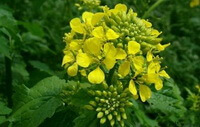
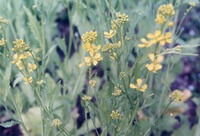
Botanical Description:Sinapis alba L. is also known as Brassica alba (L.) Boiss. It is an annual or biennial robust herb, growing 40–120 cm tall. The stem is erect, longitudinally ridged, and branched in the upper part, covered with scattered white hirsute hairs. Leaves are alternate, thin, and petiolate; basal leaves are pinnately compound or deeply lobed, broadly elliptic or ovoid (6–15 cm long, 2–3 cm wide), with a large terminal lobe and 1–3 pairs of lateral lobes; margins are sparsely toothed. Cauline leaves are smaller, short-petiolate, with ascending lobes gradually decreasing in number.
Inflorescences are terminal or axillary racemes. Sepals 4, green, erect, lanceolate or oblong, with clawed bases. Stamens 6: 4 long (8.5–9.5 mm) and 2 short (6–6.5 mm). Gynoecium: 1 pistil; ovary is cylindrical, 9–10 mm long, densely covered with white long bristles.
Fruit: silique is cylindrical, 2–2.5 cm long, densely covered with white stiff bristles; carpels are constricted between seeds into bead-like segments; apex bearing a flattened, ensiform (sword-shaped) rostrum (beak). Seeds are subspheroidal, yellowish (light yellow). Flowering period: April–June; fruiting period: May–July.
Ecological Environment:Sinapis alba is native to Europe and is also cultivated in China.
Growth characteristics:Sinapis alba prefers a warm, moist, sunny climate; it is drought-tolerant and thrives in fertile, well-drained sandy loam soil. It should not be grown on infertile, low-lying, or waterlogged land.
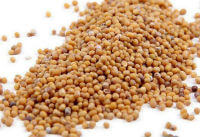
Characteristics of the Herb: Seeds are subspheroidal, 2–2.5 mm in diameter. Surface is light yellowish-white and smooth; under magnification, a faint reticulate pattern is visible. One end bears a round, light brown hilum, which swells upon hydration. After removal of the spermoderm (seed coat), two fleshy, oily cotyledons are revealed, folded longitudinally with the radicle enclosed. Odor is slight; taste is pungent and spicy; emits a characteristic pungent odor when crushed and moistened.
Pharmacological Actions: (1) Antibacterial effect: Benzyl isothiocyanate in Semen Sinapis Albae exhibits broad-spectrum antibacterial activity against yeasts, ~20 fungal species, and dozens of bacterial strains. Effective antibacterial concentrations against Gram-negative and Gram-positive bacteria range from 1:10² to 3×10². Aqueous extracts show varying degrees of antifungal activity against Achorion violaceum and Achorion schoenleinii in vitro. Sinigrin hydrolyzes to yield glucosinolates, which also possess bactericidal activity. (2) Stimulant effect; (3) Anti-lipid peroxidation, expectorant, and blood pressure–regulating effects.
Medicinal efficacy: Tonifies Qi and resolves phlegm; warms the middle burner and dispels cold; unblocks channels and alleviates pain. Indicated for cold-phlegm–type cough and wheezing, chest fullness and hypochondriac pain, phlegm obstruction in the channels, and joint numbness.
Administration of Semen Sinapis Albae (Bái Jiè Zǐ):
Reference:
Administration Guide of Semen Sinapis Albae (Bái Jiè Zǐ)
TCM Books:
(1) 1–3 qián (approximately 3–9 grams), decocted in water; (2) 3–10 grams, prepared as a water decoction; For internal use: finely ground into powder and formulated into pills or powders. External use: Apply an appropriate amount of finely ground herb powder topically.

 ✵The article records the herb White Mustard Seed—its English name, Latin name, Pinyin name, properties and flavor, botanical source—one plant species: Sinapis alba L., and provides a detailed introduction to the botanical features, growth characteristics, and ecological environment of this species, as well as the characteristics of the herb, its pharmacological actions, medicinal efficacy, and administration guidelines.
 Pinyin Name: Bái Jiè Zǐ
 Botanical Description: Sinapis alba L. is also known as Brassica alba (L.) Boiss. It is an annual or biennial robust herb, growing 40–120 cm tall. The stem is erect, longitudinally ridged, and branched in the upper part, covered with scattered white hirsute hairs. Leaves are alternate, thin, and petiolate; basal leaves are pinnately compound or deeply lobed, broadly elliptic or ovoid (6–15 cm long, 2–3 cm wide), with a large terminal lobe and 1–3 pairs of lateral lobes; margins are sparsely toothed. Cauline leaves are smaller, short-petiolate, with ascending lobes gradually decreasing in number.
 Ecological Environment: Sinapis alba is native to Europe and is also cultivated in China.
 URL QR code: