✵The article records the herb Inula Flower—its English name, Latin name, Pinyin name, properties and flavor, and botanical sources (two plant species): (1) Inula britannica L. var. chinensis Regel, and (2) Inula britannica L.—with a detailed introduction to the botanical features, growth characteristics, and ecological environments of these two species; the characteristics of the herb; its pharmacological actions; medicinal efficacy; and administration guidelines.
Flos Inulae (Inula Flower)
Pinyin Name: Xuán Fù Huā
English Name: Inula Flower
Latin Name:Flos Inulae Properties and Flavor: Slightly warm; bitter, pungent, salty
Brief Introduction:Flos Inulae is the dried flower head of Inula britannica L. var. chinensis Regel or Inula britannica L., used as an expectorant to relieve cough and wheezing with excessive phlegm, and as an antiemetic for belching and vomiting. It is commonly known as Flos Inulae, Inula Flower, or Xuán Fù Huā.
Botanical Source:Flos Inulae (Inula Flower) is the dried flower head of Inula japonica Thunb. or Inula britannica L., plants of the genus Inula, family Asteraceae (Compositae, daisy family), order Asterales. It is also known as Inula Flower, the flower of Linearleaf Inula, the flower of British Inula, or Xuán Fù Huā.
Herbal classic works define Flos Inulae (Inula Flower) as the dried flower head of: (1) Inula britannica L. var. chinensis Regel, or (2) Inula britannica L. These two commonly used species are described below:
(1) Inula britannica L. var. chinensis Regel
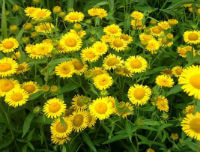
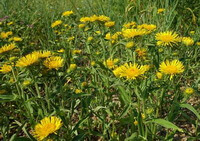
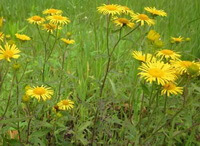
Botanical Description:Inula britannica L. var. chinensis Regel is also known as Inula britannica L. var. japonica (Thunb.) Franch. et Sav. or Inula japonica Thunb. The plant is commonly called Lǘ ér Cǎo or Bǎi Yè Cǎo. It is a perennial herb, growing 30–80 cm tall. The rhizome is short, transverse, or obliquely ascending, bearing fibrous roots. Stems are solitary or fascicled, green or purple, thinly longitudinally furrowed, and covered with long appressed hairs. Basal leaves wither during anthesis; middle-stem leaves are oblong or oblong-lanceolate (4–13 cm long, 1.5–4.5 cm wide), with an acute apex and attenuated base; often bearing small, circular, half-amplexicaul (stem-clasping) auricles; sessile; margins are entire or sparsely toothed; upper surface is sparsely pilose or subglabrous; lower surface is sparsely covered with appressed hairs and glandular points; midveins and lateral veins are densely pilose. Upper leaves gradually decrease in size and become linear-lanceolate.
Capitulum (flower head): 3–4 cm in diameter; most or several arranged in sparse corymbs; peduncle is slender; involucral bracts are semiglobose (semi-spherical), 1.3–1.7 cm in diameter, arranged in ~5 series; outermost bracts are leafy and elongated; outer bract bases is coriaceous, apices are membranous; inner bracts are scarious; ligulate flowers are yellow; ligule length is 2–2.5 times that of the involucre; ligules are filiform, 10–13 mm long; tubular flower corolla is ~5 mm long, with triangular-lanceolate lobes; pappus are white, single-whorled, composed of over 20 coarse hairs.
Achenes are cylindrical, 1–1.2 mm long, with 10 longitudinal ribs, sparsely pubescent. Flowering period: June–October; fruiting period: September–November.
Ecological Environment: Grows at altitudes of 150–2,400 m above sea level, on hillsides, roadsides, moist grasslands, riverbanks, and ridge fields.
Growth Characteristics: Prefers a warm, humid climate. Cultivation is best suited to deep, fertile, loose, humus-rich sandy loam soil. Heavy clay soils, arid soils, and continuous cropping should be avoided.
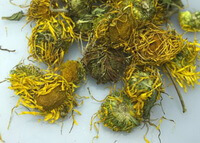
Characteristics of the Herb: The herb is oblate or spheroidal, 1–2 cm in diameter. The involucre consists of numerous imbricate (tile-like) bracts, which are lanceolate or linear, grayish-yellow, and 4–11 mm long. Pedicels may persist at the base of the involucre; both bract and pedicel surfaces are covered with white hairs. There is a single row of ligulate flowers—yellow, ~1 cm long, often curled and readily abscising, with 3-toothed apices. Tubular flowers are numerous, brownish-yellow, ~5 mm long, with 5-toothed apices. The ovary apex bears numerous white hairs, 5–6 mm long. Oval achenes are occasionally visible. The herb is light and friable. It has a slight odor and a slightly bitter taste.
Medicinal Efficacy: Directs rebellious Qi downward; resolves phlegm; promotes diuresis; arrests nausea and vomiting. Indicated for wind-cold–induced cough, phlegm-damp retention, chest and epigastric fullness and distension, dyspnea with copious sputum, and epigastric rigidity.
Administration of Flos Inulae (Xuán Fù Huā):
Reference:
Administration Guide of Flos Inulae (Xuán Fù Huā)
TCM Books:
(1) Internally: 3–9 grams; (2) 3–10 grams, prepared as a water decoction—wrapped in cloth during boiling (to filter out irritating hairs) or strained after decoction.
(2) Inula britannica L.
Botanical Description:Inula britannica L. is also known as big-flower inula or hairy inula. Morphological distinctions from Inula britannica L. var. chinensis Regel include: leaf blades oblong or elliptic-lanceolate; base broad and cordate, bearing auricles and half-amplexicaul (stem-clasping); capitulum (flower head) 2.5–5 cm in diameter; involucre 1.5–2.2 cm in diameter and ~1 cm high; achene cylindrical, with shallow longitudinal ribs, and sparsely covered with short hairs.
Ecological Environment: Grows on riverbanks, moist sloping fields, field ridges, and roadsides.

 ✵The article records the herb Inula Flower—its English name, Latin name, Pinyin name, properties and flavor, and botanical sources (two plant species): (1) Inula britannica L. var. chinensis Regel, and (2) Inula britannica L.—with a detailed introduction to the botanical features, growth characteristics, and ecological environments of these two species; the characteristics of the herb; its pharmacological actions; medicinal efficacy; and administration guidelines.
 Pinyin Name: Xuán Fù Huā
 Botanical Description: Inula britannica L. var. chinensis Regel is also known as Inula britannica L. var. japonica (Thunb.) Franch. et Sav. or Inula japonica Thunb. The plant is commonly called Lǘ ér Cǎo or Bǎi Yè Cǎo. It is a perennial herb, growing 30–80 cm tall. The rhizome is short, transverse, or obliquely ascending, bearing fibrous roots. Stems are solitary or fascicled, green or purple, thinly longitudinally furrowed, and covered with long appressed hairs. Basal leaves wither during anthesis; middle-stem leaves are oblong or oblong-lanceolate (4–13 cm long, 1.5–4.5 cm wide), with an acute apex and attenuated base; often bearing small, circular, half-amplexicaul (stem-clasping) auricles; sessile; margins are entire or sparsely toothed; upper surface is sparsely pilose or subglabrous; lower surface is sparsely covered with appressed hairs and glandular points; midveins and lateral veins are densely pilose. Upper leaves gradually decrease in size and become linear-lanceolate.
 Capitulum (flower head): 3–4 cm in diameter; most or several arranged in sparse corymbs; peduncle is slender; involucral bracts are semiglobose (semi-spherical), 1.3–1.7 cm in diameter, arranged in ~5 series; outermost bracts are leafy and elongated; outer bract bases is coriaceous, apices are membranous; inner bracts are scarious; ligulate flowers are yellow; ligule length is 2–2.5 times that of the involucre; ligules are filiform, 10–13 mm long; tubular flower corolla is ~5 mm long, with triangular-lanceolate lobes; pappus are white, single-whorled, composed of over 20 coarse hairs.
 Ecological Environment: Grows at altitudes of 150–2,400 m above sea level, on hillsides, roadsides, moist grasslands, riverbanks, and ridge fields.
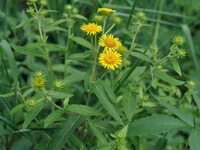 Botanical Description: Inula britannica L. is also known as big-flower inula or hairy inula. Morphological distinctions from Inula britannica L. var. chinensis Regel include: leaf blades oblong or elliptic-lanceolate; base broad and cordate, bearing auricles and half-amplexicaul (stem-clasping); capitulum (flower head) 2.5–5 cm in diameter; involucre 1.5–2.2 cm in diameter and ~1 cm high; achene cylindrical, with shallow longitudinal ribs, and sparsely covered with short hairs.
 URL QR code: