✵The article records the herb Poria cocos, including its English name, Latin name, Pinyin name, properties and flavors, and botanical source — a single fungal species: (1) Poria cocos (Schw.) Wolf. It provides a detailed introduction to the botanical features of this fungus, its growth characteristics and ecological environment, the macroscopic and microscopic characteristics of the dried sclerotium (the medicinal part), its pharmacological actions, medicinal efficacy, and administration guidelines.
Poria (Poria Cocos)
Pinyin Name: Fú Línɡ
English Name: Poria Cocos
Latin Name:Poria Properties and Flavor: Neutral; sweet, bland
Brief Introduction:Poria is the dried sclerotium of the fungus Poria cocos (Schw.) Wolf. It is commonly used (1) as a diuretic for edema and oliguria, (2) to invigorate the Spleen in cases of anorexia and diarrhea, and (3) to calm the mind and alleviate palpitations and insomnia. It is also known as Poria, Poria cocos, Fú Línɡ, hoelen, tuckahoe, or China root.
Botanical Source: Classical herbal works define Poria (Poria cocos) as the dried sclerotium of Poria cocos (Schw.) Wolf — a fungus belonging to the genus Wolfiporia, family Fomitopsidaceae (formerly classified under Polyporaceae, the bracket fungus family), and order Polyporales. This commonly used species is described below:
(1) Poria cocos (Schw.) Wolf.
Botanical Description:Poria cocos (Schw.) Wolf belongs to the family Fomitopsidaceae and genus Wolfiporia. Synonyms include Pachyma cocos Fr., Wolfiporia extensa, and Wolfiporia extensa (Peck) Ginns (syn. Poria cocos F.A. Wolf). Common vernacular names are hoelen, poria, tuckahoe, China root, and Fú Línɡ. The sclerotium is spherical, ovoid, ellipsoid, or irregularly shaped, measuring 10–30 cm in length (sometimes longer) and weighing typically 500–5,000 g. Its outer surface bears a thick, deeply wrinkled, dark brown (bistre) rind; it is soft when fresh and hardens upon drying. The interior is white or pale pink, with a powdery, granular texture. The fruiting body (encarpium) emerges on the sclerotium surface, is prostrate (flat-lying), 3–8 cm thick, white and succulent when fresh, turning sandy beige (pale brown) upon aging or drying. The pores (tube layer) are dense, with tubes 2–3 mm long, thin-walled, and circular to polygonal or irregular in outline, 0.5–1.5 mm in diameter; the pore margin is toothed. Spores are rectangular to subcylindrical, smooth, with a slightly curved apex, measuring (7.5–9) μm × (3–3.5) μm.
Poria exhibits three distinct morphological stages during its life cycle: mycelium, sclerotium, and fruiting body.
(1) Mycelium: Includes monokaryotic and dikaryotic hyphae. Monokaryotic mycelium — also called primary mycelium — arises from spore germination and exists only transiently in early development. Dikaryotic mycelium — also called secondary mycelium — is the dominant vegetative form. It appears as white, fluffy, cottony colonies, often forming distinctive concentric rings.
(2) Sclerotium: A compact, dormant structure formed by aggregated hyphae and stored nutrients. Also known as "tuckahoe" or "Fú Línɡ". It occurs as spherical, ellipsoidal, oblate, or irregular masses; small specimens weigh only a few grams, while the largest may exceed several kilograms. Fresh sclerotia are soft and easily cut; dried ones become hard and brittle. The surface is shell-like and rough, with nodular shrinkage; color ranges from light brown or tan (chocolate brown) when fresh to dark brown when dried. The cortex is light brown; the inner flesh is white or pale brown.
(3) The fruiting body typically develops on the surface of sclerotia, occasionally on aged mycelium. It is honeycombed, variable in size, sessile and prostrate, approximately 0.3–1 cm thick. Initially white, it turns pale yellow upon aging. The hymenium (spore-producing layer) forms on the inner surface of the pore tubes. Poria spores are ash-gray (grayish-white), oblong to subcylindrical, with a slightly curved apex, measuring 6–11 × 2.5–3.5 μm.
Ecological Environment:Poria cocos is parasitic on the roots of pine species—including Pinus koraiensis (Red pine), Pinus massoniana (Masson pine), and other Pinus spp.—typically at depths of 20–30 cm underground.
Growth Characteristics:Poria cocos is a facultative parasite. It grows wild in the rhizosphere of host trees such as Pinus massoniana, Pinus tabuliformis (Chinese pine), Pinus densiflora, Pinus yunnanensis, and Pinus contorta (lodgepole pine), primarily on dry, sunny, south-facing slopes in mountainous regions at elevations of 600–1,000 m above sea level. Sporulation occurs at 22–28 °C (71.6–82.4 °F); mycelial growth occurs at 18–35 °C (64.4–95 °F), optimal at 25–30 °C (77–86 °F); fruiting body differentiation and development occur at 18–26 °C (64.4–78.8 °F). It thrives in wooden substrates with 50–60% moisture content and in soils with ~20% moisture content, pH 3–7. Well-drained, sandy, slightly acidic to neutral soils on slopes of 10°–35° are most suitable. A large diurnal temperature variation favors its growth.
Characteristics of the Herb: Intact Poria cocos occurs as nearly circular, elliptical, discoid (oblate), or irregular masses of varying sizes. The outer rind is thin, tan (light brown) to dark brown, coarse and rough, with prominent shrinkage folds and constrictions; occasionally, parts of the rind peel off. The herb is heavy, with a firm, dense texture; the fracture surface is granular. The peripheral region is pale pink (rose-colored) and exhibits fine alveolate (honeycomb-like) pores; the interior is predominantly white, occasionally faintly pink. Some specimens contain embedded pine root fragments centrally—historically termed "Fu Shen Kuai" (Fushen block). The herb has a faint odor and a mild, slightly mucilaginous taste that feels sticky upon chewing.
Poria cocos blocks: Cuboidal or thick cuboidal pieces prepared by peeling. Color: white, pale pink, or light brown.
Poria cocos slices: Irregularly thick slices prepared by peeling. Color: white, pale pink, or light brown.
Pharmacological Actions: (1) Sedative; (2) anti-ulcer; (3) inhibition of hepatocyte necrosis; (4) hepatoprotective; (5) elevation of myocardial potassium content.
Medicinal efficacy: Promotes diuresis and resolves dampness; fortifies the Spleen and harmonizes the Stomach; nourishes the Spleen and calms the Heart; calms the Heart and induces tranquility. Indicated for: edema and oliguria; dysuria; abdominal distension and fullness; phlegm-damp retention; dizziness and palpitations; phlegm-damp cough; Spleen deficiency with poor appetite; loose stools or diarrhea; nausea and vomiting; spermatorrhea (nocturnal emission); turbid urine (strangury); restlessness; anxiety with palpitations; insomnia with fearfulness; forgetfulness; and white turbid discharge.
Administration of Poria (Fú Línɡ):
Reference:
Administration Guide for Poria (Fú Línɡ)
TCM Books:
(1) Internally: 9–15 grams; (2) Internally: water decoction, 3–5 qian (~4.5–15 grams), or prepared as pills or powders; (3) Internally: water decoction, 10–15 grams, or prepared as pills or powders.
Contraindications, Precautions and Adverse Reactions: should not combine with Radix Sanguisorbae (Sanguisorba officinalis root), Realgar, Radix Gentianae Macrophyllae (Gentiana macrophylla root), turtleback. Should avoid rice vinegar.

 ✵The article records the herb Poria cocos, including its English name, Latin name, Pinyin name, properties and flavors, and botanical source — a single fungal species: (1) Poria cocos (Schw.) Wolf. It provides a detailed introduction to the botanical features of this fungus, its growth characteristics and ecological environment, the macroscopic and microscopic characteristics of the dried sclerotium (the medicinal part), its pharmacological actions, medicinal efficacy, and administration guidelines.
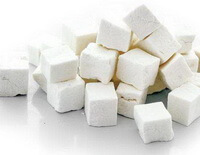 Pinyin Name: Fú Línɡ
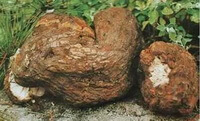 Botanical Description: Poria cocos (Schw.) Wolf belongs to the family Fomitopsidaceae and genus Wolfiporia. Synonyms include Pachyma cocos Fr., Wolfiporia extensa, and Wolfiporia extensa (Peck) Ginns (syn. Poria cocos F.A. Wolf). Common vernacular names are hoelen, poria, tuckahoe, China root, and Fú Línɡ. The sclerotium is spherical, ovoid, ellipsoid, or irregularly shaped, measuring 10–30 cm in length (sometimes longer) and weighing typically 500–5,000 g. Its outer surface bears a thick, deeply wrinkled, dark brown (bistre) rind; it is soft when fresh and hardens upon drying. The interior is white or pale pink, with a powdery, granular texture. The fruiting body (encarpium) emerges on the sclerotium surface, is prostrate (flat-lying), 3–8 cm thick, white and succulent when fresh, turning sandy beige (pale brown) upon aging or drying. The pores (tube layer) are dense, with tubes 2–3 mm long, thin-walled, and circular to polygonal or irregular in outline, 0.5–1.5 mm in diameter; the pore margin is toothed. Spores are rectangular to subcylindrical, smooth, with a slightly curved apex, measuring (7.5–9) μm × (3–3.5) μm.
 Poria exhibits three distinct morphological stages during its life cycle: mycelium, sclerotium, and fruiting body.
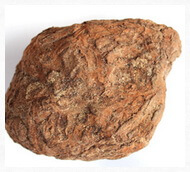 (2) Sclerotium: A compact, dormant structure formed by aggregated hyphae and stored nutrients. Also known as "tuckahoe" or "Fú Línɡ". It occurs as spherical, ellipsoidal, oblate, or irregular masses; small specimens weigh only a few grams, while the largest may exceed several kilograms. Fresh sclerotia are soft and easily cut; dried ones become hard and brittle. The surface is shell-like and rough, with nodular shrinkage; color ranges from light brown or tan (chocolate brown) when fresh to dark brown when dried. The cortex is light brown; the inner flesh is white or pale brown.
 (3) The fruiting body typically develops on the surface of sclerotia, occasionally on aged mycelium. It is honeycombed, variable in size, sessile and prostrate, approximately 0.3–1 cm thick. Initially white, it turns pale yellow upon aging. The hymenium (spore-producing layer) forms on the inner surface of the pore tubes. Poria spores are ash-gray (grayish-white), oblong to subcylindrical, with a slightly curved apex, measuring 6–11 × 2.5–3.5 μm.
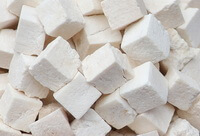 Characteristics of the Herb: Intact Poria cocos occurs as nearly circular, elliptical, discoid (oblate), or irregular masses of varying sizes. The outer rind is thin, tan (light brown) to dark brown, coarse and rough, with prominent shrinkage folds and constrictions; occasionally, parts of the rind peel off. The herb is heavy, with a firm, dense texture; the fracture surface is granular. The peripheral region is pale pink (rose-colored) and exhibits fine alveolate (honeycomb-like) pores; the interior is predominantly white, occasionally faintly pink. Some specimens contain embedded pine root fragments centrally—historically termed "Fu Shen Kuai" (Fushen block). The herb has a faint odor and a mild, slightly mucilaginous taste that feels sticky upon chewing.
 URL QR code: