✵The article records the herb Long Pepper, including its English name, Latin name, Pinyin name, properties and flavor, botanical source—namely, the plant species Piper longum L.—and provides a detailed introduction to the botanical features, growth characteristics, and ecological environment of this species, as well as the characteristics of the herb Long Pepper, its pharmacological actions, medicinal efficacy, and administration guidelines.
Fructus Piperis Longi (Long Pepper)
Pinyin Name: Bì Bá
English Name: Long Pepper
Latin Name:Fructus Piperis Longi Properties and Flavor: hot, pungent
Brief Introduction:Fructus Piperis Longi is the dried nearly ripe or ripe fruit-spike of Piper longum L., used to warm the stomach and treat cold-induced epigastric pain. It is commonly known as Fructus Piperis Longi, Long Pepper, or Bì Bá.
Botanical Source: Herbal classical works define Fructus Piperis Longi (Long Pepper) as the dried nearly ripe or ripe fruit-spike of (1) Piper longum L. It is a plant of the genus Piper L., family Piperaceae (pepper family), order Piperales. This commonly used species is described below:
(1) Piper longum L.
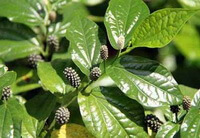
Botanical Description:Piper longum L. is commonly known as Bì Bá. It is a perennial herbaceous liana. The rhizome is erect and highly branched. The lower part of the stem is procumbent; branches are decumbent and soft, bearing vertical ridges and grooves; the young plant is covered with pulverulent pubescence. Leaves are alternate: cauline leaves on the lower stem are ovate with longer petioles; upper leaves gradually become ovate-oblong with shorter petioles; apical leaves are sessile, with an amplexicaul (stem-clasping) base; the undersurface veins are pubescent; seven palmate veins arise from the base.
Flowers are unisexual and dioecious, achlamydeous (lacking a perianth); inflorescences (spikes) are opposite to leaves. Male inflorescences are 4–5 cm long and ~3 mm in diameter; peduncles are 2–3 cm long and pubescent; floral bracts are orbicular and peltate (scutiform); each flower has two stamens with very short filaments. Female inflorescences are 1.5–2.5 cm long and ~4 mm in diameter, elongating during fruiting; floral bracts are ~1 mm in diameter; the ovary is ovoid (egg-shaped), with three styles.
The lower part of the berry is connate with the rachis (floral axis); the apex bears an umbilicate (umbilical) convexity ~2 mm in diameter. Flowering occurs in spring; fruiting extends from July to October.
Ecological Environment: The plant grows in open forests at altitudes of 580–700 meters. It is distributed in China and other regions of Southeast Asia.
Growth Characteristics:Piper longum is native to tropical regions and prefers high temperatures and humid conditions. Seedlings require moderate shading; excessive light inhibits growth and reduces yield. During flowering and fruiting, sufficient light is essential. Cultivation is best carried out in mountainous or basin fields near ditches, using moist, loose, fertile loam soil.
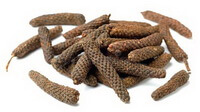
Characteristics of the Herb: The herb (fruit-ears) occurs in cylindrical, slightly curved clusters composed of numerous small berries, 1.5–3.5 cm long and 0.3–0.5 cm in diameter. The surface is blackish-brown or brown, with small protrusions arranged obliquely; the base shows residual or abscised carpopodial (fruit-stalk) marks. The texture is hard and brittle, fracturing easily into an irregular, granular cross-section. Individual berries are spheroidal (globular), ~1 mm in diameter. The herb possesses a distinctive aromatic fragrance and a pungent, hot taste.
Medicinal Efficacy: Warms the spleen and stomach to dispel cold, descends Qi, and alleviates pain. Indicated for cold-induced epigastric and abdominal pain, cold pain in the chest and abdomen, vomiting, acid regurgitation, diarrhea, borborygmus, dysentery, migraine, cold-damp dysentery, yin hernia, headache, toothache, sinusitis (acute and chronic), coronary heart disease, and angina pectoris. Externally used for toothache.
Administration of Fructus Piperis Longi (Bì Bá):
Reference:
Administration Guide for Fructus Piperis Longi (Bì Bá)
TCM Books:
(1) Internally:1.5–3 grams; externally: an appropriate amount—prepare as a finely ground herb powder and fill into carious tooth cavities. (2) Internally: water decoction, 0.5–1 qián (≈1.5–3 grams), or formulated into pills or powders; externally: prepare as a finely ground herb powder and fill into carious tooth cavities. (3) Internally: water decoction, 1–3 grams, or formulated into pills or powders; externally: an appropriate amount—prepare as a finely ground herb powder for nasal insufflation, or formulate into pills to fill carious tooth cavities, or soak in wine and apply topically to the affected area.

 ✵The article records the herb Long Pepper, including its English name, Latin name, Pinyin name, properties and flavor, botanical source—namely, the plant species Piper longum L.—and provides a detailed introduction to the botanical features, growth characteristics, and ecological environment of this species, as well as the characteristics of the herb Long Pepper, its pharmacological actions, medicinal efficacy, and administration guidelines.
 Pinyin Name: Bì Bá
 Botanical Description: Piper longum L. is commonly known as Bì Bá. It is a perennial herbaceous liana. The rhizome is erect and highly branched. The lower part of the stem is procumbent; branches are decumbent and soft, bearing vertical ridges and grooves; the young plant is covered with pulverulent pubescence. Leaves are alternate: cauline leaves on the lower stem are ovate with longer petioles; upper leaves gradually become ovate-oblong with shorter petioles; apical leaves are sessile, with an amplexicaul (stem-clasping) base; the undersurface veins are pubescent; seven palmate veins arise from the base.
 The lower part of the berry is connate with the rachis (floral axis); the apex bears an umbilicate (umbilical) convexity ~2 mm in diameter. Flowering occurs in spring; fruiting extends from July to October.
 Growth Characteristics: Piper longum is native to tropical regions and prefers high temperatures and humid conditions. Seedlings require moderate shading; excessive light inhibits growth and reduces yield. During flowering and fruiting, sufficient light is essential. Cultivation is best carried out in mountainous or basin fields near ditches, using moist, loose, fertile loam soil.
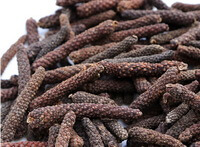 Characteristics of the Herb: The herb (fruit-ears) occurs in cylindrical, slightly curved clusters composed of numerous small berries, 1.5–3.5 cm long and 0.3–0.5 cm in diameter. The surface is blackish-brown or brown, with small protrusions arranged obliquely; the base shows residual or abscised carpopodial (fruit-stalk) marks. The texture is hard and brittle, fracturing easily into an irregular, granular cross-section. Individual berries are spheroidal (globular), ~1 mm in diameter. The herb possesses a distinctive aromatic fragrance and a pungent, hot taste.
 URL QR code: