✵The article records the herb Fennel Fruit, including its English name, Latin name, Pinyin name, properties and flavor, botanical source—namely, the dried fruit of Foeniculum vulgare Mill.—and provides a detailed introduction to the botanical features, growth characteristics, and ecological environment of this plant species, as well as the morphological characteristics of the herb Fennel Fruit, its pharmacological actions, medicinal efficacy, and administration guidelines.
Fructus Foeniculi (Fennel Fruit)
Pinyin Name: Xiǎo Huí Xiānɡ
English Name: Fennel Fruit
Latin Name:Fructus Foeniculi Properties and Flavor: Warm, pungent
Brief Introduction:Fructus Foeniculi is the dried fruit of Foeniculum vulgare Mill., used to dispel cold, regulate Qi flow, and relieve pain—particularly for cold-induced lower abdominal pain and distending pain in the testes. It is commonly known as Fructus Foeniculi, Fennel Fruit, or Xiǎo Huí Xiānɡ.
Botanical Source:Fructus Foeniculi (Fennel Fruit) is the dried fruit of Foeniculum vulgare Mill., a species belonging to the genus Foeniculum Mill. in the family Apiaceae (Umbelliferae, parsley family), order Apiales. The following describes the primary botanical source:
(1) Foeniculum vulgare Mill.
Botanical Description:Foeniculum vulgare Mill. is a perennial herb of the Apiaceae family (Umbelliferae, parsley family) and genus Foeniculum Mill., commonly known as Huí Xiānɡ, common fennel, or Xiǎo Huí Xiānɡ. It grows 0.4–2 meters tall and emits a strong aromatic odor. Stems are erect, smooth, glabrous, and celadon (sage green or grayish green) to pale yellowish-green; upper branches spread outward and bear fine longitudinal grooves. Cauline leaves are alternate; petioles of upper cauline leaves are 5–15 cm long—the sheathing portion encompassing the middle to upper leaf blade, with a membranous sheath margin. Leaf blades are broadly triangular, up to ~30 cm long and ~40 cm wide, 4–5-pinnatisect; ultimate lobes are filiform, 0.5–5 cm long and 0.5–1 cm wide.
Compound umbels are terminal or axillary, 3–15 cm in diameter, peduncles are up to 25 cm long; no general involucre or involucel present; 6–30 rays, 1.5–10 cm long; each umbellule bears 14–30 flowers; pedicels are slender and unequal in length (0.3–1.2 cm); flowers are small, lacking calyx teeth; petals are yellow, obovate or nearly obovate, primrose yellow (pale yellow), ~1.5 mm long and ~1 mm wide, involute above the midpoint, with a retuse (slightly emarginate) apex; 5 stamens, filaments are slightly longer than petals, anthers are oval (egg-shaped), pale yellow, dehiscing longitudinally; ovary is inferior, bilocular, stylopodium conical, style is very short, diverging outward or appressed to the stylopodium.
The cremocarp is oblong, 3.5–6 mm long and 1.5–2 mm wide, with five prominent ridges and spiculate (pointed) surfaces; each furrow contains one vitta (oil duct), and two vittae occur on the commissural surface; the ventral surface of the endosperm is straight or slightly concave. Flowering occurs from May to June; fruiting from July to September.
Ecological Environment:Foeniculum vulgare Mill. is cultivated worldwide in temperate regions and is native to the Mediterranean region. It prefers moist, cool climates, exhibits salt tolerance and strong environmental adaptability, and has no strict soil requirements. However, optimal cultivation conditions include flat terrain, fertile, loose, well-drained sandy loam or light alkaline black soil.
Growth Characteristics:Foeniculum vulgare thrives in moist, cool climates and tolerates salinity well, demonstrating strong adaptability. Though soil requirements are not stringent, cultivation is best undertaken on flat fields with fertile, loose, well-drained sandy loam or light alkaline black soil. Suitable preceding crops include corn, sorghum, buckwheat, and legumes.
Seeds are harvested in summer; plants are allowed to wither naturally in winter. Harvesting should occur when seeds are fully mature and brown but before dehiscence. Prior to harvest, inspect for aphids. Morning is the optimal time to minimize seed loss.
Characteristics of the Herb: The herb is a cremocarp—thin and cylindrical, with both ends slightly pointed and sometimes slightly curved—4–8 mm long and 1.5–2.5 mm in diameter. The surface is greenish-yellow to brown, smooth and glabrous, bearing a conical, yellowish-brown stylopodium at the apex; occasionally, small carpopodia (fruit stalks) persist at the base. Each mericarp is oblong-ovate; the dorsal surface is convex and bears five prominent longitudinal ridges; the commissural surface is flat, centrally darkened, and marked by longitudinal grooves. The transverse section is nearly pentagonal, with the four dorsal sides approximately equal in length. The herb possesses a distinctive aromatic odor and a taste that is slightly sweet and pungent.
Pharmacological Actions: (1) The volatile oil exhibits stomachic (stomach-strengthening effect), expectorant, and analgesic effects, and inhibits aflatoxin production. (2) Anethole in the volatile oil demonstrates anticancer and radioprotective activities.
Medicinal Efficacy: Warms the kidneys and liver, dispels cold, relieves pain, promotes Qi circulation, regulates Qi, and harmonizes the stomach. It is indicated for cold-type hernia abdominal pain, testicular swelling or descent (hernia), dysmenorrhea (menstrual abdominal pain), cold-induced lower abdominal pain, epigastric cold pain, abdominal distension and pain, anorexia, nausea, vomiting, diarrhea, hypochondriac pain, kidney-deficiency low back pain, and hydrocele. Salt-processed fennel specifically warms the kidneys, dispels cold, and alleviates pain, and is indicated for cold hernia and abdominal pain, testicular descent, cold-damp menstrual pain, and associated abdominal discomfort.
Administration of Fructus Foeniculi (Xiǎo Huí Xiānɡ):
Reference:
Administration Guide for Fructus Foeniculi (Xiǎo Huí Xiānɡ)
TCM Books:
(1) Internally: 3–6 grams; (2) Internally: water decoction, 3–6 grams, or prepared into pills or powders. External use: apply an appropriate amount—either as finely powdered herb or as warm, fried herb applied topically.

 ✵The article records the herb Fennel Fruit, including its English name, Latin name, Pinyin name, properties and flavor, botanical source—namely, the dried fruit of Foeniculum vulgare Mill.—and provides a detailed introduction to the botanical features, growth characteristics, and ecological environment of this plant species, as well as the morphological characteristics of the herb Fennel Fruit, its pharmacological actions, medicinal efficacy, and administration guidelines.
 Pinyin Name: Xiǎo Huí Xiānɡ
 Botanical Description: Foeniculum vulgare Mill. is a perennial herb of the Apiaceae family (Umbelliferae, parsley family) and genus Foeniculum Mill., commonly known as Huí Xiānɡ, common fennel, or Xiǎo Huí Xiānɡ. It grows 0.4–2 meters tall and emits a strong aromatic odor. Stems are erect, smooth, glabrous, and celadon (sage green or grayish green) to pale yellowish-green; upper branches spread outward and bear fine longitudinal grooves. Cauline leaves are alternate; petioles of upper cauline leaves are 5–15 cm long—the sheathing portion encompassing the middle to upper leaf blade, with a membranous sheath margin. Leaf blades are broadly triangular, up to ~30 cm long and ~40 cm wide, 4–5-pinnatisect; ultimate lobes are filiform, 0.5–5 cm long and 0.5–1 cm wide.
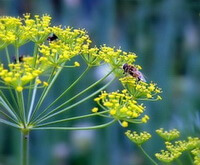 The cremocarp is oblong, 3.5–6 mm long and 1.5–2 mm wide, with five prominent ridges and spiculate (pointed) surfaces; each furrow contains one vitta (oil duct), and two vittae occur on the commissural surface; the ventral surface of the endosperm is straight or slightly concave. Flowering occurs from May to June; fruiting from July to September.
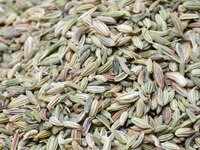 Characteristics of the Herb: The herb is a cremocarp—thin and cylindrical, with both ends slightly pointed and sometimes slightly curved—4–8 mm long and 1.5–2.5 mm in diameter. The surface is greenish-yellow to brown, smooth and glabrous, bearing a conical, yellowish-brown stylopodium at the apex; occasionally, small carpopodia (fruit stalks) persist at the base. Each mericarp is oblong-ovate; the dorsal surface is convex and bears five prominent longitudinal ridges; the commissural surface is flat, centrally darkened, and marked by longitudinal grooves. The transverse section is nearly pentagonal, with the four dorsal sides approximately equal in length. The herb possesses a distinctive aromatic odor and a taste that is slightly sweet and pungent.
 URL QR code: