Introduction of Bai Tou Weng: Chinese Pulsatilla Root.
✵The article documents the herb Chinese Pulsatilla Root, including its English name, Latin name, Pinyin name, properties and flavor, and botanical sources—six plant species: (1) Pulsatilla chinensis (Bunge) Regel, (2) Pulsatilla turczaninovii Krylov et Serg., (3) Pulsatilla ambigua Turcz. ex Pritz., (4) Pulsatilla dahurica (Fisch. ex DC.) Spreng., (5) Pulsatilla cernua (Thunb.) Bercht. et Opiz., and (6) Pulsatilla campanella Fisch. ex Regel—as well as the botanical sources of Pulsatilla recognized in North American and European herbal classics: two species, (7) Pulsatilla vulgaris Mill. (syn. Anemone pulsatilla L.), and (8) Pulsatilla pratensis L. It provides a detailed introduction to the botanical features, growth characteristics, and ecological environments of these eight species; the macroscopic and microscopic features of the herb Chinese Pulsatilla Root; its pharmacological actions, medicinal efficacy, and administration guidelines.
Radix Pulsatillae (Chinese Pulsatilla Root)
Pinyin Name: Bái Tóu Wēnɡ
English Name: Chinese Pulsatilla Root
Latin Name:Radix Pulsatillae Properties and Flavor: Cold, bitter
Brief Introduction:Radix Pulsatillae is the dried root of Pulsatilla chinensis (Bunge) Regel. It is used internally for bacterial and amoebic dysentery and externally for trichomonas vaginitis. The herb is commonly known as Radix Pulsatillae, Chinese Pulsatilla Root, or Bái Tóu Wēnɡ.
Botanical Source:Radix Pulsatillae (Chinese Pulsatilla Root) is the dried root of Pulsatilla chinensis (Bunge) Regel., a perennial herb belonging to the genus Pulsatilla (formerly classified under Anemone), family Ranunculaceae (buttercup or crowfoot family), order Ranunculales.
Traditional Chinese herbal classics define Radix Pulsatillae (Chinese Pulsatilla Root, Bái Tóu Wēnɡ) as the dried root of several Ranunculaceae species, including: (1) Pulsatilla chinensis (Bunge) Regel., (2) Pulsatilla turczaninovii Krylov et Serg., (3) Pulsatilla ambigua Turcz. ex Pritz., (4) Pulsatilla dahurica (Fisch. ex DC.) Spreng., (5) Pulsatilla cernua (Thunb.) Bercht. et Opiz., and (6) Pulsatilla campanella Fisch. ex Regel. The aerial parts—stem and leaf (Bái Tóu Wēnɡ Jīng Yè) and flower (Bái Tóu Wēnɡ Huā)—are also derived from the same species. In contrast, North American and European herbal traditions define Pulsatilla as the dried above-ground parts of two Ranunculaceae species: (7) Pulsatilla vulgaris Mill. (syn. Anemone pulsatilla L.) and (8) Pulsatilla pratensis L. These eight species are described below:
(1) Pulsatilla chinensis (Bunge) Regel.
Botanical Description:Pulsatilla chinensis (Bunge) Regel. is also known as Anemone chinensis Bunge. It belongs to the family Ranunculaceae (buttercup or crowfoot family) and the genus Pulsatilla (historically placed in Anemone). Common names include Bái Tóu Wēnɡ, Nǎi Hé Cǎo, and Bái Tóu Cǎo. It is a perennial herb reaching 15–35 cm in height. The rhizome is thick, 8–15 mm in diameter. Four to five basal (radical) leaves emerge during flowering; each leaf is ternately compound. Petioles are 7–15 cm long and densely pilose. Leaf blades are broadly ovate, 4.5–14 cm long and 6.5–16 cm wide; the upper surface bears sparse hairs that abscise late, becoming glabrous, while the lower surface is densely covered with long, trichotomous pilose hairs. The central lobe is cuneate-ovate or narrowly cuneate, entire or dentate, and either petiolulate or subsessile; lateral lobes are unequal in size and bifid; their subdivisions are sessile or subsessile and differ in size from the primary ternate lobes.
One to two scapes arise after flowering, 15–35 cm tall, bearing three bracts at the base, which are connate. The hypanthium (calyx tube) is 3–10 mm long; sepals are striate, densely villous on the outside and glabrous within. Flowers are hermaphroditic, solitary, and erect; pedicels measure 2.5–5.5 cm. There are six sepals arranged in two whorls—narrowly ovate or oblong-ovate, 2.8–4.4 cm long and 9–20 mm wide—royal purple (bluish violet) and densely pilose externally. Petals are absent. Stamens are numerous, approximately half the length of the sepals. Carpels are numerous and hairy.
Achenes are 3–4 mm long and villous; each bears a plumose, persistent style 3.5–6.5 cm long. Flowering occurs from April to May; fruiting occurs from June to July.
Ecological Environment:Pulsatilla chinensis (Bunge) Regel. grows in plains, grasslands on low hillsides and mountain slopes, forest margins, and dry rocky slopes.
Ornamental Value: More than 30 species of Pulsatilla exist. The flowers are campanulate (bell-shaped), white, purple, or blue, with a complete perianth and an unusual appearance. From flowering to capsule maturity takes approximately six weeks; the fruits are visually striking even before full maturity. In summer and autumn, the foliage remains green, but after frost the plant enters dormancy. As a perennial herbaceous plant with a persistent rootstock, it provides long-term ornamental value—overcoming the high cost and genetic degeneration commonly associated with biennial herbs. It thrives in woodland gaps and under shrubs, or in naturalistic plantings. Due to its early flowering and low stature, it is an ideal groundcover species. The fruit is plumose, with a persistent, capitate style—elegant and distinctive. It is also suitable for flower beds and container cultivation. Additionally, Pulsatilla is highly sensitive to acid rain; plants often die shortly after exposure. This sensitivity not only makes Pulsatilla a valuable bioindicator for environmental pollution but also enhances its horticultural appeal.
Growth Characteristics:Pulsatilla chinensis prefers a cool, dry climate and exhibits strong cold tolerance, drought tolerance, and moderate heat tolerance. Deep, well-drained sandy loam is optimal for cultivation; alluvial soil and clay loam are acceptable alternatives, whereas poorly drained low-lying areas are unsuitable. The plant prefers light (sandy) and medium (loamy) soils and requires well-drained conditions. It grows well in acidic, neutral, and alkaline soils—including highly alkaline substrates—but cannot tolerate shade. While it prefers consistently moist (but not waterlogged) soil, prolonged drought stress should be avoided.
Characteristics of the Herb: The root of Pulsatilla chinensis (Bunge) Regel. is long-cylindrical or conical, slightly curved—sometimes twisted and somewhat flattened—5–20 cm long and 0.5–2 cm in diameter. The surface is yellowish-brown or tan (chocolate brown), bearing irregular longitudinal wrinkles or furrows. Two to three lateral roots often arise from the mid-portion. The cortex exfoliates readily, exposing the yellow xylem; decay frequently forms concave pits revealing a reticulate pattern of raised longitudinal ridges. The root head is slightly enlarged—sometimes bifurcated—with several layers of sheath-like petiole bases and young leaf remnants at the apex, densely covered in white, long hairs. The texture is hard and brittle; the fracture surface is relatively flat. The cortex is yellowish-white or yellowish-brown, occasionally separated from the xylem by narrow gaps; the xylem is primrose yellow (pale yellow). The herb has a faint odor and a slightly bitter, astringent taste.
Pharmacological Actions: (1) Significant amoebicidal activity; (2) Inhibitory effects against Staphylococcus aureus, Pseudomonas aeruginosa, Shigella spp. (dysentery bacilli), and Salmonella typhi (typhoid bacilli); (3) Trichomonacidal and insecticidal activity; antiviral effects against influenza virus; (4) Sedative and analgesic effects.
Medicinal efficacy: Clears heat and resolves toxicity; cools the blood and arrests dysentery; dries dampness; and expels parasites. Indicated for: fever due to toxic heat; bloody dysentery; amoebic dysentery; red-and-white dysentery; epistaxis; metrorrhagia and metrostaxis; hemorrhoids; warm malaria with alternating chills and fever; morbid leukorrhea; pruritus vulvae; scrofula; eczema; carbuncles and sores; and painful, red eyes.
Administration of Radix Pulsatillae (Bái Tóu Wēnɡ):
Reference:
Administration Guide for Radix Pulsatillae (Bái Tóu Wēnɡ)
TCM Books:
(1) Internally: 9–15 grams in decoction; (2) Internally:water decoction, 3–5 qián (~9–15 grams); fresh herb, 0.5–1 liǎng (~15–30 grams); or prepared as pills or powder. External use: crush and apply as a poultice. (3) Internally: water decoction, 15–30 grams; or prepared as pills or powder. External use: appropriate amount—wash with decoction or apply crushed herb as a poultice.
(2) Pulsatilla turczaninovii Kryl. et Serg.
Botanical Description:Pulsatilla turczaninovii Kryl. et Serg. is a plant of the Ranunculaceae family (buttercup, ranunculus, or crowfoot family) and the Anemone genus. It is also known as Slim-leaf Pulsatilla, Xi Ye Bai Tou Weng (meaning "thin-leaf pulsatilla"), or Xi Lie Bai Tou Weng. A perennial herb, the plant grows up to 15–25 cm tall. It has 4–5 basal leaves, which arise from the base and emerge from the ground during the flowering phase. The leaves are bipinnate or tripinnate compound; petioles are 5–8 cm long, sometimes up to 14 cm, and sparsely covered with white pilose hairs; the leaf blade outline is narrowly elliptic or oval (egg-shaped), 7–8.5 cm long and 2.5–4 cm wide; pinnae occur in 3–4 pairs; lower pinnae have petioles, while upper pinnae are sessile; the pinnae are pinnately lobed (pinnatifid), with linear-lanceolate or linear lobes—sometimes oval (egg-shaped)—1–2.5 mm wide; the apex is often acute, the margin is slightly revolute, and the mature leaf is glabrous on both surfaces or slightly villous along the veins.
The scape is pubescent; there are 3 bracts, 2.8–3.4 cm long, with a connate base; the tube is 5–6 mm long; the lobes are linear or linear-lanceolate, 1–1.5 mm wide, and villous on the outside; flowers are hermaphroditic, solitary, and erect; the pedicel is about 1.5 cm long, elongating up to 15 cm in fruit; there are 6 sepals arranged in two whorls, ovate-oblong or elliptic, 2.2–4.2 cm long and 1–1.3 cm wide, royal purple (bluish violet), with an apically acute or obtuse tip, and villous on the outside; petals are absent; stamens are numerous, approximately half the length of the sepals; carpels are numerous.
Achenes are about 4 mm long, densely villous; a plumose, persistent style arises from the apex, about 3 cm long. Flowering occurs in May; fruiting occurs in June.
Ecological Environment:Pulsatilla turczaninovii Kryl. et Serg. grows in grasslands, mountain grassy slopes, or forest margins.
Characteristics of the Herb: The roots are relatively slender, long-cylindrical, and sparsely branched; the periderm and cortex do not exfoliate.
(3) Pulsatilla ambigua Turcz. ex Pritz.
Botanical Description:Pulsatilla ambigua Turcz. ex Pritz. is a plant of the Ranunculaceae family (buttercup, ranunculus, or crowfoot family) and the Anemone genus. It is commonly known as Menggu Bai Tou Weng, Bei Bai Tou Weng, or Gao Shan Bai Tou Weng (meaning "alpine pulsatilla"). A perennial herb, the plant grows up to 16–22 cm tall. The rhizome is thick, 5–8 mm in diameter. It has 6–8 basal leaves, which emerge from the ground during the flowering phase; the leaves are ternately divided; petioles are 3–10 cm long and sparsely pilose; the leaf blade outline is oval (egg-shaped), 2–3.2 cm long and 1.2–3.2 cm wide; the upper surface is glabrate, the lower surface is villous; the leaf is ternately divided, with central lobes bearing slender stalks and further subdivided (ternately again); lobelets are 0.8–1.5 mm wide and bear 1–2 serrations; lateral lobes resemble the central ones and are sessile.
There are 1–2 scapes, 16–22 cm tall, sparsely covered with long pilose hairs; 3 bracts, 1.5–2.8 cm long, with a connate base; the hypanthium (floral tube) is about 2 mm long; the lobes are lanceolate or linear-lanceolate, entire or with one lobe or two-lobed, and pubescent on the outside; flowers are hermaphroditic, solitary, and erect; pedicels are about 4 cm long, elongating up to 16 cm in fruit; there are 6 sepals arranged in two whorls, oblong-ovate, 2.2–2.8 cm long and 8 mm wide, purple, with an acute apex, and densely covered with silky hairs on the outside; petals are absent; stamens are numerous and approximately half the length of the sepals; carpels are numerous.
Achenes are about 2.5 mm long and covered with long pilose hairs; a plumose, persistent style arises from the apex, about 2.5–3 cm long. Flowering occurs in July; fruiting occurs from August to September.
Ecological Environment:Pulsatilla ambigua Turcz. ex Pritz. grows in alpine meadows, mountain slopes, sandy areas, or forest margins, at altitudes of 2,100–3,400 m above sea level.
Characteristics of the Herb: The root of Pulsatilla ambigua Turcz. ex Pritz. is slender and short, cylindrical, 5–8 mm in diameter, and sparsely branched.
(4) Pulsatilla dahurica (Fisch. ex DC.) Spreng.
Botanical Description:Pulsatilla dahurica (Fisch. ex DC.) Spreng. is also known as Anemone dahurica Fisch. ex DC., a plant of the Ranunculaceae family (buttercup, ranunculus, or crowfoot family) and the Anemone genus. It is also known as Xing’an Bai Tou Weng. A perennial herb, the plant grows up to 25–40 cm tall. Rhizomes are 5–7 mm in diameter. It has 7–9 basal leaves, which emerge from the ground during the flowering phase; the leaves are ternately divided; petioles are 2.8–15 cm long and pubescent; the leaf blade outline is oval (egg-shaped), 4.5–7.5 cm long and 3–6 cm wide; the upper surface is glabrate, while the lower surface is sparsely pilose along the veins; the leaves are ternately divided or nearly pinnate; central lobes bear slender stalks and are further ternately subdivided; the ultimate lobes are broadly linear or narrowly cuneate, entire or—with 2–3 lobelets or dentate-serrate margins—in the upper part; lateral lobes are sessile or subsessile, unequally 3-parted, with entire margins or several dentate serrations or 2–3 lobelets.
There are 2–4 scapes, pubescent; 3 bracts, 4–5 cm long, with a connate base; the hypanthium (floral tube) is 1.2–1.4 cm long; the lobes resemble basal leaf lobes and are densely pilose on the outside; flowers are hermaphroditic, solitary, and nearly erect; pedicels are about 7.5 cm long, elongating in fruit and densely pubescent; there are 6 sepals arranged in two whorls, elliptic-ovate, purple, approximately 2 cm long and 0.5–1 cm wide, with a slightly obtuse apex and dense pubescence on the outside; petals are absent; stamens are numerous; carpels are numerous and pilose.
Achenes are about 3 mm long and densely pilose; a plumose, persistent style arises from the apex, 5–6 cm long. Flowering occurs from May to June; fruiting occurs from June to July.
Ecological Environment:Pulsatilla dahurica (Fisch. ex DC.) Spreng. grows on mountain-slope grasslands, stony ground, forest clearings, and shrublands.
Characteristics of the Herb: The root of Pulsatilla dahurica (Fisch. ex DC.) Spreng. is slender and cylindrical, up to 16 cm long and 5–7 mm in diameter, with a few rootlets.
(5) Pulsatilla cernua (Thunb.) Bercht. et Opiz.
Botanical Description:Pulsatilla cernua (Thunb.) Bercht. et Opiz. is a plant of the Ranunculaceae family (buttercup, ranunculus, or crowfoot family) and the Anemone genus. Synonyms include Pulsatilla cernua (Thunb.) Berchtold et Presl, Anemone cernua Thunb., A. cernua Thunb. var. koreana Yabe ex Nakai, and Pulsatilla koreana Nakai ex Mori. A perennial herb, the plant grows up to 14–28 cm tall. Rhizomes are 5–7 mm in diameter. It has 4–6 basal leaves, which emerge from the ground during the flowering phase; the leaves are ternately divided; petioles are 4.5–14 cm long and densely pilose; the leaf blade is oval (egg-shaped), 3–7.8 cm long and 4.4–6.5 cm wide; it is ternately divided, with central lobes bearing slender petioles and further ternately subdivided; the ultimate lobes are pinnately divided, with distal or terminal lobes lanceolate or narrowly ovate, 1.5–2.2 mm wide, entire or sparsely toothed; lateral lobes are sessile and pinnately parted, with sparse teeth on the lobes.
There are 1–3 scapes, pilose; 3 bracts, 3–4.5 cm long, with a connate base; the hypanthium (floral tube) is 0.8–1.2 cm long; the lobes are linear or narrowly oblong, entire or—with 3 lobelets in the upper part—and densely pilose on the outside; flowers are hermaphroditic and solitary; pedicels are 2.5–6 cm long, woolly, and elongate in fruit; there are 6 sepals arranged in two whorls, oblong or ovate-oblong, 1.8–3 cm long and 6–12 mm wide, prunus (violet-red), with a rounded or slightly obtuse apex, densely pilose on the outside and glabrate on the inner surface; petals are absent; stamens are numerous and approximately half the length of the sepals; carpels are numerous and pilose.
Achenes are about 3 mm long and pubescent; a plumose, persistent style arises from the apex, approximately 4 cm long. Flowering occurs from April to May; fruiting occurs from May to June.
Ecological Environment:Pulsatilla cernua (Thunb.) Bercht. et Opiz. grows in mountain-slope grasslands or along roadsides.
Characteristics of the Herb: The root is about 8 cm long; the upper part is 5–7 mm in diameter, and the lower part bears a few rootlets; the outer surface is tawny (yellowish-brown).
(6) Pulsatilla campanella Fisch.ex Regel.
Botanical Description:Pulsatilla campanella Fisch. ex Regel is a plant of the Ranunculaceae family (buttercup, ranunculus, or crowfoot family) and the Anemone genus. It is also known as Bell-calyx Pulsatilla or Zhong’e Bai Tou Weng. A perennial herb, the plant grows up to 14–20 cm tall. Rhizomes are 2.5–4 mm in diameter. It has 5–8 basal leaves, which emerge from the ground during the flowering phase; the leaves are bipinnate or tripinnate compound; petioles are 2.5–12 cm long and villous; the leaf blade outline is oval or narrowly ovate, 2.8–6 cm long and 2–3.5 cm wide; the upper surface is glabrous, while the lower surface is pubescent; there are three pairs of pinnae, obliquely ovate, pinnately lobed; terminal lobes are narrowly lanceolate or narrowly ovate, about 1 mm wide, with an acute apex.
There are 1–2 scapes, erect, pilose; 3 bracts, approximately 1.8 cm long, with a connate base; the hypanthium (floral tube) is approximately 2 mm long; the bracts are 3-parted, with narrowly lanceolate lobes that are either undivided or bear three lobelets, and are covered with long pilose hairs on the outside; flowers are hermaphroditic, solitary, and slightly pendulous; pedicels are 2.5–4.5 cm long, elongating up to 22 cm in fruit; there are 6 sepals arranged in two whorls, elliptic-ovate or oval (egg-shaped), 1.4–1.9 cm long and 8–9 mm wide, puce (purple-brown), with a slightly revolute apex (outwardly curved), and covered with silky pubescence on the outside; petals are absent; stamens are numerous; carpels are numerous and pilose.
Achenes are about 4 mm long and densely pilose; a plumose, persistent style arises from the apex, 1.5–2.4 cm long. Flowering occurs from May to June; fruiting occurs from June to July.
Ecological Environment:Pulsatilla campanella Fisch. ex Regel grows in hillside and mountain-slope grasslands, at altitudes of 1,900–2,600 m above sea level.
Characteristics of the Herb: The root is slender, approximately 5 mm in diameter; the rootlets are slender and elongated.
(7) Pulsatilla vulgaris Miller.
Botanical Description:Pulsatilla vulgaris Mill. is a herbaceous perennial plant of the Ranunculaceae family (buttercup, ranunculus, or crowfoot family) and the Anemone genus. It is also known as Anemone pulsatilla L. or Ou Bai Tou Weng. It develops upright, fleshy rhizomes that function as food-storage organs. Its leaves and stems are long, soft, silver-gray, and pilose. It grows up to 15–30 cm tall, reaching up to 40 cm in fruit. The roots penetrate deeply into the soil—up to 1 m depth. The finely dissected leaves form a basal rosette and appear concurrently with the campanulate (bell-shaped) flowers in early spring. The purple flowers are followed by distinctive, silky seed heads that may persist on the plant for many months.
Ecological Environment:Pulsatilla vulgaris Mill. grows in calcareous grasslands, sparsely wooded pine forests, or meadows—typically on sunny, sloping sites with calcium-rich soils.
Anemone pulsatilla occurs not in woodlands but in open habitats. It grows wild in the dry, well-drained soils of nearly every Central and Northern European country; however, in England it is relatively local, abundant on high chalk downlands and limestone pastures—particularly in Yorkshire, Berkshire, Oxfordshire, and Suffolk—but rarely found elsewhere in the country. It is also known as the Pasque Flower, Wind Flower, Meadow Anemone, Passion Flower, and Easter Flower.
Pulsatilla—valued in modern herbal medicine as a simple remedy—is obtained not only from the whole herb of Anemone pulsatilla (A. pulsatilla) but also from Anemone pratensis (A. pratensis), the Meadow Anemone, a closely allied species differing chiefly in its smaller flowers with deeper purple, apically inflexed sepals. A. pratensis grows in Denmark and Italy but is absent from England. It is recommended for certain ocular disorders, like A. pulsatilla, and is used in homeopathy; however, it has been regarded as potentially toxic. The whole plant has a strong acrid taste but is consumed by sheep and goats, whereas cattle and horses avoid it. When bruised and applied to the skin, the leaves induce vesication (blistering). Anemone patens var. nuttalliana is also used for similar therapeutic purposes as A. pulsatilla.
In all cases, the whole herb is collected shortly after flowering and must be carefully dried and stored; it deteriorates if kept longer than one year.
(8) Pulsatilla pratensis L.
Botanical Description:Pulsatilla pratensis L. is a plant of the Ranunculaceae family (buttercup, ranunculus, or crowfoot family) and the genus Anemone. It is also known as Pulsatilla patens (L.) Mill., reniform-leaf pulsatilla, small pasqueflower, or Shen Ye Bai Tou Weng. A herbaceous perennial, it grows up to 40 cm tall. Rhizomes are cylindrical and often branched at the top. Five basal leaves emerge at flowering, 8–16 cm long and long-petiolate; leaf blades are reniform-pentagonal or nearly reniform, 2.5–4.5 cm long and 4.5–7 cm wide, with a broadly cordate base. The middle lobes bear short petioles (1–4 mm in diameter) or are subsessile, broadly rhombic, proximal to the basal part, with 1–2 lobules, apiculate, narrowly trigonous or triangular-lanceolate, 2–3.5 mm wide; all lobes are subsessile and nearly as large as the central lobes, ranging from 2-parted; the adaxial surface is glabrous, while the abaxial surface is white-villous; petioles are 5.5–12 cm long and pilose.
Scapes are erect and approximately equal in length to the petioles; the involucre is campanulate (bell-shaped), 3.5–4.5 cm long and densely villous; the tube is 0.8–1.2 cm long; lobes are narrowly linear, 0.5–1.2 mm wide; pedicels are villous; fruits reach up to 27 cm in length; flowers are erect; sepals are royal purple (bluish violet), oblong-ovate, ~3 cm long and ~1 cm wide, glabrous adaxially and sparsely villous abaxially.
The aggregate fruit is ~5 cm in diameter; achenes are nearly fusiform, ~5 mm long, and pilose; the persistent style is ~2.8–3 cm long and adaxially spreading-villous. Flowers are 2–3 cm long, pendulous and campanulate (bell-shaped), with tepal tips reflexed; flower color varies from purple in the northern part of the species’ range to greenish-violet in the south. Flowers are hermaphroditic and pollinated by bees; flowering occurs from early to mid-spring.
Ecological Environment:Pulsatilla pratensis L. grows in grasslands on mountain slopes at elevations ranging from near sea level in the north of its range to 2,100 m in the south, commonly at ~1,100 m above sea level. It is widely distributed in Eastern Europe and northern Asia. This species is native to Central and Eastern Europe, from southeastern Norway and western Denmark southward and eastward to Bulgaria.
Article Link:
URL QR code:
References:
1.Introduction of Bai Tou Weng: Chinese Pulsatilla Root.

 ✵The article documents the herb Chinese Pulsatilla Root, including its English name, Latin name, Pinyin name, properties and flavor, and botanical sources—six plant species: (1) Pulsatilla chinensis (Bunge) Regel, (2) Pulsatilla turczaninovii Krylov et Serg., (3) Pulsatilla ambigua Turcz. ex Pritz., (4) Pulsatilla dahurica (Fisch. ex DC.) Spreng., (5) Pulsatilla cernua (Thunb.) Bercht. et Opiz., and (6) Pulsatilla campanella Fisch. ex Regel—as well as the botanical sources of Pulsatilla recognized in North American and European herbal classics: two species, (7) Pulsatilla vulgaris Mill. (syn. Anemone pulsatilla L.), and (8) Pulsatilla pratensis L. It provides a detailed introduction to the botanical features, growth characteristics, and ecological environments of these eight species; the macroscopic and microscopic features of the herb Chinese Pulsatilla Root; its pharmacological actions, medicinal efficacy, and administration guidelines.
 Pinyin Name: Bái Tóu Wēnɡ
 Botanical Description: Pulsatilla chinensis (Bunge) Regel. is also known as Anemone chinensis Bunge. It belongs to the family Ranunculaceae (buttercup or crowfoot family) and the genus Pulsatilla (historically placed in Anemone). Common names include Bái Tóu Wēnɡ, Nǎi Hé Cǎo, and Bái Tóu Cǎo. It is a perennial herb reaching 15–35 cm in height. The rhizome is thick, 8–15 mm in diameter. Four to five basal (radical) leaves emerge during flowering; each leaf is ternately compound. Petioles are 7–15 cm long and densely pilose. Leaf blades are broadly ovate, 4.5–14 cm long and 6.5–16 cm wide; the upper surface bears sparse hairs that abscise late, becoming glabrous, while the lower surface is densely covered with long, trichotomous pilose hairs. The central lobe is cuneate-ovate or narrowly cuneate, entire or dentate, and either petiolulate or subsessile; lateral lobes are unequal in size and bifid; their subdivisions are sessile or subsessile and differ in size from the primary ternate lobes.
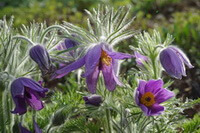 Ecological Environment: Pulsatilla chinensis (Bunge) Regel. grows in plains, grasslands on low hillsides and mountain slopes, forest margins, and dry rocky slopes.
 Ornamental Value: More than 30 species of Pulsatilla exist. The flowers are campanulate (bell-shaped), white, purple, or blue, with a complete perianth and an unusual appearance. From flowering to capsule maturity takes approximately six weeks; the fruits are visually striking even before full maturity. In summer and autumn, the foliage remains green, but after frost the plant enters dormancy. As a perennial herbaceous plant with a persistent rootstock, it provides long-term ornamental value—overcoming the high cost and genetic degeneration commonly associated with biennial herbs. It thrives in woodland gaps and under shrubs, or in naturalistic plantings. Due to its early flowering and low stature, it is an ideal groundcover species. The fruit is plumose, with a persistent, capitate style—elegant and distinctive. It is also suitable for flower beds and container cultivation. Additionally, Pulsatilla is highly sensitive to acid rain; plants often die shortly after exposure. This sensitivity not only makes Pulsatilla a valuable bioindicator for environmental pollution but also enhances its horticultural appeal.
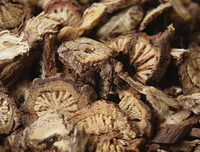 Characteristics of the Herb: The root of Pulsatilla chinensis (Bunge) Regel. is long-cylindrical or conical, slightly curved—sometimes twisted and somewhat flattened—5–20 cm long and 0.5–2 cm in diameter. The surface is yellowish-brown or tan (chocolate brown), bearing irregular longitudinal wrinkles or furrows. Two to three lateral roots often arise from the mid-portion. The cortex exfoliates readily, exposing the yellow xylem; decay frequently forms concave pits revealing a reticulate pattern of raised longitudinal ridges. The root head is slightly enlarged—sometimes bifurcated—with several layers of sheath-like petiole bases and young leaf remnants at the apex, densely covered in white, long hairs. The texture is hard and brittle; the fracture surface is relatively flat. The cortex is yellowish-white or yellowish-brown, occasionally separated from the xylem by narrow gaps; the xylem is primrose yellow (pale yellow). The herb has a faint odor and a slightly bitter, astringent taste.
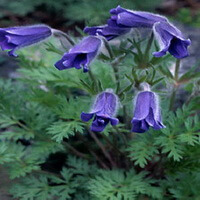 Botanical Description: Pulsatilla turczaninovii Kryl. et Serg. is a plant of the Ranunculaceae family (buttercup, ranunculus, or crowfoot family) and the Anemone genus. It is also known as Slim-leaf Pulsatilla, Xi Ye Bai Tou Weng (meaning "thin-leaf pulsatilla"), or Xi Lie Bai Tou Weng. A perennial herb, the plant grows up to 15–25 cm tall. It has 4–5 basal leaves, which arise from the base and emerge from the ground during the flowering phase. The leaves are bipinnate or tripinnate compound; petioles are 5–8 cm long, sometimes up to 14 cm, and sparsely covered with white pilose hairs; the leaf blade outline is narrowly elliptic or oval (egg-shaped), 7–8.5 cm long and 2.5–4 cm wide; pinnae occur in 3–4 pairs; lower pinnae have petioles, while upper pinnae are sessile; the pinnae are pinnately lobed (pinnatifid), with linear-lanceolate or linear lobes—sometimes oval (egg-shaped)—1–2.5 mm wide; the apex is often acute, the margin is slightly revolute, and the mature leaf is glabrous on both surfaces or slightly villous along the veins.
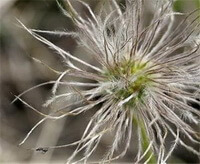 Ecological Environment: Pulsatilla turczaninovii Kryl. et Serg. grows in grasslands, mountain grassy slopes, or forest margins.
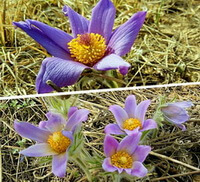 Botanical Description: Pulsatilla ambigua Turcz. ex Pritz. is a plant of the Ranunculaceae family (buttercup, ranunculus, or crowfoot family) and the Anemone genus. It is commonly known as Menggu Bai Tou Weng, Bei Bai Tou Weng, or Gao Shan Bai Tou Weng (meaning "alpine pulsatilla"). A perennial herb, the plant grows up to 16–22 cm tall. The rhizome is thick, 5–8 mm in diameter. It has 6–8 basal leaves, which emerge from the ground during the flowering phase; the leaves are ternately divided; petioles are 3–10 cm long and sparsely pilose; the leaf blade outline is oval (egg-shaped), 2–3.2 cm long and 1.2–3.2 cm wide; the upper surface is glabrate, the lower surface is villous; the leaf is ternately divided, with central lobes bearing slender stalks and further subdivided (ternately again); lobelets are 0.8–1.5 mm wide and bear 1–2 serrations; lateral lobes resemble the central ones and are sessile.
 Ecological Environment: Pulsatilla ambigua Turcz. ex Pritz. grows in alpine meadows, mountain slopes, sandy areas, or forest margins, at altitudes of 2,100–3,400 m above sea level.
 Botanical Description: Pulsatilla dahurica (Fisch. ex DC.) Spreng. is also known as Anemone dahurica Fisch. ex DC., a plant of the Ranunculaceae family (buttercup, ranunculus, or crowfoot family) and the Anemone genus. It is also known as Xing’an Bai Tou Weng. A perennial herb, the plant grows up to 25–40 cm tall. Rhizomes are 5–7 mm in diameter. It has 7–9 basal leaves, which emerge from the ground during the flowering phase; the leaves are ternately divided; petioles are 2.8–15 cm long and pubescent; the leaf blade outline is oval (egg-shaped), 4.5–7.5 cm long and 3–6 cm wide; the upper surface is glabrate, while the lower surface is sparsely pilose along the veins; the leaves are ternately divided or nearly pinnate; central lobes bear slender stalks and are further ternately subdivided; the ultimate lobes are broadly linear or narrowly cuneate, entire or—with 2–3 lobelets or dentate-serrate margins—in the upper part; lateral lobes are sessile or subsessile, unequally 3-parted, with entire margins or several dentate serrations or 2–3 lobelets.
 Ecological Environment: Pulsatilla dahurica (Fisch. ex DC.) Spreng. grows on mountain-slope grasslands, stony ground, forest clearings, and shrublands.
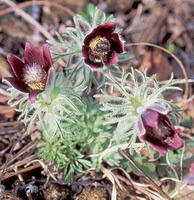 Botanical Description: Pulsatilla cernua (Thunb.) Bercht. et Opiz. is a plant of the Ranunculaceae family (buttercup, ranunculus, or crowfoot family) and the Anemone genus. Synonyms include Pulsatilla cernua (Thunb.) Berchtold et Presl, Anemone cernua Thunb., A. cernua Thunb. var. koreana Yabe ex Nakai, and Pulsatilla koreana Nakai ex Mori. A perennial herb, the plant grows up to 14–28 cm tall. Rhizomes are 5–7 mm in diameter. It has 4–6 basal leaves, which emerge from the ground during the flowering phase; the leaves are ternately divided; petioles are 4.5–14 cm long and densely pilose; the leaf blade is oval (egg-shaped), 3–7.8 cm long and 4.4–6.5 cm wide; it is ternately divided, with central lobes bearing slender petioles and further ternately subdivided; the ultimate lobes are pinnately divided, with distal or terminal lobes lanceolate or narrowly ovate, 1.5–2.2 mm wide, entire or sparsely toothed; lateral lobes are sessile and pinnately parted, with sparse teeth on the lobes.
 Ecological Environment: Pulsatilla cernua (Thunb.) Bercht. et Opiz. grows in mountain-slope grasslands or along roadsides.
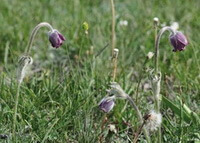 Botanical Description: Pulsatilla campanella Fisch. ex Regel is a plant of the Ranunculaceae family (buttercup, ranunculus, or crowfoot family) and the Anemone genus. It is also known as Bell-calyx Pulsatilla or Zhong’e Bai Tou Weng. A perennial herb, the plant grows up to 14–20 cm tall. Rhizomes are 2.5–4 mm in diameter. It has 5–8 basal leaves, which emerge from the ground during the flowering phase; the leaves are bipinnate or tripinnate compound; petioles are 2.5–12 cm long and villous; the leaf blade outline is oval or narrowly ovate, 2.8–6 cm long and 2–3.5 cm wide; the upper surface is glabrous, while the lower surface is pubescent; there are three pairs of pinnae, obliquely ovate, pinnately lobed; terminal lobes are narrowly lanceolate or narrowly ovate, about 1 mm wide, with an acute apex.
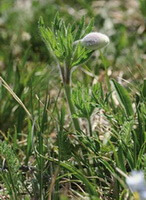 Ecological Environment: Pulsatilla campanella Fisch. ex Regel grows in hillside and mountain-slope grasslands, at altitudes of 1,900–2,600 m above sea level.
 Botanical Description: Pulsatilla vulgaris Mill. is a herbaceous perennial plant of the Ranunculaceae family (buttercup, ranunculus, or crowfoot family) and the Anemone genus. It is also known as Anemone pulsatilla L. or Ou Bai Tou Weng. It develops upright, fleshy rhizomes that function as food-storage organs. Its leaves and stems are long, soft, silver-gray, and pilose. It grows up to 15–30 cm tall, reaching up to 40 cm in fruit. The roots penetrate deeply into the soil—up to 1 m depth. The finely dissected leaves form a basal rosette and appear concurrently with the campanulate (bell-shaped) flowers in early spring. The purple flowers are followed by distinctive, silky seed heads that may persist on the plant for many months.
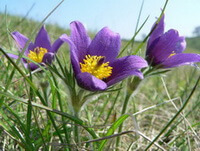 Ecological Environment: Pulsatilla vulgaris Mill. grows in calcareous grasslands, sparsely wooded pine forests, or meadows—typically on sunny, sloping sites with calcium-rich soils.
 Botanical Description: Pulsatilla pratensis L. is a plant of the Ranunculaceae family (buttercup, ranunculus, or crowfoot family) and the genus Anemone. It is also known as Pulsatilla patens (L.) Mill., reniform-leaf pulsatilla, small pasqueflower, or Shen Ye Bai Tou Weng. A herbaceous perennial, it grows up to 40 cm tall. Rhizomes are cylindrical and often branched at the top. Five basal leaves emerge at flowering, 8–16 cm long and long-petiolate; leaf blades are reniform-pentagonal or nearly reniform, 2.5–4.5 cm long and 4.5–7 cm wide, with a broadly cordate base. The middle lobes bear short petioles (1–4 mm in diameter) or are subsessile, broadly rhombic, proximal to the basal part, with 1–2 lobules, apiculate, narrowly trigonous or triangular-lanceolate, 2–3.5 mm wide; all lobes are subsessile and nearly as large as the central lobes, ranging from 2-parted; the adaxial surface is glabrous, while the abaxial surface is white-villous; petioles are 5.5–12 cm long and pilose.
 Ecological Environment: Pulsatilla pratensis L. grows in grasslands on mountain slopes at elevations ranging from near sea level in the north of its range to 2,100 m in the south, commonly at ~1,100 m above sea level. It is widely distributed in Eastern Europe and northern Asia. This species is native to Central and Eastern Europe, from southeastern Norway and western Denmark southward and eastward to Bulgaria.
 URL QR code: