✵The article documents the herb Light Wheat, including its English name, Latin name, Pinyin name, properties and flavor, botanical source—namely a single plant species, Triticum aestivum L.—and provides a detailed introduction to the botanical characteristics, growth habits, ecological environment, macroscopic characteristics of the herb, pharmacological actions, medicinal efficacy, and administration guidelines.
Fructus Tritici Levis (Light Wheat)
Pinyin Name: Fú Xiǎo Mài
English Name: Light Wheat; Blighted Wheat; Shriveled Wheat
Latin Name:Fructus Tritici Levis Properties and Flavor: Cool in nature; sweet and slightly salty in taste
Brief Introduction:Fructus Tritici Levis is the dried, lightweight (shrunken or underdeveloped) grains of Triticum aestivum L. It is used clinically as an antihidrotic for spontaneous sweating and night sweats. Commonly known as Light Wheat, Fú Xiǎo Mài, or Fructus Tritici Levis.
Botanical Source: Classical herbal works define Fructus Tritici Levis (Light Wheat) as the dried, lightweight grains of Triticum aestivum L. This species belongs to the genus Triticum L., family Poaceae (formerly Gramineae), order Poales. The following describes this commonly used species:
(1) Triticum aestivum L
Botanical Description: The plant Triticum aestivum L. is commonly known as Xiǎo Mài. It is an annual or biennial herb that grows up to 60–100 cm tall. Culms are upright and usually consist of 6–9 internodes. Leaf sheaths are smooth and often shorter than the corresponding internodes; the ligule is membranous, short, and small; leaf blades are flat and long-lanceolate, 15–40 cm long and 8–14 mm wide, with an acuminate apex and a truncate to broadly rounded base.
Spikes are erect, 3–10 cm long; spikelets are laterally compressed, about 12 mm long, arranged parallelly or nearly parallelly along the rachis (ear axis); each spikelet bears 3–9 florets, of which only the lower ones are fertile. Glumes are short; the first glume is broader than the second, and both bear sharp keels on their dorsal surfaces—sometimes extending into an awn. The lower palea is membranous and shallowly tridentate, with the central tooth often prolonged into an awn; the upper palea is equal in length to or slightly shorter than the lower palea, and its keel bears narrow, scaly, piliferous wings. There are three stamens; the ovary is ovoid.
Caryopses are oblong or subovate, approximately 6 mm long, and hazel (pale brown) in color. The flowering period is from April to May; the fruiting period is from May to June.
Ecological Environment: Triticum aestivum is cultivated throughout rural China as one of the country’s major cereal crops. Fields with deep soil profiles—and particularly deep topsoil—are preferred, as they favor water retention, nutrient conservation, and root development. Soil structure refers to the relative proportions of solid components (organic and mineral), liquid (water), and air; it strongly influences soil moisture, aeration, temperature, and nutrient availability. Wheat is a long-day plant requiring 8–12 hours of sunlight daily; insufficient photoperiod prevents proper developmental progression and results in poorly filled (shriveled) ears.
Wheat is a product of Neolithic human domestication of its wild ancestors and has been cultivated for over 10,000 years. In Central Asia, numerous archaeological remains have been unearthed from prehistoric settlements, including wild and domesticated wheat spikes and grains, charred wheat grains and spikes, and impressions of wheat grains preserved in hardened mud. Wheat was widely cultivated in West Asia as early as 7000–6000 BCE, in Europe by 6000–5000 BCE, and in Central Asia by 5000–4000 BCE. In China, wheat cultivation gradually expanded from the middle reaches of the Yellow River southward to the Yangtze River basin and northeastward into Northeast Asia. Between the 15th and 17th centuries CE, European settlers introduced wheat to North and South America; it reached Oceania in the 18th century.
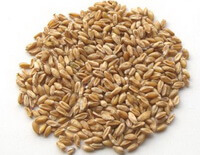
Characteristics of the Herb: The dried caryopsis is oblong, with both ends slightly pointed, measuring 2–6 mm (or occasionally 5–7 mm) in length and 1.5–2.5 mm (or occasionally 3–3.5 mm) in diameter. The surface is pale yellow or yellowish-brown, finely wrinkled, plump, and features a prominent longitudinal groove along the ventral surface; the embryo is inconspicuous and located near the base of the dorsal surface; the apical region bears yellowish pubescence, while the anterior end displays whitish-yellow pubescence and the base is obliquely pointed. The texture is hard; a few specimens may be extremely flattened, and the grain may be soft in some cases. The fracture surface is white or light yellowish-brown, mealy and starchy. A few samples retain glumes and lemmas. The herb is odorless and tasteless.
Medicinal Efficacy: Clears deficient heat and arrests spontaneous or nocturnal sweating. It is indicated for yin-deficiency fever, tidal fever due to yin deficiency (e.g., bone-steaming fever, consumptive fever), night sweats, and spontaneous sweating.
Administration of Fructus Tritici Levis (Fú Xiǎo Mài):
Reference:
Administration Guide for Fructus Tritici Levis (Fú Xiǎo Mài)
TCM Books:
(1) Not available; (2) Internally: water decoction, 3–5 qian (≈9–15 grams); or stir-fry until brown and grind into fine powder; (3) Internally: water decoction, 15–30 grams; or prepare as powdered herb. For antiperspirant effect, stir-frying is recommended.
Contraindications, Precautions, and Adverse Reactions: Avoid use in cases of dysphoria without sweating or collapse accompanied by profuse sweating.

 ✵The article documents the herb Light Wheat, including its English name, Latin name, Pinyin name, properties and flavor, botanical source—namely a single plant species, Triticum aestivum L.—and provides a detailed introduction to the botanical characteristics, growth habits, ecological environment, macroscopic characteristics of the herb, pharmacological actions, medicinal efficacy, and administration guidelines.
 Pinyin Name: Fú Xiǎo Mài
 Botanical Description: The plant Triticum aestivum L. is commonly known as Xiǎo Mài. It is an annual or biennial herb that grows up to 60–100 cm tall. Culms are upright and usually consist of 6–9 internodes. Leaf sheaths are smooth and often shorter than the corresponding internodes; the ligule is membranous, short, and small; leaf blades are flat and long-lanceolate, 15–40 cm long and 8–14 mm wide, with an acuminate apex and a truncate to broadly rounded base.
 Ecological Environment: Triticum aestivum is cultivated throughout rural China as one of the country’s major cereal crops. Fields with deep soil profiles—and particularly deep topsoil—are preferred, as they favor water retention, nutrient conservation, and root development. Soil structure refers to the relative proportions of solid components (organic and mineral), liquid (water), and air; it strongly influences soil moisture, aeration, temperature, and nutrient availability. Wheat is a long-day plant requiring 8–12 hours of sunlight daily; insufficient photoperiod prevents proper developmental progression and results in poorly filled (shriveled) ears.
 Wheat is a product of Neolithic human domestication of its wild ancestors and has been cultivated for over 10,000 years. In Central Asia, numerous archaeological remains have been unearthed from prehistoric settlements, including wild and domesticated wheat spikes and grains, charred wheat grains and spikes, and impressions of wheat grains preserved in hardened mud. Wheat was widely cultivated in West Asia as early as 7000–6000 BCE, in Europe by 6000–5000 BCE, and in Central Asia by 5000–4000 BCE. In China, wheat cultivation gradually expanded from the middle reaches of the Yellow River southward to the Yangtze River basin and northeastward into Northeast Asia. Between the 15th and 17th centuries CE, European settlers introduced wheat to North and South America; it reached Oceania in the 18th century.
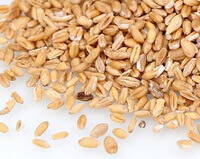 Characteristics of the Herb: The dried caryopsis is oblong, with both ends slightly pointed, measuring 2–6 mm (or occasionally 5–7 mm) in length and 1.5–2.5 mm (or occasionally 3–3.5 mm) in diameter. The surface is pale yellow or yellowish-brown, finely wrinkled, plump, and features a prominent longitudinal groove along the ventral surface; the embryo is inconspicuous and located near the base of the dorsal surface; the apical region bears yellowish pubescence, while the anterior end displays whitish-yellow pubescence and the base is obliquely pointed. The texture is hard; a few specimens may be extremely flattened, and the grain may be soft in some cases. The fracture surface is white or light yellowish-brown, mealy and starchy. A few samples retain glumes and lemmas. The herb is odorless and tasteless.
 URL QR code: