
Qi Bo: Biographical introduction and legendary stories, major works and academic contributions
-
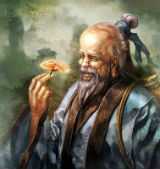 ✵Qi Bo, a famous physician during the reign period of Huangdi (2698–2589 BCE). The emperor asked him to taste various kinds of herbs and study medicine and pharmacy. The first and greatest medical work produced in China, the Huangdi Nei Jing, also known as Huangdi's Internal Classic, or Canon of Medicine. It mainly consists of questions and answers between Huangdi and Qi Bo on health.
- Qi Bo
-
Brief Introduction Chinese Name: 岐伯 (Qí Bó) Alias: 仙伯 (Xiān Bó) Popular name: ☯ 岐伯 English Name: Qi Bo, Uncle Qi Hometown: Unknown Dates: c. 2717–2599 BCE Major Work: Huang Di Nei Jing (the Yellow Emperor's Internal Canon), one of co-authors. Representative Work: Huang Di Nei Jing (the Yellow Emperor's Internal Canon), one of co-authors. Biographical introduction and legendary stories
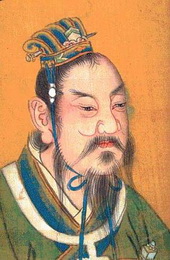 Qi Bo, a famous physician during the reign period of Huangdi (2698–2589 BCE), was asked by the emperor to taste various kinds of herbs and study medicine and pharmacy. The first and greatest medical work produced in China, the the Huangdi Nei Jing, or Huangdi's Internal Classic, also known as the Canon of Medicine, mainly consists of questions and answers between Huangdi and Qi Bo on health.
Qi Bo's hometown is disputed; based on recent historical records, he is likely a native of Beidi, Qingyang City, Gansu. The county annals of Qingyang during the Qing dynasty state that "Qi Bo, native to Bei Di, is shrewd at birth, a master of medicine and theory of pulse, was taken as a teacher by Huang Di (the Yellow Emperor), and compiled the work Nei Jing (the Inner Canon). The book is the ancestor of medical books," and the same county annals state that "there is a Qi Bo temple; it is located at the south of the county."
Qi Bo is the most prominent herbalist with high prestige at the ancient legendary time of China. As his living time is from a very far ancient period, not many deeds were recorded in written books that are survived till today. The ancient book Han Shu·Yi Wen Zhi·Fang Ji recorded that: "There were Qi Bo, Yu Fu in remote antiquity; there were Bian Que, Qin He in the middle age," and "In the ancient legendary time, there were Qi Bo, Yu Fu; in the middle age, there were Bian Que, Qin He." The ancient history book Di Wang Shi Ji (The Records of Generations of Emperors) recorded that: "The Emperor asked Qi Bo to taste herbs, manage affairs of treatment, and the books Jing Fang, Ben Cao, Su Wen all came out," and "Di (Huang Di, or the Yellow Emperor) asked master Qi Bo to taste hundreds of herbs, master in treatment. Those books, Jing Fang (the classical prescriptions), Ben Cao (herbal materia medica), Su Wen (the plain question), all appeared."
Official herbalists and emendator Lín Yì of the Song Dynasty provided several records in the ancient book Chong Guang Bu Zhu Huang Di Nei Jing Su Wen·Biao (the Supplementary of Huang Di Nei Jing Su Wen·Biao) and noted that: "Seek the sufferings of folks. Take pity on folk's pains, are the deep kindness of master and lord, is the governing of the Yellow Emperor... then seek truth with Qi Bo up to the heaven, down to the earth, far to the things, close to the body, questioning and answering in dialog, and left methods to benefit later generations, so Lei Gong and others, taught and spread it, the works Neijing was compiled," and "Ask and care about folks' illness. Take pity on the sickness of folks; the deep kindness of ancient kings could be traced back to Huang Di's succession. Then Huangdi discussed with Qi Bo those topics, including celestial disciplines, geography, things in nature, corporeity of man, questioning and answering with each other in dialog form, to benefit later generations. Thus Lei Gong and others made records and taught to spread the classics, thus the book Nei Jing was written." Today's version of the ancient classic Su Wen comes as a dialog between Huang Di and Qi Bo in question and answer pairs, to explain and expatiate the medicine theory, from which the profession of Qi Bo in the medical field could be studied.
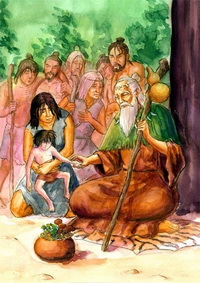 The ancient book Yun Ji Qi Jian·Xuan Yuan Ben Ji recorded that “There was an immortal uncle, came from the Qishan mountain, self-titled Qi Bo, good at talking about nature and tastes of herbs, was a great physician, the Yellow Emperor asked him to manage affairs of prescriptions and herbs,...ever compiled the Nei Jing and Wai Jing.”, and recorded that "There was an immortal uncle, came from Qi Shan mountain, his alias is Qi Bo, good at medicinal nature, property and tastes of herbs, a respected grand physician, Huang Di (the Yellow Emperor) invited him to minister prescriptions and medicines, ever wrote Nei Jing (the Inner Cannon) and Wai Jing (the Exterior Cannon)."
Qi Bo was wise and had gifted talent in his childhood, knowledgeable when he grew up, kind and humble, and wiser than others. When he grew up, he decided to help others and save them from suffering. He traveled a long distance to study medicine with Guang Chengzi, Chi Songzi, and other masters of Tao, and learned medicine from Jiu Daiji. He learned about medicine and the properties of herbs during the daytime, studies the health preservation methods at night, mastered Yin and Yang, the four seasons, the theory of five evolutive phases and six climatic factors, meridians, and therapy methods. Years later, Qi Bo's medical theory and treatment techniques were both exquisite; all of them were wonderful and miraculous in treatment. Later, when Huang Di (the Yellow Emperor) asked Guang Chengzi to teach him Tao on Kongtong mountain, Qi Bo was recommended to Huang Di (the Yellow Emperor) by Guang Chengzi; thereafter, Huang Di (the Yellow Emperor) also took Qi Bo as his master.
According to relevant records in history books and annals, except for the Huangdi Nei Jing, there are eight other books ascribed their authorship to Qi Bo; they are: Huang Di Qi Bo An Mo (Massage book of the Yellow Emperor and Qi Bo), in 10 volumes, Qi Bo Jing (the classic of Qi Bo), in 10 volumes, Qi Bo Jiu Jing (the moxibustion classic of Qi Bo), 1 volume, Qi Bo Zhen Jing (the acupuncture classic of Qi Bo), 1 volume, Huang Di Qi Bo Zhen Lun (The acupuncture discussion of the Yellow Emperor and Qi Bo), 2 volumes, Qi Bo Jing Zang Lun (the Essential Viscera treatise by Qi Bo), 1 volume, Huang Di Qi Bo Lun Zhen Jiu Yao Jue (the Essentials of treatise on acupuncture and moxibustion by the Yellow Emperor and Qi Bo), 1 volume, and Qi Bo Wu Zang Lun (The treatise on five Zang-viscera by Qi Bo). The subjects and contents of these books are mainly about acupuncture and moxibustion, massage, visceral manifestations; However, these eight books did not survive till today.
References:
-
- 1. Qi Bo: Biographical introduction and legendary stories, major works and academic contributions
- 2. Han Shu·Yi Wen Zhi·Fang Ji (The History of the Han Dynasty·Descriptive Accounts of Books in Dynastic Histories·Medicine, Divination, and Similar Arts), by Ban Gu
- 3. Di Wang Shi Ji (The Records of Generations of Emperors), by Huangfu mi
- 4. Yun Ji Qi Jian·Xuan Yuan Ben Ji (The Collective Trunks of Taoism Books in Seven Notes·The Basic Annals of Xuan Yuan), by Zhang Junfang
- 5. County annals of Qing Yang during Qian Long years
