
Bao Gu: Biographical Introduction and Legendary Stories, Major Works and Academic Contributions
-
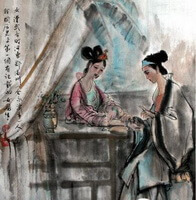 ✵Bao Gu: A famous physician of the Eastern Jin Dynasty and the first known female moxibustionist in Chinese medical history. She likely contributed to the compilation of Ge Hong’s Zhou Hou Bei Ji Fang (Handbook of Prescriptions for Emergencies), particularly in summarizing moxibustion techniques documented therein. Bao Gu was especially renowned for treating scrofula and warts.
- Bao Gu
-
Brief Introduction Chinese Name: 鲍潜光 (Bào Qiǎnguāng) Alias: Unknown Popular Name: 鲍仙姑 (Bào Xiān Gū) English Name: Bao Gu (family name first), also known as Lady Bao or Aunt Bao Hometown: Shangdang (during the Eastern Jin Dynasty) Dates: c. 309–363 CE Major Work: Zhou Hou Bei Ji Fang (Handbook of Prescriptions for Emergencies)— co-authored with Ge Hong Representative Work: Zhou Hou Bei Ji Fang (Handbook of Prescriptions for Emergencies) Biographical Introduction and Legendary Stories
 Bao Gu (Bào Gū, c. 309–363 CE), a renowned physician of the Eastern Jin Dynasty. Her family name is Bào; her given name is Qiǎnguāng. She was native to Shangdang and the daughter of Bao Liang, Prefect of Nanhai Commandery. She married the famed alchemist and physician Ge Hong. She inherited and advanced the medical knowledge of both her father and husband, mastering moxibustion to exceptional proficiency. For many years, she practiced medicine and collected herbs across Nanhai, Panyu (modern Guangzhou), Huiyang, Boluo, and other regions of Lingnan — earning deep affection from local people, who revered her as “Bào Xiān Gū” (Immortal Maiden Bao).
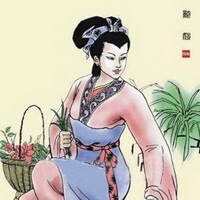 Bao Gu once resided at the foot of Yuexiu Mountain in Guangzhou, where she built a residence and dug a well. Later generations named the well “Bàogū Jǐng” (Bao Gu’s Well). A Taoist temple was erected on the site of her former residence and originally named “Yuègāng Yuàn”. During the Wanli reign (1573–1620) of the Ming Dynasty, the temple was rebuilt and renamed “Sānyuán Gōng” (Three Origins Palace). Today, the Sanyuan Palace still stands, housing a statue of Bao Gu that is enshrined and venerated.
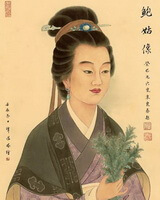 Bao Gu is the first documented female moxibustionist in Chinese historical literature. She likely contributed to the compilation of Ge Hong’s Zhou Hou Bei Ji Fang (Handbook of Prescriptions for Emergencies), particularly in summarizing moxibustion techniques recorded therein. Bao Gu was especially renowned for treating scrofula and warts. She adapted treatments to local conditions and utilized locally available medicinal materials. Red-rooted mugwort — abundant in the Lingnan region — was her primary moxibustion material and yielded remarkable therapeutic effects. “For each wart, one moxibustion cone suffices — healing occurs immediately. Not only does it cure the disease, but it also leaves the skin smooth and unblemished.” A brief history inscribed on a stele inscription at Sanyuan Palace on Yuexiu Mountain notes that Bao Gu "has zhui’ai (red-footed mugwort) and used spring water from Baogu Well together with this herb as her principal prescriptions, saving countless people."
After Bao Gu’s death, the people of Lingnan built a shrine in her honor within Sanyuan Palace at the foot of Yuexiu Mountain to commemorate her contributions to the development of traditional Chinese medicine.
References:
-
- 1. Bao Gu: Biographical Introduction and Legendary Stories, Major Works and Academic Contributions
